What is the Riester-Rente? Subsidies and contract types explained

Published on · Publisher and Managing Director, Alsterspree Verlag
This article was written by an author with the support of AI.
Riester-Rente or AVD - which fits you?
A free, no-obligation conversation with an adviser from our independent network of 1,000+ vetted advisers.
How does the Riester-Rente work?
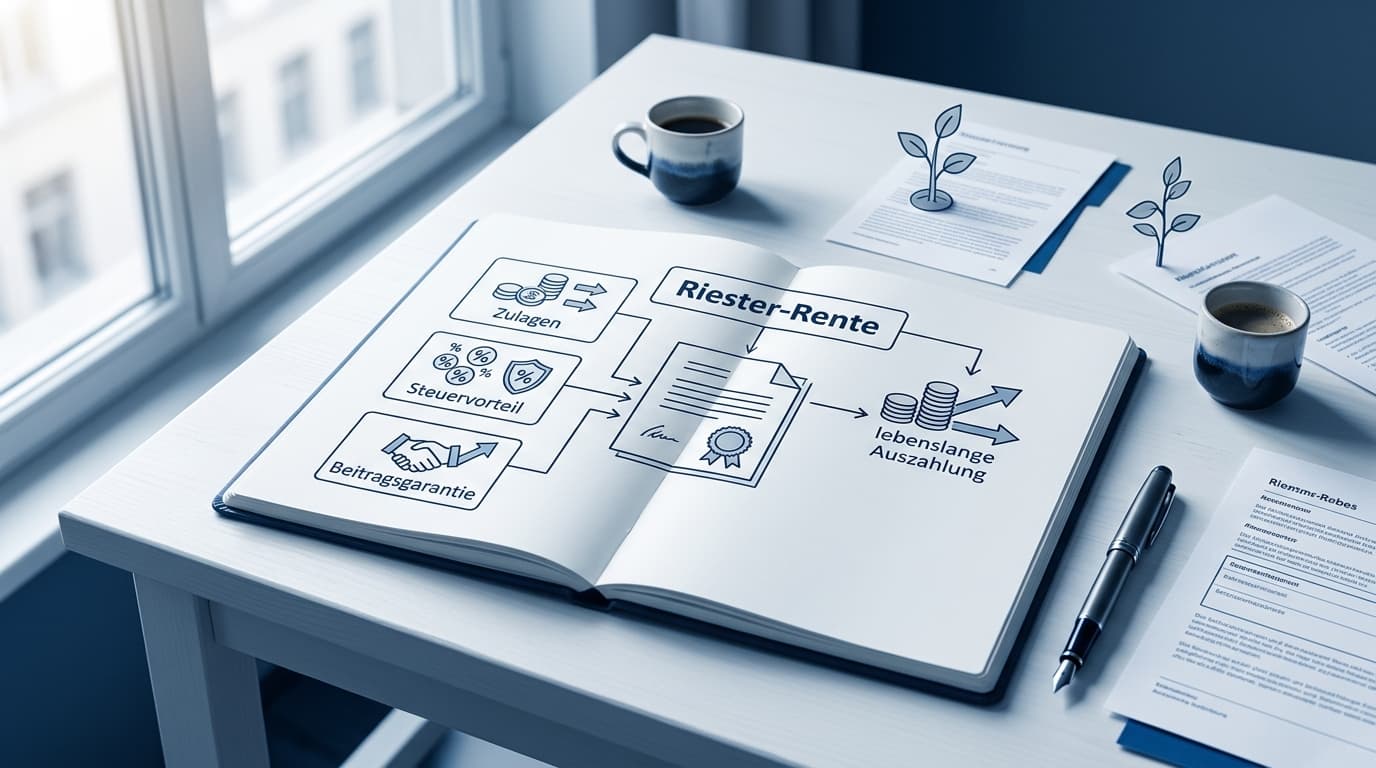
The Riester-Rente is a state-subsidised private pension that has existed since 2002[1]. It rests on three building blocks: direct allowances, a tax advantage through the deduction as a special expense, and a contribution guarantee. Only contracts that the Federal Central Tax Office (BZSt) has certified under the Altersvorsorgeverträge-Zertifizierungsgesetz (AltZertG) are subsidised. Once you know these three building blocks, you can see exactly what changes with the Altersvorsorgedepot and what stays the same.
Certification is no formality. A certified contract has to provide a lifelong benefit calculated independently of gender, which may be paid out at age 62 at the earliest; for contracts signed before 2012, age 60 can still apply in some cases. The provider must also promise that at least the contributions paid in are available at the start of the payout phase[2]. This contribution guarantee is the central safety promise of the system. The Riester-Rente was introduced in 2002 and named after the former Federal Minister of Labour Walter Riester, with the aim of supplementing the falling level of the statutory pension.
- Allowances: a basic allowance of 175 euros a year, plus a child allowance of 185 euros for children born before 2008 and 300 euros for children born from 2008, for as long as child benefit is paid
- Tax advantage: contributions can be deducted as special expenses (Anlage AV of the tax return); the tax office checks of its own accord, in the Günstigerprüfung (§ 10a Abs. 2 EStG), whether the special-expense deduction brings more than the allowances, and takes any difference into account
- Contribution guarantee: at the start of the payout phase, at least the contributions paid in must be available[2]
The payout phase offers two forms: a lifelong annuity, or a drawdown plan followed by a partial annuity from age 85 at the latest; up to 30 percent of the capital may be paid out outside the monthly benefits. In return, the later pension is taxed to the extent that it is based on subsidised contributions (§ 22 Nr. 5 EStG); the subsidy therefore takes effect later, at payout. All figures in this article are statutory benchmarks or illustrative examples and do not constitute investment advice within the meaning of § 1 Abs. 1a Nr. 1a KWG.
Who is eligible for the subsidy?
Two groups are eligible: those directly entitled and those indirectly entitled. Those directly entitled are mainly employees who pay into statutory pension insurance, and civil servants. A spouse is indirectly entitled if they have their own Riester contract and pay in at least 60 euros a year. In both groups the allowance is paid in full only if the minimum own contribution is made.
- employees in statutory pension insurance, civil servants, judges and soldiers
- people receiving unemployment benefit or sickness benefit, and people on a full disability pension if they belonged to the eligible group immediately before the pension began
- mini-jobbers who pay their own social security contributions
- people raising children during the child-raising periods, and carers who are not in paid employment
Under § 79 EStG, the spouse of someone directly entitled is indirectly entitled to the allowance if both live together and are not permanently separated, both have their residence or habitual abode in an EU or EEA state, an Altersvorsorge contract exists in this spouse's name, they paid in at least 60 euros in the contribution year, and the payout phase of that contract has not yet begun[3]. The same applies to partners in registered civil partnerships. What counts is the spouse's own contract: the partner's contract alone does not give rise to an allowance of its own.
The law sets the minimum own contribution at 4 percent of the contribution-liable income of the previous year, at most 2,100 euros a year, in each case minus the allowance (§ 86 EStG); at the very least you pay the base amount of 60 euros a year. If your contribution falls short of the amount calculated, the allowance office reduces the allowance proportionally. So check after every change in income or family situation whether your contribution is still right, and apply for allowances on time, no later than the end of the second calendar year after the contribution year; a standing allowance application does this automatically.
Which Riester contract types exist?
There are four main contract types, and the state subsidy is the same for all of them: it depends solely on the contributions paid in, not on the product[4]. Which type suits you depends on your need for security, your investment horizon and whether you plan to own a home.
| Contract type | Character | Suits you mainly if |
|---|---|---|
| Riester insurance | Most common type; the guaranteed pension is promised at the start of the contract and the investment is conservative | You want a guaranteed payout and still have a long working life ahead of you |
| Riester bank savings plan | Interest at a variable base rate, low risk; now offered by only a few providers | Your need for security is high and retirement is not far off |
| Riester fund savings plan | Investment in equity, bond or mixed funds, return-oriented with price fluctuations | A return as high as possible matters to you and you bear the investment risk |
| Wohn-Riester | Building society contract, loan or combined loan for an owner-occupied home | You are buying, building, converting for accessibility or renovating for energy efficiency |
As an existing customer, you can place your type with two questions: how much guaranteed security does the contract contain, and how long does it still run? A classic insurance contract with a high guaranteed interest rate offers a different level of security from a fund savings plan that, if the worst comes to the worst, contains only the statutory contribution guarantee; the consumer advice centre advises thinking carefully before swapping a contract with a high guaranteed interest rate for a fund-linked product. Also look at costs: acquisition and distribution costs must be spread evenly over at least the first five contract years[2], and for occupational pensions the German pension insurance advises always asking for administration costs in euro amounts[4].
Beyond private contracts, an occupational pension can also be Riester-subsidised, for example as a direct insurance, a Pensionskasse or a Pensionsfonds; in that case the employer chooses the provider. The subsidy mechanism is the same as for private contracts.
How widespread is Riester today?
At the end of 2025 there were around 14.66 million Riester contracts in Germany, around two thirds of them insurance contracts[5]. Two clarifications belong here: the BMAS statistics count contracts, not people, and they include dormant contracts into which nothing is currently being paid; the ministry estimates their share at a little over a fifth to just under a quarter[5].
| Contract type | Number at the end of 2025 |
|---|---|
| Insurance contracts | 9.745 million |
| Fund savings plans | 2.996 million |
| Wohn-Riester | 1.437 million |
| Bank savings plans | 486,000 |
| Total | around 14.66 million |
The number has been falling for years: in 2025 it shrank by a net 318,000 contracts[5]. The conservative investment of the classic Riester insurance is seen as one cause; according to the German pension insurance, its equity share rarely exceeds ten percent in practice[4]. We look at the structural disadvantages that go with this in a separate guide.
For your decision in 2027 this means: whether your contract is dormant or you are actively paying in is one of the most important turning points, because the two situations lead to different considerations about switching. The contract numbers also show that you are not alone in your situation.
What changes for Riester savers in 2027?
For existing contracts, little changes in legal terms: contracts signed before 1 January 2027 are grandfathered and continue with the current tax subsidy until the payout phase begins (§ 52 Abs. 50a Satz 1 EStG). You are not forced to switch, and there is no automatic conversion of your contract.
- Grandfathering: you carry on with your contract as usual, under the current allowance and tax logic; the old subsidy with its basic allowance of 175 euros remains in place for existing contracts
- Sales stop for new contracts only: Altersvorsorge contracts certified under the old rules may no longer be sold from the end of 31 December 2026; existing contracts are not affected
- Optional switch of subsidy regime: by declaration to your provider, you can move the existing contract alone into the new tax subsidy; the other terms remain in place; the switch is irrevocable and applies to all your contracts (§ 52 Abs. 50a Satz 4 EStG)
- New contract after 2026: anyone who takes out a new certified Altersvorsorge contract after 31 December 2026, such as an Altersvorsorgedepot, moves into the new subsidy regime with all contracts, even without a switching declaration (§ 52 Abs. 50a Satz 6 EStG)
Your freedom under the contract remains: Riester contracts must allow you to let them rest, and to terminate them with the capital transferred to another contract (§ 1 Abs. 1 Nr. 10 AltZertG). Terminating with a full cash payout, however, is harmful use and costs you the subsidy; by contrast, up to 30 percent of the capital can be withdrawn at the start of the payout phase without harming the subsidy. If you want to keep your contract, you can keep paying into it from 2027 as well.
This creates no time pressure: as long as you make no switching declaration and take out no new certified contract, your contract continues with the current subsidy. You can therefore examine a possible switch at your own pace, but you should know that the step into the new regime cannot be reversed.
How does the Altersvorsorgedepot differ?
Compared with your Riester contract, the Altersvorsorgedepot changes mainly two things: the contribution guarantee becomes voluntary, and the allowance follows the contribution. The rest of the logic remains largely intact: certification under the AltZertG, a lifelong payout and deferred taxation; in addition there are, among other things, a later start of payout (age 65 at the earliest) and a cost cap. The Altersvorsorgedepot sits alongside the Riester-Rente; it does not replace existing contracts.
| Feature | Riester-Rente (existing contract) | Altersvorsorgedepot (from 2027) |
|---|---|---|
| Contribution guarantee | Mandatory: at the start of the payout phase at least the contributions paid in are available[2] | Voluntary: guaranteed products secure 80 or 100 percent of contributions, and the Altersvorsorgedepot is also possible without a guarantee |
| Basic allowance | Fixed 175 euros if the minimum own contribution is paid | 50 cents per euro paid in up to 360 euros, plus 25 cents for further payments up to 1,440 euros, together up to 540 euros a year |
| Existing contracts | Continue with grandfathering and the old subsidy | Sits alongside Riester and does not replace existing contracts; with a new contract, however, the new subsidy regime applies to all your contracts (§ 52 Abs. 50a Satz 6 EStG) |
For investing, the Altersvorsorgedepot is more opportunity-oriented: you can also pay into funds such as ETFs through it, and investment income stays tax-free during the accumulation phase. The three product variants on offer are without a guarantee, with 80 percent and with 100 percent contribution protection; a state standard product limits the average annual reduction in return caused by costs to 1.0 percent. Transferring your Riester contract to the Altersvorsorgedepot is also possible; it can cause costs, and assets that have already been subsidised cannot be subsidised again in the year of the transfer.
If, after this overview, you want to compare specific Altersvorsorgedepot providers, the criteria-based provider comparison from Vorsorgedepot-Lotse gives you a neutral, criteria-based comparison of various neobrokers and Altersvorsorgedepot providers, including direct account-opening links. That lets you decide at your own pace whether your Riester contract stays, moves into the new subsidy regime or is transferred to the Altersvorsorgedepot. All details are based on the sources cited and do not constitute investment advice within the meaning of § 1 Abs. 1a Nr. 1a KWG.
Frequently asked questions
- What is the Riester-Rente in simple terms?
- The Riester-Rente is a private pension that the state has subsidised since 2002 through allowances and a deduction as a special expense. It is meant to close the gap created by the falling level of the statutory pension. Only certified contracts are subsidised, and for these at least the contributions paid in must be available at the start of the payout phase.
- How high are the Riester allowances at present?
- The basic allowance has been 175 euros per person since 2018, provided the minimum own contribution has been paid. On top of this comes a child allowance of 185 euros for children born before 2008 and 300 euros for children born later. If you claim the special-expense deduction in your tax return, the tax office checks of its own accord, in the Günstigerprüfung, whether the allowances or the tax saving are more favourable.
- Who is eligible for the Riester-Rente?
- Those directly entitled are mainly employees and civil servants who are compulsorily insured in statutory pension insurance. A spouse is indirectly entitled if they have their own Riester contract and pay in at least 60 euros a year.
- What happens to my existing Riester contract in 2027?
- Contracts signed before 1 January 2027 are grandfathered. You can carry on with your contract as usual under the current subsidy; there is no automatic termination or conversion. However, new Riester contracts under the old rules can no longer be taken out from 2027.
- How many Riester contracts are there still?
- At the end of 2025 there were around 14.66 million Riester contracts, of which about 9.745 million were classic annuity insurance policies[5]. These are contract numbers, not numbers of people. The share of dormant contracts, into which no contributions are currently being paid, is estimated by the BMAS at a little over a fifth to just under a quarter[5].
- Do I have to pay tax on the Riester-Rente in retirement?
- Yes: to the extent that the benefits are based on subsidised contributions, they are subject to income tax, which arises only in the payout phase (deferred taxation, § 22 Nr. 5 EStG).
- Can I transfer my Riester contract to an Altersvorsorgedepot?
- Yes, an existing Riester contract can be transferred to an Altersvorsorgedepot, to which the new terms and the new subsidy then apply. Switching can cause costs, and assets that have already been subsidised cannot be subsidised again in the year of the transfer. Grandfathering applies only as long as you make no switching declaration and take out no new certified contract.
Sources
- [1]verbraucherzentrale.de
- [2]gesetze-im-internet.de
- [3]gesetze-im-internet.de
- [4]riester.deutsche-rentenversicherung.de
- [5]tagesbriefing.de
- []Riester-Rente Nachteile: was 2027 dagegen spricht
- []Will my Riester-Rente contract be converted automatically?
- []Can I keep paying into my Riester contract after 2027?
- []What is the Altersvorsorgedepot? Definition and 2027 launch
- []Altersvorsorgedepot: the 3 product variants compared
- []Kriteriengestützten Anbietervergleich
Riester-Rente or AVD - which fits you?
Wondering whether switching to the AVD makes sense? Let's work it out together.
Free and without obligation. Advice from an adviser in our independent network of 1,000+ vetted advisers.