Altersvorsorgedepot: the 3 product variants compared

Published on · Managing Director & Partner, Alsterspree Verlag GmbH
This article was written by an author with the support of AI.
Have questions about the Altersvorsorgedepot?
A free, no-obligation conversation with an adviser from our independent network of 1,000+ vetted advisers.
The 2027 reform: the new subsidy system and its three paths
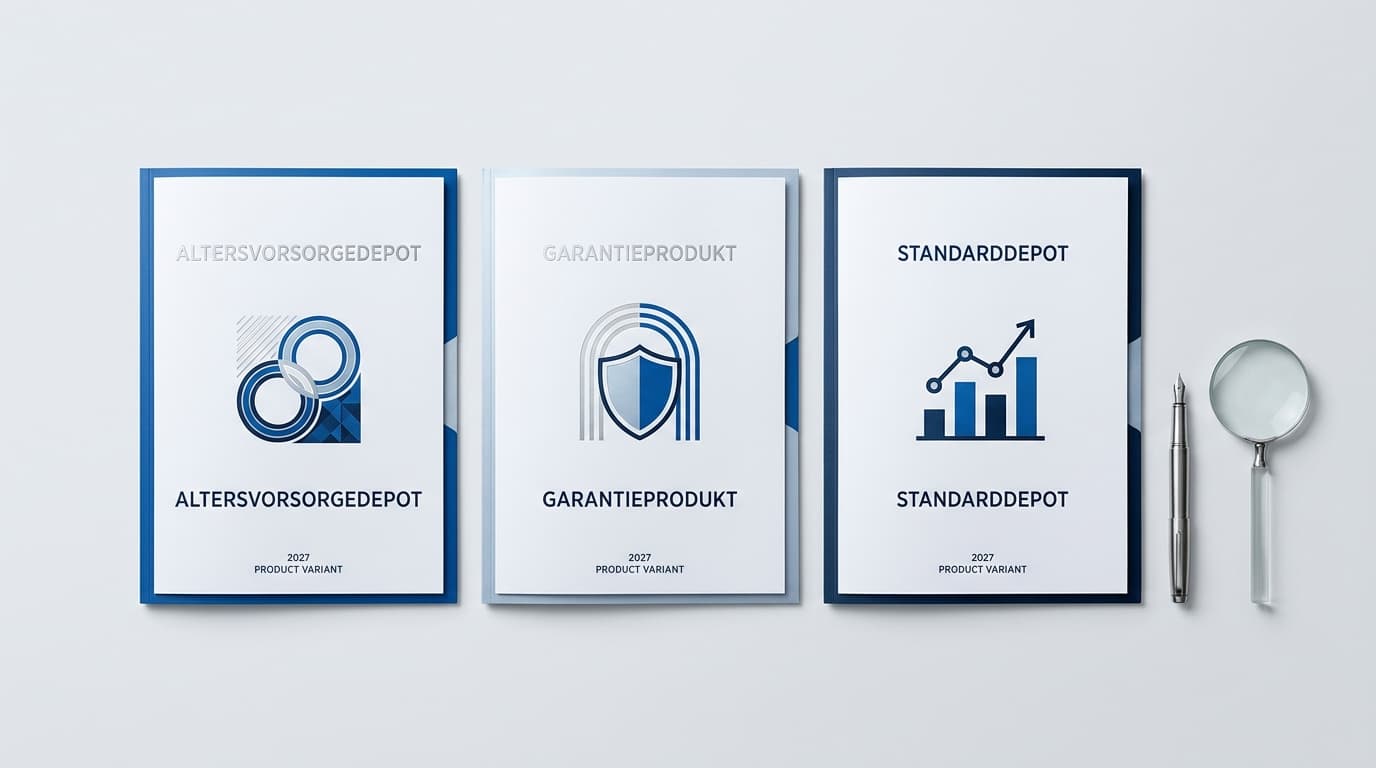
With the reform of private retirement provision effective 1 January 2027, the legislature replaces the previous monopoly of rigid Riester-Rente contracts and introduces a clear, three-way subsidy system[1]. Savers get a choice for the first time between a return-oriented Altersvorsorgedepot with no mandatory guarantee, classic guarantee products, and a standardised entry-level account. The state supports all three product paths, so you can align your investment decision with your risk profile.
The same subsidy across different investment structures
The reform's primary goal is to remove barriers to building wealth and to make access to the capital markets transparent. Under conventional Riester policies, a large share of the contributions was tied up in low-yield investment forms to meet the nominal contribution guarantee; the legislature now decouples the state allowances from fixed guarantee requirements. The key parameters of the reform that have been passed ensure that own contributions and state bonuses flow equally, regardless of the investment structure chosen.
| Product variant | Guarantee level | Investment range | Regulatory feature |
|---|---|---|---|
| Altersvorsorgedepot | No guarantee (0%) | Broad choice from a state approved list (e.g. ETFs, funds) | Maximum market upside with no guarantee discount |
| Guarantee product | 80% or 100%, your choice | Security-oriented portfolios and classic retirement concepts | Binding capital preservation at the start of the payout phase |
| Standarddepot | No guarantee (0%) | Highly limited choice (e.g. two standard ETFs) | Statutory cap on effective costs of 1.0% p.a. maximum |
With this structuring measure, the legislature creates viable options for different types of user, from self-directed investors to people who prefer an automated default. In the following sections, we analyse the specific features, cost structures and suitability profiles of the three variants in detail. Note on sample calculations: all figures shown are illustrative. Not investment advice within the meaning of § 1 Abs. 1a Nr. 1a KWG.
Variant 1: the guarantee-free Altersvorsorgedepot for maximum returns
The guarantee-free Altersvorsorgedepot marks the central turning point of the reform from 2027. While earlier Riester-Rente contracts required a statutory guarantee of contributions, this product variant dispenses with contribution guarantees entirely. As a result, your monthly savings rate flows directly into the capital markets, without loss-making hedging instruments. By deliberately giving up the guarantee, providers' costly capital-protection strategies fall away, which unlocks the full compounding potential over the long run.
The approved list and eligible asset classes
To maintain an orderly risk profile despite the lack of capital preservation, the legislature sets out a strict approved list of eligible assets. Through their account, investors get access to broadly diversified ETFs, equity funds and fixed-income securities, while highly speculative financial instruments remain consistently excluded.
- Full waiver of contribution guarantees in favour of unthrottled capital-market returns
- Investment via a BMF approved list into asset-backed index funds and bonds
- Full price risk during the accumulation phase, with no cushioning from the state or the provider
- High cost transparency and direct control options within your own securities account
Savers with a long investment horizon until retirement can, historically, offset temporary market fluctuations effectively and benefit from higher return potential. Please note for this analysis: return calculations are for illustration only and do not constitute investment advice.
Variant 2: guarantee products with 80 or 100 percent contribution protection
Alongside the guarantee-free Altersvorsorgedepot, the reform of subsidised private retirement provision also provides for modernised guarantee products for security-minded savers[4]. With these certified retirement contracts, the chosen provider guarantees the preservation of the saved capital, in full or in part, at the point of retirement. Savers can choose between two fixed guarantee levels: 80 or 100 percent of the own contributions and allowances paid in. Compared with the previous Riester-Rente, which prescribed 100 percent contribution preservation without exception, this step opens the way to more return-oriented portfolio structures.
How the guarantee levels work, and the trade-offs
- 100 percent contribution protection: with this variant, the provider secures the entire own capital paid in, plus all state subsidy allowances, at 100 percent. To keep this promise, most of the capital has to go into high-interest, low-volatility investments. This reliably protects the balance from market losses, but limits participation in positive developments in global capital markets.
- 80 percent contribution protection: here, the provider guarantees at least 80 percent of the money paid in by the start of retirement. The remaining 20 percent can be invested more flexibly in higher-potential assets such as global equity ETFs. Lowering the guarantee level like this creates the room needed to generate higher returns in the long run and cushion the impact of inflation.
Choosing the right guarantee level is an individual trade-off between your need for security and your return expectations. A full guarantee causes a permanent reduction in returns, because of the conservative asset allocation, since equity-market return potential cannot be fully exploited. Anyone who values the familiar Riester-Rente guarantee, or who has only a few years left until retirement, benefits from the 80 percent variant's calculable minimum capital combined with improved growth potential. For investors with a very long investment horizon, however, the guarantee component remains a contractual constraint that can reduce the final capital sum.
Note on methodology: all calculations, return assumptions and models are illustrative and for guidance only. They do not constitute financial or investment advice within the meaning of § 1 Abs. 1a Nr. 1a KWG.
Variant 3: the Standarddepot as a low-cost base offering
The Standarddepot ("Standarddepot Altersvorsorge") was designed by the legislature to enable a barrier-free entry into subsidised retirement provision without the effort of making your own selections. For savers who don't want to make individual investment decisions, preset standard options apply for fund choice and savings rate. The goal is straightforward, digitally accessible provision with maximum transparency and reliable cost protection.
Features and regulatory requirements of the Standarddepot
The framework for the standard product is clearly defined by law. To prevent an unprofitable fee burden, strict limits apply for providers:
- Cap on effective costs: the average annual reduction in returns from product and account costs is capped by law at a maximum of 1.0 percent.
- Automatic standard settings: the investment structure follows predefined guidelines, so you can get started directly without deep financial knowledge.
- Possibility of a public provider: in addition to the private market, a publicly organised option is planned to be set up if the market fails to provide enough standard offerings.
- Flexible switching: you can move away from the standard settings towards more individual investment decisions at any time.
This clear structure protects the Standarddepot from the unexpected fees we highlight in our analysis of cost structures. It particularly suits people who want to benefit from the state subsidy without engaging intensively with choosing individual securities. (Not investment advice within the meaning of § 1 Abs. 1a Nr. 1a KWG.)
The three product variants compared directly
Once the reform takes effect, investors will have three subsidised product paths to choose from starting in 2027: the return-oriented Altersvorsorgedepot with no guarantee, classic or hybrid guarantee products, and the state-structured Standarddepot. While all three variants benefit from the same tax subsidy, they differ fundamentally in cost structure, risk class and investor flexibility. We compare the three models to give you a transparent, reliable basis for deciding on your retirement provision.
| Criterion | Altersvorsorgedepot (AVD) | Guarantee product | Standarddepot |
|---|---|---|---|
| Contribution guarantee | No guarantee (0%) | 80% or 100%, your choice | No guarantee (0%) |
| Investment choice | Broad choice of ETFs and funds (approved list) | Combination of protected assets and funds | Highly limited (e.g. two standard ETFs) |
| Effective costs | Market-standard (varies by provider) | Higher, due to guarantee costs | Capped by law (max. 1.0% p.a.) |
| Investor profile | Self-directed, return-oriented investors | Security-minded savers | Beginners who want simplicity |
Effective costs, flexibility and risk profile in detail
The key difference between the variants lies in the trade-off between the contribution guarantee and long-term return potential. While the pure Altersvorsorgedepot uses the full price potential of the capital markets, guarantee products tie up significant funds in low-interest reserve assets, which can reduce overall returns. The Standarddepot protects beginners through a statutory cost brake of a maximum 1.0% effective costs per year[7], but offers hardly any scope for individual customisation. Across all three product forms, flexibility for additional payments and the legal portability for switching providers are preserved. You'll find detailed fee analyses in our guide. (This is not investment advice.)
The same state subsidy for all three product paths
The new subsidy system does not distinguish between the three different product variants in its subsidy rules. Whether you choose a return-oriented Altersvorsorgedepot with no guarantee, a classic guarantee product, or a cost-capped Standarddepot, the state contribution and tax benefits follow exactly the same statutory rules. The principle of equal treatment ensures your personal risk appetite and product choice cause no financial disadvantage in the state allowances. How your private provision is specifically subsidised for tax purposes therefore depends primarily on your own savings contributions and your personal circumstances.
The core components of the state subsidy at a glance
- Minimum own contribution: to secure the full entitlement to the state subsidy, a statutory minimum own contribution of 120 euros a year is required.
- Percentage-based allowances: the state support consists of a basic allowance (Grundzulage) plus, where applicable, child allowances (Kinderzulagen), granted as a fixed percentage top-up on your own savings contributions.
- Tax favourability check: through the special-expenses deduction (Sonderausgabenabzug), the tax office automatically checks, as part of your income tax return, whether your personal tax benefit is higher than the allowances received, and credits the difference as a tax refund.
Thanks to this uniform subsidy framework, the state incentive stays transparent and directly comparable across all paths. That lets you choose the right product variant purely on criteria such as return potential, need for a guarantee, and cost structure. With our Altersvorsorgedepot knowledge portal and the subsidy calculator, you can work out different scenarios individually. Note: all model calculations are for guidance only. Not investment advice within the meaning of § 1 Abs. 1a Nr. 1a KWG.
Switching rights and portability between the variants
One key advance in the retirement-provision reform from 2027 concerns the consumer-friendly overhaul of portability and switching rights. Under previous subsidised retirement contracts, rigid contract terms and high cancellation fees often left savers stuck in unprofitable products. The new subsidy system creates full transparency here and protects your financial flexibility throughout the entire accumulation phase. So, if your circumstances change, new market offers appear, or your return goals shift, you can switch provider at any time, or transfer the contract balance between the three product variants.
Cost ceilings and deadlines for switching
| Phase / process | Statutory rule | Financial effect |
|---|---|---|
| First 5 contract years | Administration fee capped | The receiving provider may charge a maximum of 150 euros as a switching fee. |
| From the 6th contract year | Completely free of charge | The transferring provider is required to carry out the switch free of charge. |
| Acquisition and distribution costs | Spread over the contract term | Acquisition costs are charged continuously; there's no renewed charge. |
| Transfer of capital and subsidy | Tax-free carry-over | The saved balance and state allowances are transferred seamlessly. |
Because acquisition costs must by law be spread over the entire contract term, the financial hurdle to switching early disappears. If you want to work out how switching costs specifically affect existing contracts, the new ceilings give you a reliable basis for the calculation. This flexibility applies not just during the accumulation phase, but also when you move into retirement: at the start of the payout phase, you can transfer the balance from a return-oriented Altersvorsorgedepot free of charge into an annuity product or a drawdown plan with a different provider.
Decision help: how to find the right product variant
Choosing the right variant in the new subsidy system depends largely on your personal risk appetite and your time horizon until retirement. While younger savers with a long investment horizon benefit from the full return power of a guarantee-free Altersvorsorgedepot, savers close to retirement often look specifically for guarantee products with contribution protection. The information portal helps you place these different options in transparent context.
- Investment horizon and age: the more years remain until retirement begins, the better short-term market fluctuations can be offset in a return-oriented portfolio.
- Need for security: do you want to use a contractual contribution guarantee of 80 or 100 percent, or forgo guarantees in favour of higher return potential?
- Investment expertise and initiative: do you prefer to select your own portfolio, or would you rather use a standardised solution with a statutorily capped cost ratio?
To work out your individual subsidy amount and the effect of effective costs on your returns, the digital subsidy calculator offers a well-founded basis. The tool simulates different retirement-provision scenarios and calculates the expected final capital, drawing on sourced data.
Once you've clarified your own risk profile, the next step is choosing the right implementation path: self-directed savers use a provider comparison to compare terms from neobrokers and account providers directly. Anyone who prefers personal guidance can find their way to individual professional advice through an independent advice service. (Not investment advice within the meaning of § 1 Abs. 1a Nr. 1a KWG.)
Frequently asked questions
- What three product variants does the new subsidy system offer from 2027?
- The new subsidy system comprises the Altersvorsorgedepot with no contribution guarantee, classic guarantee products with 80 or 100 percent contribution protection, and the statutorily regulated Standarddepot. While the Altersvorsorgedepot bets on full return potential in the capital markets, the guarantee product protects the contributions paid in. The Standarddepot serves as a simple entry-level solution with limited costs.
- What distinguishes the Standarddepot from the free-choice Altersvorsorgedepot?
- The Standarddepot is a particularly simple variant of the Altersvorsorgedepot with fixed framework conditions. The annual effective costs are capped by law at a maximum of 1.0 percent. The Standarddepot also uses preselected funds and standardised settings, so savers don't have to make complex investment decisions.
- Are there differences in the state subsidy between the variants?
- No, the state subsidy is identical for all three product variants. Once you make the minimum own contribution of 120 euros a year, you receive the full state allowances plus the special-expenses tax deduction, regardless of whether you choose an account system or a guarantee product.
- What contribution guarantees do the new guarantee products offer?
- Providers of guarantee products can offer guarantee levels of 80 percent or 100 percent of the contributions paid in. A reduced guarantee level of 80 percent allows the provider to invest a larger share of the capital in higher-potential investments than with a full contribution guarantee.
- Can I switch between the product variants?
- Yes, the law provides for transparent switching rights. In the first five years, switching costs are capped at a maximum of 150 euros. From the sixth contract year onward, the existing provider must let you switch provider or product free of charge.
- Who is the guarantee-free Altersvorsorgedepot best suited for?
- The guarantee-free Altersvorsorgedepot is particularly well suited to savers with a long investment horizon who are willing to accept normal market fluctuations. Because no contribution guarantee has to be expensively secured, the capital can work fully in the capital markets and achieve higher return potential.
Sources
- [1]dieversicherer.de
- [2]check24.de
- [3]extraetf.com
- [4]bundestag.de
- [5]check24.de
- [6]extraetf.com
- [7]extraetf.com
- [8]bundesfinanzministerium.de
- [9]dieversicherer.de
- [10]dieversicherer.de
- []Altersvorsorgedepot 2027: all the key facts at a glance
- []Altersvorsorgedepot: app or advice?
- []Can I change my Altersvorsorgedepot provider later?
- []Give up the Riester guarantee for more return?
- []What does switching from Riester to the Altersvorsorgedepot cost?
- []Which ETFs for the Altersvorsorgedepot? The selection guide
- []Which subsidised retirement plan is best for me?
- []What does an Altersvorsorgedepot cost?
- []Tax subsidy & Sonderausgabenabzug for the AVD
Have questions about the Altersvorsorgedepot?
Our experts explain everything about the AVD - for free and with no obligation.
Free and without obligation. Advice from an adviser in our independent network of 1,000+ vetted advisers.