Riester-Rente payouts: options, timing and deductions

Published on · Managing Director & Partner, Alsterspree Verlag GmbH
This article was written by an author with the support of AI.
Riester-Rente or AVD - which fits you?
A free, no-obligation conversation with an adviser from our independent network of 1,000+ vetted advisers.
When can the Riester-Rente be paid out?
The Riester-Rente is paid out at the date you agreed with your provider when you signed the contract, but no earlier than the statutory age limits. For contracts signed on or after 1 January 2012, the payout phase may not begin before you turn 62; for older contracts it may begin from age 60[1]. Your contract is therefore always decisive: it determines when the money first flows.
According to the ZfA, the Riester-Rente generally starts between the ages of 60 and 68, with the lower limit of 62 applying to contracts signed from 2012. The earliest pension start and the guaranteed minimum payout are recorded in your contract documents and form part of your contract terms; the payout is made automatically through your provider[2].
| Contract signed | Earliest start of the payout phase | Legal basis |
|---|---|---|
| before 1 January 2012 | from age 60 | § 14 Abs. 2 AltZertG[1] |
| on or after 1 January 2012 | from age 62 | § 1 Abs. 1 Satz 1 Nr. 2 AltZertG[3] |
Three points are worth knowing about this age limit:
- The start date in your contract overrides the statutory minimum: if the agreed start is later than age 62, the provider only pays out from that later date.
- The age limit depends on the contract date, not on your year of birth: people born in the same year may have different earliest start dates depending on their contract.
- The start of your Riester-Rente is independent of the start of your statutory pension or civil-service pension; the two dates do not necessarily coincide[2].
For practical planning, this means: look up the earliest pension start in your contract documents or on your latest annual statement. That is where the binding date on which your provider first has to pay is set out.
Which payout forms does a Riester contract allow?
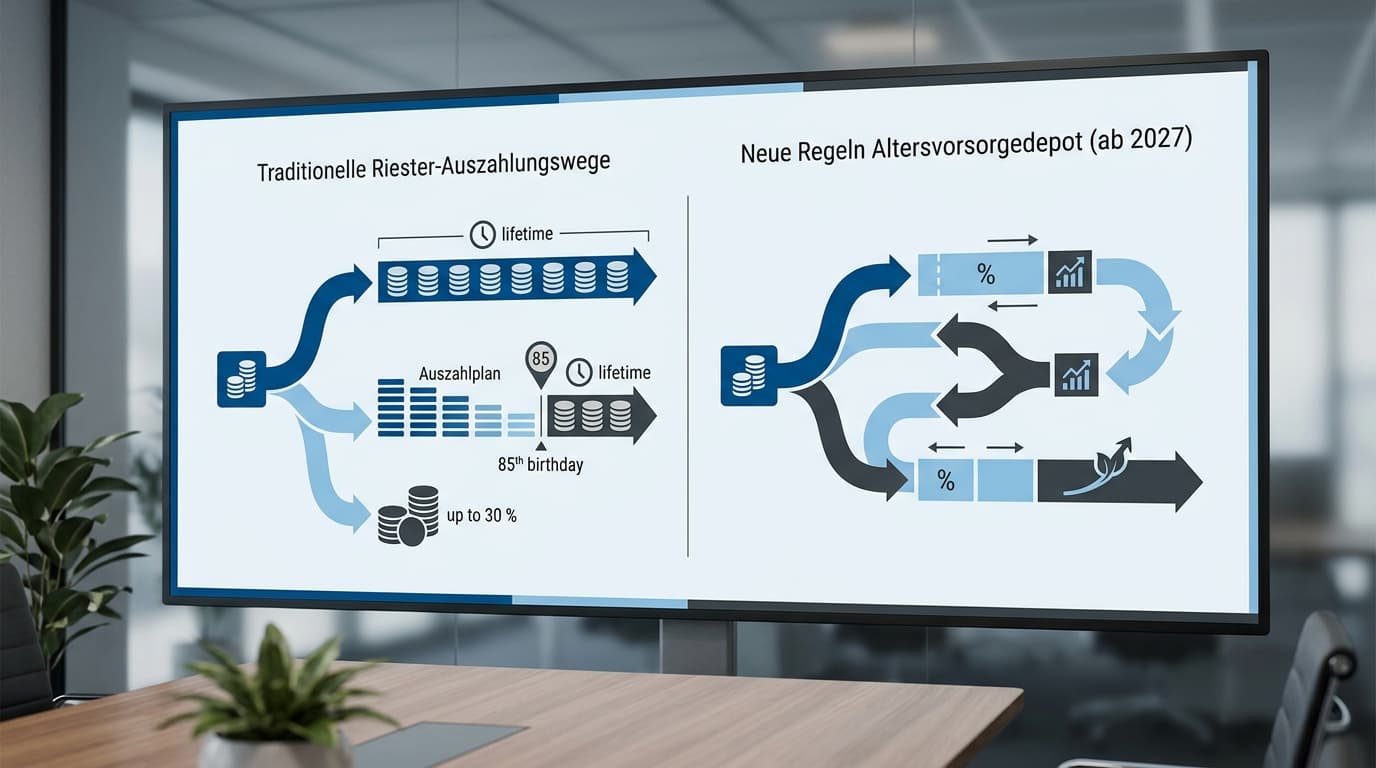
A certified Riester contract may pay out the balance only in certain forms; otherwise you lose the state support. Under § 1 AltZertG, the contract provides for monthly payments either as a lifelong life annuity or as instalments under a drawdown plan, followed by partial annuitisation of the remaining capital from age 85 at the latest[3]. Payments must stay level or rise throughout the payout phase.
- Life annuity: a lifelong monthly retirement income, calculated without regard to sex, that is paid until death[3].
- Drawdown plan with annuitisation from 85: monthly instalments during the payout phase; from age 85 at the latest, whatever capital remains is converted into a lifelong residual annuity (partial annuitisation)[3].
- Lump sum of up to 30 percent: at the start of the payout phase, you may take up to 30 percent of the capital then available as a payment separate from the monthly benefits; the rest goes into the life annuity or the drawdown plan[3].
The law also allows up to twelve monthly payments to be combined into one payout, or a Kleinbetragsrente (a very small pension) to be settled as a lump sum. A pension counts as a Kleinbetragsrente if the monthly amount from the whole capital does not exceed 1.5 percent of the monthly reference value (Bezugsgröße), which means no more than 59.33 euros in 2026; settling it keeps the state support intact only at the start of the payout phase (§ 93 Abs. 3 EStG)[4][2]. Interest and investment income arising during the payout phase may also be paid out separately[3].
Key point for your planning: the 30 percent lump sum is the ceiling for withdrawing capital at the start of the payout phase without losing the state support. Anything beyond that, in particular taking out the full balance, falls outside these forms.
What does taking out the full balance cost?
If subsidised retirement savings are paid out to the person entitled to the allowance in any form other than those permitted, this is a schädliche Verwendung (non-qualifying use). The legal consequence is set out in § 93 EStG: the allowances attributable to the amount paid out and the amounts separately determined under § 10a EStG, in other words the tax relief, must be repaid as a repayment amount[4]. This also applies to payouts made after the payout phase has begun.
In practice, the deduction works like this:
- Your provider deducts the allowances granted so far and the tax relief you claimed through your tax return directly from your Riester balance[5].
- If the balance held with your provider is not enough, the ZfA reclaims the remaining amount directly from you[5].
- On top of that, you have to pay tax on the investment income contained in the lump-sum payout[2].
- If you cancel before the payout phase begins, the same consequences apply; in addition, any outstanding contract acquisition costs may be deducted from the surrender value[5].
How much you have to repay in your case depends on the state support you have received over the years. Before you consider a full payout or a cancellation, ask the ZfA for a statement of the allowances and tax relief currently on record; the ZfA's online service provides this information[5]. Then work through with your provider what is actually left once all amounts have been deducted.
How does the lump sum change your pension?
The lump sum of up to 30 percent that keeps the state support intact is not a free withdrawal. According to the ZfA, taking a lump sum at the start makes your subsequent monthly payouts correspondingly smaller, because only the remaining amount goes into the lifelong Riester-Rente. You have to pay full tax on the lump sum after it is paid out[2].
- Full tax rate in the year of receipt: the lump sum is taxed in full as income in the year it is paid out and may push you into a higher tax bracket[2].
- Lower monthly pension: because up to 30 percent of the capital is paid out upfront, a correspondingly smaller amount is left for the lifelong pension; the monthly payment stays permanently lower[2].
- Deferred taxation as a system: the Riester subsidy makes the contributions you pay in tax-free, and the later payouts are taxed. Because your pension is lower than your income during your working years, your tax rate later on is likely to be lower[2].
Whether the lump sum is worthwhile for you depends on your tax rate in the payout year, your life expectancy and your need for cash. A worked example with specific pension or tax amounts would be purely illustrative here and is no substitute for individual advice; this is not investment advice within the meaning of § 1 Abs. 1a Nr. 1a KWG. Ask your provider to quantify the specific effects for your contract before you use the option.
How will the Altersvorsorgedepot pay out from 2027?
The reform of private retirement provision changes the payout options for new contracts: if you pay into an Altersvorsorgedepot from 2027, your payout phase begins between the ages of 65 and 70. At the start of the payout phase, you choose between two forms:
- Lifelong life annuity: a fixed monthly pension payment until death.
- Fixed-term drawdown plan: it runs at least until you turn 85, and a longer plan is possible. In these cases, capital not yet paid out can be inherited, although the state support attributable to it must then be repaid, unless the capital passes to a contract held by your spouse[4]; when the plan ends, the capital has been used up. The new drawdown plan ends at age 85 at the earliest and no longer provides for annuitisation of the remainder afterwards.
| Feature | Existing Riester (contract before 2027) | Altersvorsorgedepot (new contract from 2027) |
|---|---|---|
| Start of the payout phase | set by contract, generally between 60 and 68[2] | between the ages of 65 and 70 |
| Payout forms | life annuity or drawdown plan with partial annuitisation from 85 at the latest[3] | life annuity or drawdown plan ending at 85 at the earliest, without annuitisation of the remainder |
| Lump sum | up to 30 percent at the start[3] | up to 30 percent at the start of the payout phase |
| Inheritability | remaining capital can be inherited on death; the state support on it must be repaid, unless it is transferred to a contract held by the spouse | capital not yet paid out under the drawdown plan can be inherited; state support repaid as with Riester |
The reform generally leaves the payout rules of your existing contract unchanged: Riester contracts signed before 1 January 2027 are grandfathered, and you can continue the contract with the existing tax support as long as you neither switch to the new subsidy rules nor take out a new subsidised contract after 2026. From 2027, dropping the annuitisation of the remainder under an existing drawdown plan is only possible by mutual agreement, that is, through a contract amendment with your provider (§ 14 Abs. 7 AltZertG as amended by the Altersvorsorgereformgesetz, the pension reform act). The options available in detail if you want to move from your old contract into the new system are covered in our article on the transition to the Altersvorsorgedepot.
Keep your existing contract or compare payout options?
Before your pension starts, existing Riester savers therefore face a clear decision: the existing contract continues under the current rules, meaning a life annuity or a drawdown plan with annuitisation of the remainder from age 85 at the latest. From 2027, new contracts in the Altersvorsorgedepot offer more flexible drawdown plans with no subsequent annuitisation and with inheritable remaining capital. Both routes are legitimate; which one suits you better depends on your age, the start date in your contract and whether you prefer security or flexibility.
- Grandfathering versus new flexibility: if you keep the contract, § 1 and § 14 AltZertG continue to apply with the payout forms described above[3]; you can also switch to the new subsidy without having to repay the support received so far.
- Clarify the start date in your contract: before the payout phase, ask your provider in writing when your contract first pays out and which payout forms it specifically provides for; your contract documents state the earliest pension start[2].
- Compare providers' payout options: if you are considering a switch, it is worth looking at which providers offer which payout options, costs and terms, once certified terms are available.
Frequently asked questions
- When is the Riester-Rente paid out?
- Payouts begin at the date agreed with the provider when the contract was signed. Under the AltZertG, the payout phase may not begin before age 62 for contracts signed from 2012, or before age 60 for contracts signed before 2012. The earliest pension start is stated in your contract documents.
- Can you have the Riester-Rente paid out in full?
- Yes, that is possible, but it keeps the state support intact only in narrow exceptions, such as settling a Kleinbetragsrente. Taking out the full balance counts as non-qualifying use under § 93 EStG: you must repay all allowances and tax advantages received. The provider deducts these amounts directly from the balance; if the balance is not enough, the ZfA reclaims the rest from you.
- What percentage of the Riester-Rente can you take as a one-off payment?
- At the start of the payout phase, you can take up to 30 percent of the available capital as a one-off payment without it counting as non-qualifying use. The lump sum is fully taxable in the payout year, and your monthly pension is correspondingly lower afterwards.
- What happens if you take a payout before the contractual pension start?
- An early payout is also non-qualifying use: you lose all of the state support and must repay allowances and tax advantages. Alternatively, you can make the contract paid-up and so keep the support received so far, or transfer the balance to another Riester contract without losing the state support.
- Does the Altersvorsorgedepot pay out differently from Riester from 2027?
- Yes. New contracts in the Altersvorsorgedepot begin the payout phase between the ages of 65 and 70 and offer either a lifelong life annuity or a drawdown plan ending at age 85 at the earliest, with no subsequent annuitisation of the remainder. Capital not yet paid out can be inherited; as with Riester, the state support attributable to it must be repaid, unless it is transferred to a contract held by the spouse. Existing Riester contracts are grandfathered and continue under the current rules.
- Do I have to pay health and long-term care insurance contributions on Riester payouts?
- No. For members compulsorily insured in statutory health and social long-term care insurance, benefits from a private Riester contract are free of contributions. Tax does apply, however, because the Riester-Rente is subject to deferred taxation: payouts are taxed at your personal tax rate.
- As an existing saver, can I opt out of annuitisation of the remainder at 85?
- Only by agreement with your provider. Under the Altersvorsorgereformgesetz, certified existing contracts may, from 2027, be amended by mutual agreement so that the annuitisation of the remainder no longer applies to drawdown plans. You have no right to this; the provider has to agree.
Sources
Riester-Rente or AVD - which fits you?
Wondering whether switching to the AVD makes sense? Let's work it out together.
Free and without obligation. Advice from an adviser in our independent network of 1,000+ vetted advisers.