Riester allowances: Grundzulage, Kinderzulage, own share

Published on · Publisher and Managing Director, Alsterspree Verlag
This article was written by an author with the support of AI.
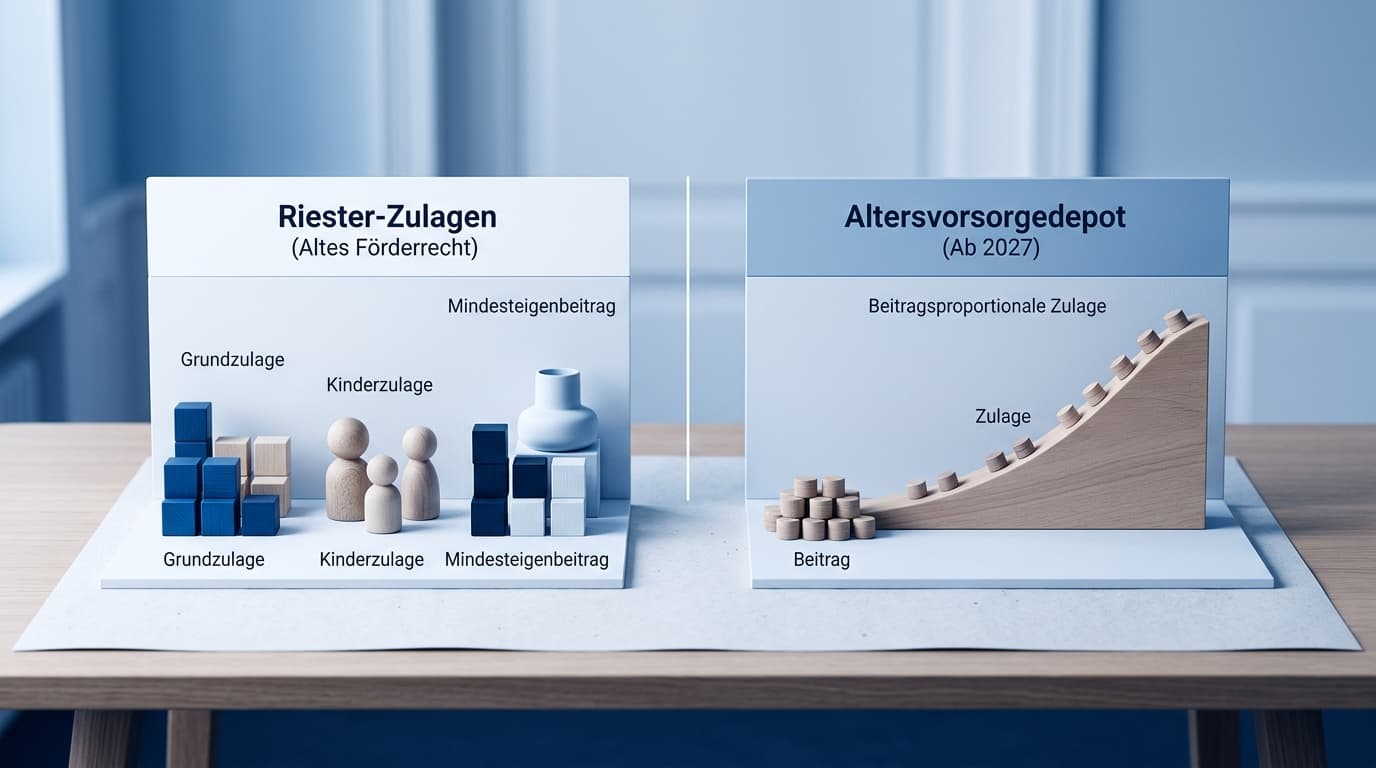
Riester-Rente or AVD - which fits you?
A free, no-obligation conversation with an adviser from our independent network of 1,000+ vetted advisers.
How much are the Grundzulage and Kinderzulage?
From the 2018 contribution year, the Grundzulage is 175 euros a year for each person entitled to the allowance (§ 84 EStG). Under the old subsidy rules, the Kinderzulage is 185 euros for each child born before 1 January 2008 and 300 euros for each child born later (§ 85 EStG). Under the new subsidy rules, from the 2027 contribution year, this tiering no longer applies: the Kinderzulage is a uniform 100 percent of contributions up to 300 euros per child, regardless of year of birth. For existing contracts under the old rules, the amounts remain 185 and 300 euros. Under the old rules, however, you only receive both amounts in full if you pay the minimum own contribution, which the next section covers.
Berufseinsteigerbonus of 200 euros
If you are entitled to the allowance and have not yet reached the age of 25 at the start of the contribution year, the Grundzulage is increased by a one-off 200 euros. This Berufseinsteigerbonus is granted for the first contribution year for which a retirement savings allowance is claimed[1]. It is tied to direct entitlement to the allowance and is paid only once per person.
| Allowance | Amount (old subsidy rules) | Legal basis |
|---|---|---|
| Grundzulage | 175 euros a year | § 84 EStG[1] |
| Kinderzulage, born before 2008 | 185 euros a year | § 85 EStG[2] |
| Kinderzulage, born 2008 or later | 300 euros a year | § 85 EStG[2] |
| Berufseinsteigerbonus | one-off 200 euros if under 25 | § 84 EStG[1] |
These amounts are fixed by law, so they are not estimates; whether they apply in full in your case, however, depends on your own contribution. All the calculations that follow are illustrative and do not constitute investment advice within the meaning of § 1 Abs. 1a Nr. 1a KWG.
How much do you need to pay in for the full allowance?
The minimum own contribution is 4 percent of the previous year's income subject to statutory pension insurance, capped at 2,100 euros, less the total allowances you are entitled to (§ 86 EStG)[3][4]. A floor of 60 euros a year applies: if the calculation comes out lower, you must pay in at least this floor amount. For married couples where one partner is indirectly entitled to the allowance, both spouses' allowances are added together.
- Step 1: Calculate 4 percent of the previous year's income. Example: on an income of 26,000 euros, that is 1,040 euros[5].
- Step 2: Deduct the allowances you are entitled to. With two children born after 2007, that is 175 euros Grundzulage plus 600 euros Kinderzulage, so 775 euros.
- Step 3: The result is the minimum own contribution: 1,040 euros minus 775 euros gives 265 euros a year, around 22 euros a month.
This example follows the calculation method of the Zentrale Zulagenstelle für Altersvorsorge (ZfA), the central office that administers the allowances[5]. If you pay less than the minimum own contribution, the allowance is reduced proportionally: the reduction is based on the ratio of your retirement contributions to the minimum own contribution (§ 86 EStG)[3][4]. If you pay only half the minimum own contribution, for example, you receive only half the allowance. You cannot top up a missing own contribution for a contribution year that has already ended; what counts is the contributions paid in each contribution year.
It is therefore worth checking every year whether your savings plan still matches the current minimum own contribution, for instance after a pay rise or the birth of another child. The calculation is illustrative and is no substitute for investment advice within the meaning of § 1 Abs. 1a Nr. 1a KWG.
Who receives the Kinderzulage?
The Kinderzulage requires Kindergeld (child benefit) to have been assessed in favour of the person entitled to the allowance (§ 85 EStG)[2]. If the Kindergeld is reclaimed, the entitlement to the Kinderzulage lapses for the period concerned. If several people receive Kindergeld for the same child, the allowance goes to the person for whom the Kindergeld was assessed first in the calendar year.
For married parents of opposite sexes who are not permanently separated and live in the EU or the EEA, the Kinderzulage is allocated to the mother, or to the father if both parents apply. For same-sex parents, it goes to the parent for whom the Kindergeld is assessed, or to the other parent if both apply. Worth knowing: such an application cannot be withdrawn for a contribution year that has already ended[2]. From 1 January 2028, the Altersvorsorgereformgesetz (the pension reform act) changes this rule: the Kinderzulage will then be allocated to the parent for whom the Kindergeld is assessed, or to the other parent if both make a matching declaration[8]. The basics are covered in our guide to the Kinderzulage in the Altersvorsorgedepot.
Typical reasons for a reclaim
- Entitlement to Kindergeld has lapsed retrospectively, for example after the child has moved abroad.
- The Kinderzulage was subsequently transferred to the spouse or partner.
- Income corrections were reported to the tax office or the ZfA.
This list follows the reclaim provisions of the Einkommensteuergesetz (Germany's Income Tax Act): if the central office has to reclaim allowances that were credited or paid out wrongly, it notifies the person entitled to the allowance by formal notice (§ 90 EStG)[6]. Since every reclaim reduces the savings built up, it pays to report changes in Kindergeld or income to your provider without delay.
How do you claim the allowance in time?
You submit the allowance application to your contract's provider, by the end of the second calendar year following the contribution year (§ 89 EStG)[7][4]. For the 2026 contribution year, the deadline is therefore 31 December 2028. The application can also be submitted electronically if both the provider and the person entitled to the allowance agree.
- Standing application (Dauerzulageantrag): you authorise the provider in writing to claim the allowance on your behalf for every contribution year (§ 89 Abs. 1a EStG)[7][4]. You can revoke it up to the end of the contribution year for which the provider should no longer apply.
- Duty to notify: you must tell the provider without delay about any change that reduces or removes your entitlement to the allowance (§ 89 Abs. 1 Satz 5 EStG)[7].
- Two-contract rule: if you pay into several contracts, the allowance is granted for only two of them; if you claim it for more than two, the two contracts with the highest retirement contributions receive the allowance (§ 89 Abs. 1 Satz 3 EStG)[7]. You decide which contracts are subsidised when you apply.
The two-contract rule matters for savers who already hold another subsidised contract alongside their Riester contract: contributions to a third contract are ignored for allowance purposes. If you use the standing authorisation, you should still check the provider's annual statement, because the provider only knows about changes such as a new child or a different income if you tell them.
How does the Altersvorsorgedepot provide support from 2027?
Under the new subsidy rules, from the 2027 contribution year the allowance is no longer paid as a fixed amount once the minimum own contribution is reached; instead, it is calculated in proportion to what you pay in. For every euro paid in up to 360 euros, you receive 50 cents of Grundzulage, and for further contributions up to 1,800 euros, 25 cents per euro, up to a maximum of 540 euros a year in total. The income-based 4 percent calculation no longer applies; in future, a minimum own contribution of 120 euros a year is enough.
- Grundzulage: 50 cents per euro up to 360 euros of own contribution, then 25 cents per euro up to 1,800 euros, capped at 540 euros.
- Kinderzulage: 100 percent of contributions up to 300 euros per child, regardless of year of birth; the old 185/300 euro tiering no longer applies.
- Berufseinsteigerbonus: a one-off 200 euros if you have not yet reached the age of 25 at the start of the contribution year, as before.
- Minimum own contribution: a fixed amount of 120 euros a year, including for indirectly entitled spouses.
| ZfA example calculation | Old subsidy rules | New subsidy rules from 2027 (our own calculation) |
|---|---|---|
| Income, children, own contribution | 26,000 euros, 2 children, 265 euros own contribution[5] | 26,000 euros, 2 children, 265 euros own contribution |
| Grundzulage | 175 euros | 132.50 euros (50 cents per euro up to 265 euros) |
| Kinderzulage | 600 euros | 530 euros (1 euro per euro up to 300 euros per child) |
| Total allowance | 775 euros | 662.50 euros |
| Total paid into the contract | 1,040 euros | 927.50 euros |
The example shows that, at this income and in this family situation, the old subsidy rules produce the higher allowance this year; with other combinations of income and contributions, the balance may tip the other way. No general conclusion about which set of rules is better can be drawn from it. We have covered the details of the new Grundzulage and the minimum contribution of 120 euros separately. All figures are illustrative and do not constitute investment advice within the meaning of § 1 Abs. 1a Nr. 1a KWG.
Old or new subsidy rules for your contract?
Contracts taken out before 1 January 2027 are protected: they can continue with the existing tax relief and the existing allowance rules until the payout phase begins (§ 52 Abs. 50a EStG)[8]. You therefore do not have to cancel, and any subsidy already built up is not lost. We have set out the trade-off between keeping and switching in a separate decision guide.
- Switching by declaration: from 2027, you can move to the new subsidy system by making a declaration to your provider, without the provider having to agree. The declaration takes effect from the contribution year in which the provider receives it.
- New contract: if you take out a new subsidised contract after 31 December 2026, such as an Altersvorsorgedepot, the new subsidy rules automatically apply uniformly to all your contracts, even without a declaration.
- Uniformity: if you hold several Riester contracts and move one into the new system, all your other contracts follow; you cannot choose contract by contract.
- Irrevocability: once you have made the declaration, you cannot switch back to the old tax relief. The declaration applies uniformly to all existing contracts.
Because the declaration is irrevocable, it should rest on figures you can follow: for your income and family situation, compare the allowance under the old and new rules, the cost structure of both systems and the investment options. This is exactly the step the provider comparison is designed for: it sets out the providers and terms for the Altersvorsorgedepot neutrally and by criteria, including direct account-opening links, so you know the alternative of a new Altersvorsorgedepot before you commit irrevocably. For more background on the transition, see our guide to grandfathering protection for Riester contracts.
Frequently asked questions
- How much is the Grundzulage for the Riester-Rente?
- From the 2018 contribution year, the Grundzulage is 175 euros a year. If you have not yet reached the age of 25 at the start of the contribution year, you also receive a one-off 200 euros Berufseinsteigerbonus. You must pay the minimum own contribution; otherwise the allowance is reduced proportionally.
- How much do you need to pay in yourself to get the full Riester allowance?
- The minimum own contribution is 4 percent of the previous year's income subject to statutory pension insurance, capped at 2,100 euros, less the allowances you are entitled to. A floor of at least 60 euros a year applies. If you pay less, the allowance is reduced in the ratio of the contributions paid to the minimum own contribution.
- Who is the Kinderzulage allocated to, the mother or the father?
- For married parents of opposite sexes who are not permanently separated and live in the EU/EEA, the Kinderzulage is allocated to the mother, or to the father if both parents apply. The application cannot be withdrawn for a contribution year that has already ended. Kindergeld must have been assessed in favour of the person entitled to the allowance.
- What is the deadline for claiming the Riester allowance?
- The application must be submitted to the contract's provider by the end of the second calendar year following the contribution year. Alternatively, you can make a standing application under which the provider claims the allowance every year. Note that the allowance is granted for no more than two contracts.
- Why has my Kinderzulage been reclaimed?
- Common reasons are a retrospective loss of entitlement to Kindergeld, a subsequent transfer of the Kinderzulage to your spouse, or reported income corrections. If Kindergeld lapses for the whole assessment period, the entitlement to the Kinderzulage for that year lapses too.
- Does the Altersvorsorgedepot change Riester support from 2027?
- Yes. For contracts under the new subsidy rules, the allowance is calculated in proportion to contributions: 50 cents per euro up to 360 euros of own contribution, plus 25 cents for further contributions up to 1,800 euros, with a maximum Grundzulage of 540 euros. The Kinderzulage is 100 percent of contributions up to 300 euros per child. The minimum own contribution falls to 120 euros.
- Can I move my existing Riester contract to the new subsidy rules?
- Yes. You can switch to the new subsidy system by making a declaration to your provider, without the provider having to agree. The declaration applies uniformly to all existing Riester contracts and is irrevocable; you cannot switch back to the old subsidy rules. Taking out a new subsidised contract after 31 December 2026 has the same effect. If you do neither, existing contracts keep their current subsidy under grandfathering protection.
Sources
- [1]gesetze-im-internet.de
- [2]gesetze-im-internet.de
- [3]gesetze-im-internet.de
- [4]smartsteuer.de
- [5]riester.deutsche-rentenversicherung.de
- [6]gesetze-im-internet.de
- [7]gesetze-im-internet.de
- [8]dserver.bundestag.de
- []Kinderzulage in the Altersvorsorgedepot: who gets it?
- []Grundzulage for the Altersvorsorgedepot: amount & requirements
- []Minimum contribution for the AVD: how much for the full subsidy?
- []Keep or switch Riester: what works for whom?
- []Kriteriengestützte Anbietervergleich
- []Can I keep paying into my Riester contract after 2027?
Riester-Rente or AVD - which fits you?
Wondering whether switching to the AVD makes sense? Let's work it out together.
Free and without obligation. Advice from an adviser in our independent network of 1,000+ vetted advisers.