Cancelling your Riester-Rente: losses and alternatives

Published on · Updated on · Managing Director & Partner, Alsterspree Verlag GmbH
This article was written by an author with the support of AI.
Riester-Rente or AVD - which fits you?
A free, no-obligation conversation with an adviser from our independent network of 1,000+ vetted advisers.
Why does cancelling a Riester-Rente count as harmful use?
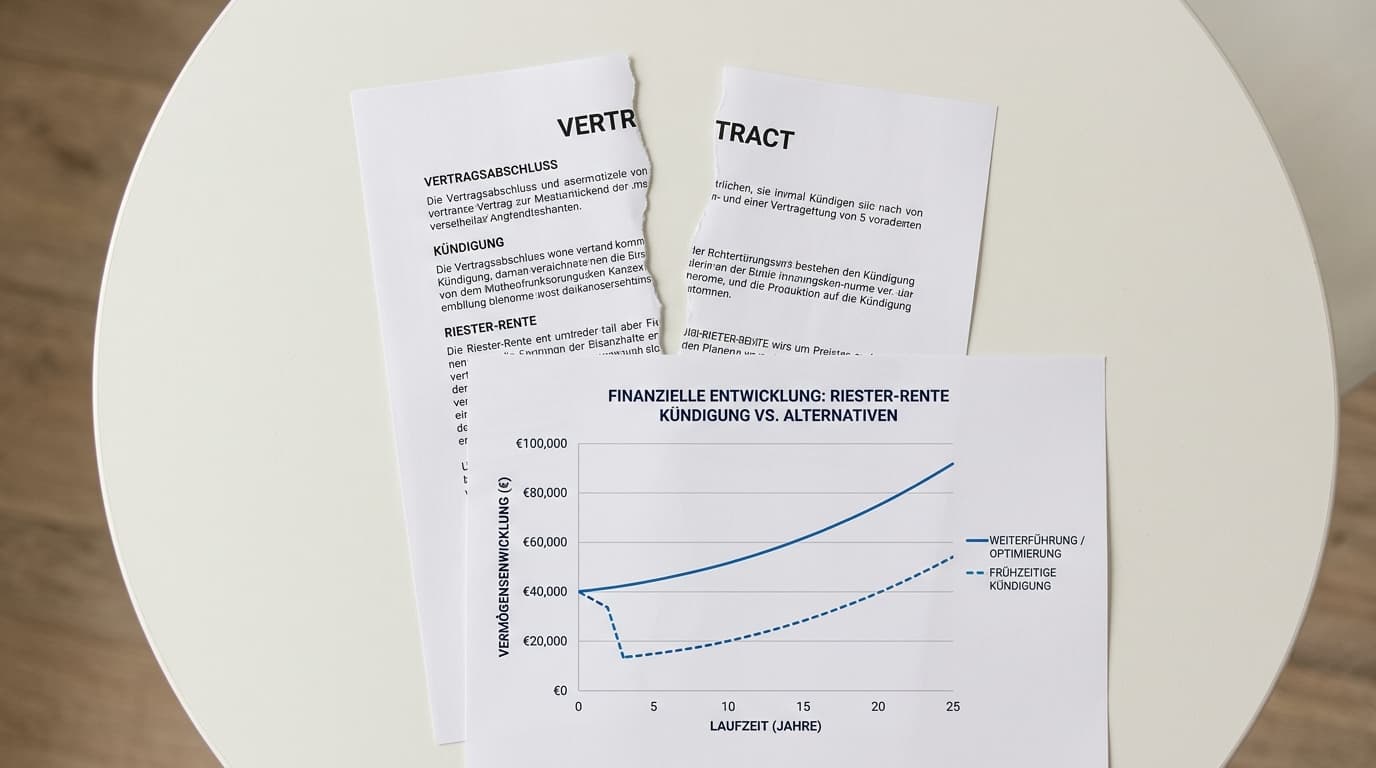
Legally, cancelling a Riester contract early counts as harmful use under § 93 EStG, because the accumulated capital is no longer used to provide a lifelong pension[1]. In that case, every state allowance you received and the tax relief separately assessed for you are reclaimed, and the investment returns you earned become taxable on top[2]. Anyone who dissolves their contract prematurely therefore suffers substantial financial losses and forfeits their entitlement to the subsidised pension in retirement.
The legal framework of Section 93 EStG
Lawmakers tie state support for retirement contracts to a strict purpose requirement: the capital must serve to supplement your income in retirement. If you dissolve your contract and have the money paid out early for free use, that purpose requirement is lifted retroactively. The allowance office (Zulagenstelle, better known by its abbreviation ZfA) then offsets every tax break and every basic and child allowance from previous years directly against your contract balance.
- Purpose requirement: as a rule, retirement assets must stay tied up until the contractual retirement date.
- Reclaim mechanism: the ZfA claims the subsidy money directly from the provider before any payout reaches you.
- Necessary weighing-up: before cancelling, you need to check whether an alternative can avoid the loss of capital.
A well-founded decision about your Riester-Rente therefore requires a close look at the overall sums, since the amount paid out is regularly well below the account's current value.
The loss formula: how the financial deduction is calculated
The financial deduction on early dissolution follows a clear pattern made up of statutory reclaims and contractual costs[2]. Providers first deduct every state allowance from the gross balance in the contract, followed by the cumulative tax benefits claimed through your annual tax returns. Cancellation fees and any acquisition costs not yet amortised then further reduce the remaining payout.
The three stages of the balance deduction
- Deduction of state allowances: the ZfA reclaims 100 percent of the basic and child allowances.
- Offsetting of tax benefits: the tax office recalculates the savings achieved through the Sonderausgabenabzug (deduction as a special expense).
- Product costs incurred: the provider's administration and dissolution fees further reduce the remaining net balance.
In the first half of 2025, savers cancelling a Riester-Rente had to repay around 2,500 euros in subsidies received, according to Deutsche Rentenversicherung — about 1,750 euros in allowances and around 750 euros in tax benefits[2]. The percentage deduction is especially drastic on contracts with high tax subsidies through the Sonderausgabenabzug, which means the capital paid out often does not even match the saver's own contributions.
Worked example: what cancelling a Riester-Rente actually costs
To make the financial impact of harmful use concrete, the worked example below shows how the balance, the reclaim and the payout relate to each other. Mandatory notice: this is not investment advice within the meaning of § 1 Abs. 1a Nr. 1a KWG. The figures shown illustrate the statutory mechanics only.
| Item | Amount |
|---|---|
| Own contributions over five years | €9,625 |
| Basic allowances received | €875 |
| Acquisition and administration costs (example) | -€1,500 |
| Balance in the contract | €9,000 |
| Repayment of tax benefit received | -€2,125 |
| Repayment of allowances received | -€875 |
| Payout amount after cancellation | €6,000 |
| Effective contribution after tax savings | €7,500 |
| Difference from the effective contribution | -€1,500 |
Analysis of the example scenario
In the example of an average earner with no children, the contract holds a balance of 9,000 euros after five years, but after the allowance and tax-benefit reclaim, only 6,000 euros is actually paid out — even though the effective contribution was 7,500 euros[2]. The higher the cumulative subsidy from the basic allowance, child allowances and the Sonderausgabenabzug, the bigger the gap between the contract balance and the actual payout. What matters is always the current surrender value, which you can request from your provider, together with a statement from the ZfA on the allowances and tax relief granted so far.
Four options compared: cancel, suspend contributions, or keep paying?
Besides the harmful route of cancelling, Riester savers have several other ways to respond to changed circumstances or dissatisfaction with their contract: both suspending contributions and transferring the capital to another Riester contract are explicitly not treated as harmful use[1]. A careful comparison helps protect your assets from needless losses.
| Course of action | State subsidy | Guarantees & capital protection | Flexibility |
|---|---|---|---|
| Cancellation | Complete loss | No guarantees | Immediate payout of capital |
| Suspending contributions | Existing subsidy retained | Contribution guarantee retained | No contributions for now |
| Continuing to pay | Full ongoing allowances | Full guarantee on the contribution series | Regular monthly savings rate |
Assessing the options before 2027
In most cases, suspending your contributions is the economically superior alternative to cancelling. The balance you have already built up keeps earning interest in the contract, while all state allowances and guarantees stay untouched. Continuing to pay unchanged, by contrast, pays off mainly for families with several children or lower earners, who benefit from high relative subsidy rates.
The fourth option from 2027: transferring into the Altersvorsorgedepot
When the reform of private pension provision takes effect on 1 January 2027, a fourth option opens up for Riester holders: existing contracts enjoy grandfathering, but a switch into the new subsidy scheme is possible on request[3]. The balance held in existing legacy contracts can be transferred into the new, state-subsidised Altersvorsorgedepot without losing the subsidy. This keeps the statutory retention of your allowances fully intact, without triggering harmful use.
Statutory cost cap and regulation for the system switch
Lawmakers have enshrined clear consumer-protection rules for the switch to the new account model. Switching fees are capped by law: the receiving provider may charge at most 150 euros as an administrative flat fee for the transfer, while the outgoing provider must offer the switch completely free of charge from five years after the contract was concluded[4].
- Transfer without loss of subsidy: no repayment of allowances or tax benefits on transfer.
- Statutory cap on switching costs: a maximum administrative flat fee of 150 euros from the new provider.
- Higher return potential: the option to invest in high-return ETF portfolios without rigid contribution-guarantee constraints.
This new rule removes any need to dissolve contracts in haste, since the switch from 2027 allows a cost- and tax-efficient modernisation of your retirement provision.
Calculator or advice: how to make the right decision now
The decision about the future of a Riester contract should never be based on blanket advice or emotional dissatisfaction. At Vorsorgedepot-Lotse, we offer you two equally valid, transparent routes to finding the best solution for your personal situation: working it out yourself, or neutral guidance from professionals.
Two routes to a well-founded decision
- Self-directed analysis: use the subsidy calculator to compare switching deltas and subsidy rates on a data basis.
- Neutral information resource: explore the details of tax rules and grandfathering in depth via the knowledge section.
- Personal expertise: for complex contract structures, use the independent advice service to get individually tailored recommendations.
- Criteria-based comparison: compare future account providers objectively with the provider comparison.
Before any change to your contract, a careful comparison of the figures is worthwhile. As an independent guide, we help you avoid missteps and position your retirement capital purposefully for the future.
Frequently asked questions
- What counts as harmful use with a Riester-Rente?
- Harmful use under Section 93 EStG occurs when you don't use the capital for its intended purpose of providing a lifelong pension. If you cancel, the tax office and the allowance office reclaim every subsidy you received.
- Do I have to repay the allowances if I cancel?
- Yes. All the basic and child allowances you received from the state, along with the tax benefits credited to you, are deducted from your current contract balance before the remaining amount is paid out to you.
- What are the advantages of suspending contributions?
- If you suspend contributions, payments into the contract pause, so you no longer transfer any monthly instalments. You won't receive any new allowances for now, but you keep every subsidy you have already received, and your capital stays invested.
- Can I transfer my Riester balance into the Altersvorsorgedepot?
- From 2027, you will be able to switch into the new, state-subsidised Altersvorsorgedepot or a guarantee product. Your existing allowances are retained and do not lapse.
- How much will switching cost from 2027?
- After five years of the contract running, the outgoing provider must offer the switch free of charge from 2027. Under the law, the new provider may charge at most 150 euros as an account-opening fee.
Sources
- [1]dejure.org
- [2]finanztip.de
- [3]deutsche-rentenversicherung.de
- [4]bundesfinanzministerium.de
- []Keep or switch Riester: what works for whom?
- []Suspend your Riester contract or switch to the Altersvorsorgedepot?
- []Do Riester allowances get lost when switching to the AVD?
- []What does switching from Riester to the Altersvorsorgedepot cost?
Riester-Rente or AVD - which fits you?
Wondering whether switching to the AVD makes sense? Let's work it out together.
Free and without obligation. Advice from an adviser in our independent network of 1,000+ vetted advisers.