Do Riester allowances get lost when switching to the AVD?

Published on · Updated on · Managing Director & Partner, Alsterspree Verlag GmbH
This article was written by an author with the support of AI.
Riester-Rente or AVD - which fits you?
A free, no-obligation conversation with an adviser from our independent network of 1,000+ vetted advisers.
The core question answered: do my Riester allowances get lost when I switch?
No, with a properly executed, subsidised transfer from Riester to the Altersvorsorgedepot, the allowances you have already received remain fully intact[1]. The capital you have saved carries over together with the state subsidy, provided you do not make the mistake of terminating the contract. A loss only threatens if there is a harmful use, such as a premature termination of the contract.
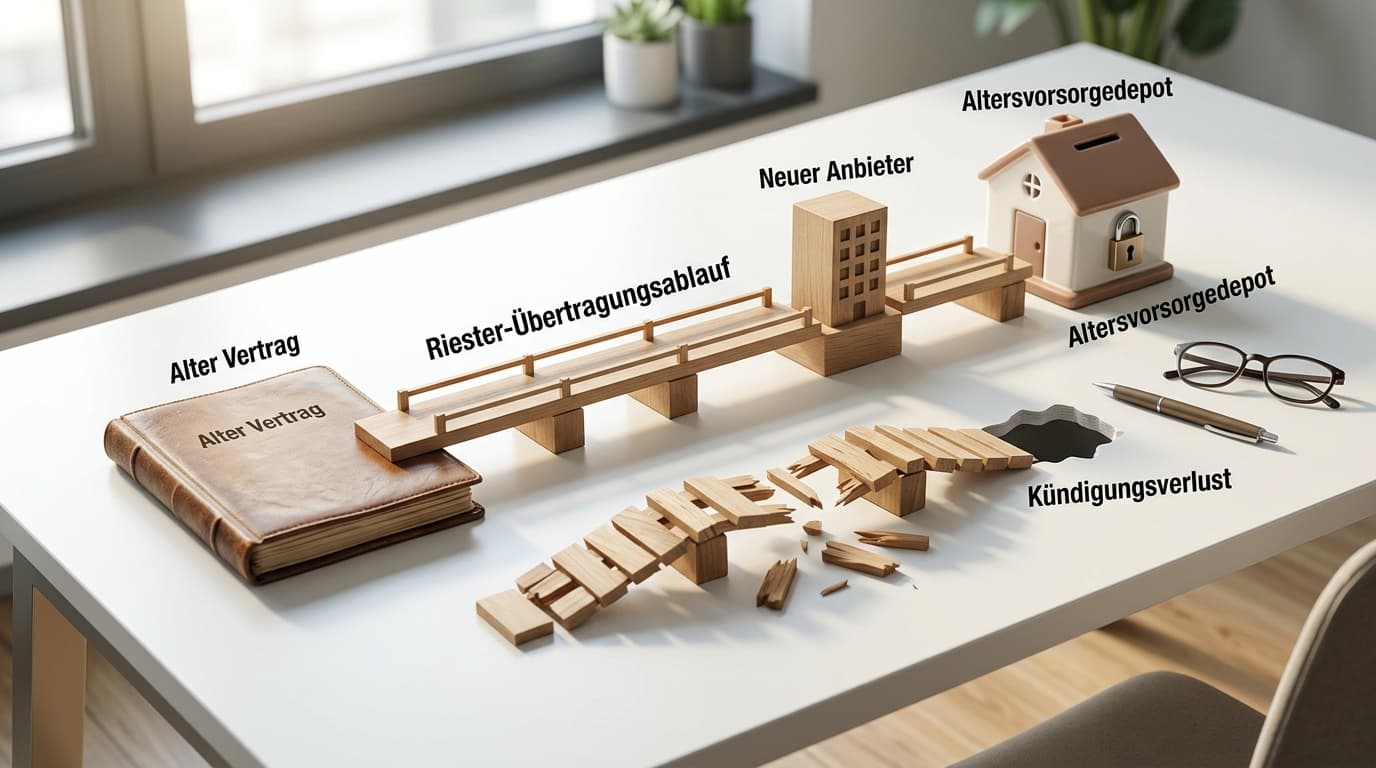
For this kind of transfer, the legislator draws a strict line between a subsidy-neutral transfer and a subsidy-harmful termination. If you terminate your Riester contract and have the balance paid out on your own initiative, you must repay all the state allowances received, along with all the tax benefits from previous years. This massively reduces your savings balance. With a direct, formal transfer to the new Altersvorsorgedepot, by contrast, the saved contract balance, together with the state subsidy, is transferred directly to the new account provider. This way, your existing subsidy history remains completely untouched, and you avoid any repayment obligation.
- Subsidised transfer: the contract balance, including all allowances, is transferred directly to the new provider. Tax benefits already received stay secure.
- Termination with payout: the balance is paid out to your current account. This triggers a mandatory settlement in which all state allowances and tax savings are withheld and repaid to the state.
- Contribution-free dormancy: you stop paying in contributions. The allowances remain in the old Riester contract, but the often high ongoing contract fees of the old product continue to apply.
To reliably check whether a switch pays off financially for your personal situation, a precise mathematical comparison helps. Our knowledge section offers in-depth guides and regulatory background reports on this. With the interactive subsidy calculator, you can transparently calculate the projected switch-versus-stay delta yourself, factoring in the statutory cap on switching costs of a maximum of 150 euros. For complex situations, or if you want individual support, our independent advice service arranges a free introductory conversation with licensed, independent experts.
The decisive difference: switching with subsidy protection versus a harmful termination
Anyone thinking about switching from the classic Riester-Rente (Germany's existing subsidised private pension) to the new Altersvorsorgedepot often worries about losing the state subsidy. For many existing Riester savers, keeping the state subsidy remains the most important criterion when switching. Here's the rule: with a properly executed, subsidised transfer to the Altersvorsorgedepot, all allowances and tax benefits already received remain fully intact. The capital you have saved carries over one-to-one into the new account, including the subsidy. You only risk losing the state allowances if you terminate your existing contract yourself and have the money paid out. This so-called harmful use means you have to repay all allowances and tax benefits to the state.
| Criterion | Subsidised transfer to the AVD | Contract termination with payout |
|---|---|---|
| Allowances retained | Yes, all state allowances remain fully intact in the account. | No, all allowances received must be repaid in full. |
| Historical tax benefits | Remain untouched and do not need to be repaid. | Must be repaid in full to the allowance office. |
| Capital transfer | The entire capital is transferred directly into the new Altersvorsorgedepot. | The remaining balance, after deduction of all subsidies, is paid out. |
Why a termination becomes expensive
Terminating an existing Riester contract has serious financial consequences. In the event of a harmful use, the Zulagenstelle für Altersvermögen (ZfA, the retirement-savings allowance office) reclaims all previously granted Grundzulage and Kinderzulage payments (the basic and child allowances), along with the Sonderausgabenabzug (deduction as a special expense) claimed in previous years[2]. This deduction is taken directly from the contract balance before payout, which drastically reduces the payout amount. A properly executed transfer, by contrast, protects this capital. For the switch to the new Altersvorsorgedepot, the legislator provides a special transfer procedure under which the capital is transferred directly between providers, with no taxes or repayments falling due. To analyse the financial impact of a switch for your personal situation in detail, our subsidy calculator is available to you. This comparison serves general information purposes and does not constitute investment advice within the meaning of § 1 Abs. 1a Nr. 1a KWG.
For the switch to go smoothly, you should under no circumstances terminate your existing contract yourself. The correct route is a subsidised switch application with the new provider, who initiates the transfer of the balance directly. The knowledge section offers further reliable guides on the legal framework. For complex contracts, it is also advisable to use an independent advice service to reliably rule out mistakes during the transfer process.
Legal framework: grandfathering and rules under the new Altersvorsorgereformgesetz
With the new Altersvorsorgereformgesetz (pension reform act) from 2027, state-subsidised private retirement provision in Germany is being fundamentally modernised. If you are a Riester saver wondering whether the allowances you have already received will be lost when you switch, the clear answer is: no, provided you carry out a properly executed, subsidised transfer. Under the statutory requirements of the Federal Ministry of Finance (BMF), your state subsidy remains fully intact when you switch directly to a new Altersvorsorgedepot, because this process is neutral for both tax and subsidy purposes[1].
Grandfathering and statutory switching rules at a glance
The reform act enshrines comprehensive grandfathering for all existing Riester contracts. You have the statutory right to transfer your saved capital to a new Altersvorsorgedepot without needing the consent of your existing provider. A premature termination of your existing contract, on the other hand, counts as a so-called harmful use, under which you must repay all allowances and tax benefits to the state. For the regular switch, the legislator has also set a clear fee cap to protect savers from excessive switching costs: for contracts under five years old, a maximum of 150 euros may be charged; after that, the transfer is free of charge for you.
| Criterion | Subsidised transfer (switch) | Termination (payout) |
|---|---|---|
| Treatment of allowances | All state allowances remain in the account | All allowances must be repaid |
| Tax effects | Existing tax benefits remain untouched | Tax savings must be repaid |
| Cost structure | Capped by law, or free of charge after five years | Often additional cancellation fees from the provider |
For the strategic planning of your retirement provision, it is essential to weigh these options precisely. If you want to simulate the potential advantages of a system switch for your personal situation, our interactive subsidy calculator is available to you. As a neutral guide within our Altersvorsorgedepot guides, we provide you with all the necessary facts so that you can make a well-founded decision. Not investment advice within the meaning of § 1 Abs. 1a Nr. 1a KWG.
Costs and fees when switching: the statutory switching-cost cap
A switch from an existing Riester contract to the new Altersvorsorgedepot is, provided the proper transfer route is followed, legally entirely neutral for subsidy purposes. This means that all the state allowances you have collected so far, as well as the tax benefits, are transferred to the new account undiminished and can keep working for you there. By contrast, a premature termination of your Riester contract followed by a payout counts as a so-called harmful use. In this case, the state reclaims all allowances and tax relief granted, resulting in significant financial losses. To protect savers from disproportionate hurdles, the legislator has defined clear rules for the switching fees that apply.
The statutory fee ceilings in detail
The costs for such a subsidised transfer are strictly regulated by law under the new reform of private retirement provision[3]. If you switch within the first five years after taking out your new Altersvorsorgedepot contract, the outgoing providers may charge you a maximum of 150 euros in fees. After these first five years of the contract term have passed, the transfer is even entirely free of charge for you by law[4]. This rule ensures a high level of transparency and prevents old providers from artificially blocking the switching process, or making it uneconomical, through excessive penalty fees.
| Aspect | Subsidised transfer to the AVD | Contract termination with payout |
|---|---|---|
| Allowances retained | Full transfer of capital, including all state subsidies | Loss of allowances and obligation to repay the state |
| Tax benefits | Existing tax savings remain untouched | Tax benefits must be repaid retroactively |
| Switching fees | Maximum of 150 euros in the first five years, then entirely free of charge | No direct switching fees, but heavy financial losses through repayments |
In the long run, these one-off switching costs pay for themselves very quickly in most cases, because the Altersvorsorgedepot has a markedly leaner fee structure, thanks to forgoing expensive insurance wrappers and using low-cost ETFs instead. If you want to know how large your personal advantage from switching would be, and how the reduced costs affect your final capital, our digital subsidy calculator is available to you. For deeper research and further details on the legal basis, you can also use the knowledge section.
Why the transfer pays off: higher returns and more flexible investment options
Many Riester savers shy away from a change because they fear losing the state allowances they have saved. This worry is unfounded, though, as long as you opt for a properly executed, subsidised transfer. With this route, your entire capital, including all state subsidies, carries over in full into the new Altersvorsorgedepot, whereas a premature termination of the existing contract would trigger a repayment obligation[1]. The switch corrects the biggest structural drawback of the classic Riester-Rente: the statutory requirement for a hundred-percent contribution guarantee, which acted as a major brake on returns in the past.
Return brake released: free choice of ETFs without rigid guarantees
The old contribution guarantee forced providers to put a large share of your contributions into low-yield, fixed-income securities, in order to guarantee the sums paid in by the start of retirement. The new Altersvorsorgedepot, in its standard account model, dispenses with this rigid guarantee obligation. As a result, you can invest your retirement savings entirely in higher-return asset classes, such as global ETFs and equities, and so make the most of the capital markets' earning potential. In doing so, the BMF is creating the legal basis for putting subsidised retirement provision back on a profitable footing[1]. The subsidy calculator lets you calculate the long-term effect of this difference in returns directly for your personal retirement situation.
- End of the contribution guarantee: no forced shifts into low-yield pension securities during market turbulence.
- Maximum flexibility: free choice of low-cost ETFs and equities for long-term wealth building.
- State-regulated cost cap: statutory standard products in the Altersvorsorgedepot are capped at a maximum of 1.0 percent per year in ongoing costs.
- Gentle transfer: grandfathering of all allowances and tax benefits already received via the direct transfer route.
In addition, a statutory cost cap on standard products ensures that the effective costs of managing the account are limited to a maximum of 1.0 percent per year. Compared with many highly opaque existing contracts, which are often burdened with high set-up and administration costs, the Altersvorsorgedepot therefore offers a considerable financial relief. Please note that all scenarios shown here are purely illustrative and do not constitute investment advice within the meaning of the Kreditwesengesetz (Banking Act). For detailed background information, take a look at the knowledge section.
The new subsidy system from 2027: more support in the Altersvorsorgedepot
With the Altersvorsorgereformgesetz from 1 January 2027, the federal government is fundamentally restructuring private retirement provision and replacing the old Riester system[5]. Important for Riester savers: with a properly executed transfer, switching to the new Altersvorsorgedepot is entirely neutral for subsidy purposes, so all state allowances already received remain fully intact. The new account also offers you a markedly simplified and more lucrative subsidy model, which rewards your own savings effort even more directly.
Grundzulage and bonuses compared directly
Until now, Riester savers received an annual Grundzulage of a maximum of 175 euros. In the Altersvorsorgedepot, this state support rises considerably: you receive a Grundzulage of 50 percent on the first 360 euros of your annual own contribution, plus a further 25 percent on all payments up to a limit of 1,800 euros. This results in a maximum annual subsidy of up to 540 euros[1]. In addition, young savers under 25 benefit from a one-off Berufseinsteiger-Bonus (the career-starter bonus) of 200 euros.
| Subsidy component | Classic Riester-Rente | Altersvorsorgedepot (from 2027) |
|---|---|---|
| Maximum Grundzulage | 175 euros per year | Up to 540 euros per year |
| Kinderzulage | Up to 300 euros (born from 2008) | 100 percent of the own contribution (maximum 300 euros) |
| Berufseinsteiger-Bonus | 200 euros, one-off (up to age 25) | 200 euros, one-off (up to age 25) |
| Minimum own contribution | Largely income-dependent (typically 4 percent) | A flat 120 euros per year |
This new subsidy model pays off for almost all Riester savers, because transferring the saved capital into the new Altersvorsorgedepot remains neutral for both tax and subsidy purposes. The allowances you have already received carry over fully into the new account and are not lost. If you want to calculate the exact effect for your personal situation, feel free to use the subsidy calculator. Our neutral knowledge section also gives you all the legal background for your well-founded decision. Please note: all model calculations and comparisons mentioned serve for illustration only and do not constitute investment advice (not investment advice within the meaning of § 1 Abs. 1a Nr. 1a KWG).
Step-by-step guide: how to transfer your capital safely
If you want to transfer your existing Riester balance into the new Altersvorsorgedepot from 2027, taking the right route is crucial. A properly executed, subsidised switch ensures that all existing allowances and tax benefits remain fully intact. The Deutsche Rentenversicherung (Germany's statutory pension insurance provider) points out that a pure provider switch without tax disadvantages is possible, as long as the capital flows directly to the new institution[6]. Our knowledge section has detailed guides and step-by-step instructions on this.
- Step 1: choose a suitable AVD provider. Carefully compare the offers on the market in terms of account fees and investment options before taking out a new contract.
- Step 2: submit the official transfer form. Instruct the new provider to transfer your Riester capital. They will contact your old provider directly and initiate the flow of capital.
- Step 3: avoid the termination trap. Never terminate your Riester contract yourself. A self-initiated termination counts as a harmful use and obliges you to repay all allowances and tax benefits.
In addition to preserving your allowances, the statutory rules protect you from excessive switching fees. The reform provides that switching costs for a transfer before five years have elapsed are capped at a maximum of 150 euros. If the switch happens only after five years, the transfer is even entirely free of charge. If you want to know how such a switch would work out mathematically for your personal retirement situation, you can use the subsidy calculator to compare the future final capital and the cost impact precisely.
Decision aid: a self-directed account or professional advice?
The planned transition from a classic Riester-Rente to the new Altersvorsorgedepot (AVD) raises fundamental questions of practical implementation for many savers. On our neutral platform, two equally valid, reliable paths are available to you for this important step, geared to your personal preferences and prior knowledge: acting independently as an informed self-directed decision-maker, or making use of qualified, personal advice. Both options give you a structured way to set up your state-subsidised retirement capital for the long term with strong return potential. Which route suits you best depends largely on your prior knowledge of capital-market-based saving and your personal need for reassurance[1].
The route for self-directed decision-makers
If you like to manage your finances digitally and independently, the self-directed route is ideal for you. Once the reform has officially come into force, you can initiate a transfer of your existing Riester balance yourself and structure your portfolio according to your own preferences, for example via broadly diversified, low-cost ETFs. To identify the neobroker or account provider that suits you best, our provider comparison helps. With this neutral tool, you compare ongoing account fees, available investment options and technological interfaces in a fully source-based and transparent way. The state allowances and tax benefits you have already received carry directly over into your new account with a correct, subsidy-neutral transfer, and so remain fully intact[1].
When personal advice makes sense
For savers who want professional support, or who want to check the complex contractual details of their old Riester contract, personal advice is often the safer choice. A qualified expert can precisely analyse individual tax aspects and help you structure your contributions optimally under the new system. Through our independent advice service, you get direct access to licensed, independent financial advisers who guide you reliably through the entire switching process. In addition, we recommend using our digital subsidy calculator on the knowledge section to simulate the state subsidy and the cost impact precisely in advance.
| Criterion | Self-directed account | Professional advice |
|---|---|---|
| Target group | Experienced investors, self-directed decision-makers | Security-oriented savers, families |
| Advantage | Maximum control and low costs | Individual support and tax optimisation |
| Support | Provider comparison | Independent advice service |
Frequently asked questions
- Do the Riester allowances I have already received get lost when I switch?
- No, with a properly executed, subsidised transfer of your Riester balance to the new Altersvorsorgedepot, all existing allowances and tax benefits remain fully intact. The entire capital, including the state subsidy, carries over into your new account.
- What happens to the allowances if I terminate my Riester contract?
- If you terminate your contract and have the capital paid out, this counts as a harmful use. In this case, you must repay all the allowances and tax benefits received to the state, which often results in significant financial losses.
- What fees apply when transferring the Riester contract?
- Switching fees are strictly regulated by law. If your Riester contract has already been running for at least five years, the transfer is entirely free for you. In the first five years after taking out the contract, the switching fee is capped at a maximum of 150 euros.
- When can I transfer my Riester contract into an Altersvorsorgedepot?
- A transfer is possible from the official start of the Altersvorsorgedepot on 1 January 2027. From that point on, you can initiate the transfer directly through your new account provider.
- Does my existing Riester provider have to agree to the switch?
- No, the new Altersvorsorgereformgesetz enshrines the right to transfer in law. Your existing provider cannot refuse the transfer of your saved capital to a certified Altersvorsorgedepot.
- Does the switch pay off for every Riester saver?
- For most savers, the switch pays off thanks to the higher return potential without a rigid contribution guarantee and the lower fees, which for the standard product are capped at a maximum of 1.0 percent. Only low earners with several children should have the numbers checked carefully beforehand.
Sources
- [1]bundesfinanzministerium.de
- [2]riester.deutsche-rentenversicherung.de
- [3]ivfp.de
- [4]versicherungenmitkopf.de
- [5]bundesfinanzministerium.de
- [6]riester.deutsche-rentenversicherung.de
- []Vorsorgedepot-Lotse – understand, calculate and decide on the Altersvorsorgedepot
- []Altersvorsorgedepot subsidy calculator
- []Altersvorsorgedepot guides
Riester-Rente or AVD - which fits you?
Wondering whether switching to the AVD makes sense? Let's work it out together.
Free and without obligation. Advice from an adviser in our independent network of 1,000+ vetted advisers.