Wohn-Riester withdrawal: process, deadlines and taxes

Published on · Managing Director & Partner, Alsterspree Verlag GmbH
This article was written by an author with the support of AI.
Riester-Rente or AVD - which fits you?
A free, no-obligation conversation with an adviser from our independent network of 1,000+ vetted advisers.
What can you withdraw Riester capital for?
Until the start of the payout phase you may withdraw your subsidised Riester capital to buy or build an owner-occupied home, to repay a loan taken out for it, for compulsory shares in a registered cooperative, for a barrier-reducing conversion and, since 1 January 2024, also for an energy-efficiency renovation. The law calls this withdrawal the Altersvorsorge-Eigenheimbetrag (§ 92a Abs. 1 EStG)[1]. The home must be located in the EU or the EEA and be your main residence or the centre of your life interests[1]; holiday homes and holiday flats are not eligible[2]. You must be the owner or a co-owner of the property and live in it yourself[3].
| Purpose | Minimum withdrawal | Points to note |
|---|---|---|
| Purchase or construction of an owner-occupied home | 3,000 euros | The costs must have been incurred and be documented |
| Repayment of a loan for purchase or construction | 3,000 euros | E.g. a special repayment or partial redemption at the end of the fixed interest period |
| Compulsory shares in a cooperative | 3,000 euros | Compulsory shares only, no further shares; repaying a loan taken out for them is also possible |
| Barrier-reducing conversion (DIN 18040-2) | 6,000 euros for a conversion within three years of purchase or construction, otherwise 20,000 euros | At least 50 percent of the costs must go to measures under DIN 18040-2; an expert confirms the use |
| Energy-efficiency renovation | 6,000 euros for a renovation within three years of purchase or construction, otherwise 20,000 euros | Work by a specialist company is mandatory and a certificate is required; eligible since 1 January 2024 |
With a partial withdrawal, at least 3,000 euros of subsidised remaining capital must stay in the contract. With 12,000 euros of subsidised balance, the provider can therefore pay out at most 9,000 euros[3]. If the capital is 5,000 euros, only a full withdrawal is possible, because with a partial withdrawal either less than 3,000 euros would be withdrawn or less than 3,000 euros would remain in the contract[4].
Loans taken out for a conversion or renovation cannot be repaid with Riester capital[3]. For conversion and renovation the following also applies: for the same costs, neither grants nor tax reductions under §§ 35a or 35c EStG may be claimed, and you have to confirm this when you apply[1].
How does the withdrawal work: application, deadlines, payout?
The withdrawal takes place in three steps. The application goes to the Zentrale Zulagenstelle für Altersvermögen (ZfA, the central allowance agency for retirement assets); the payout follows from your provider.
- Submit the application to the ZfA: online, with the PDF form, or informally by email, phone or letter, in each case with evidence such as the purchase contract[3]. The application must reach the ZfA at least ten months before the start of the payout phase of your contract[5]. The costs claimed must not be older than six months when you apply[3]. For an energy-efficiency renovation you also need a certificate from the specialist company or from a person authorised to issue it[3].
- Review and decision: the ZfA informs you by notice, and your provider by data transmission, up to what amount a use for housing purposes can apply[5].
- Payout by the provider: with the positive decision, you contact your provider. The payout is possible until the end of the saving phase. You should ask in advance whether the contract allows a partial payout and whether withdrawal costs apply[3].
- Use: after the payout you have twelve months to use the money for the approved purpose[3].
The payout is not a taxable benefit from the contract. Instead the amount is recorded in the Wohnförderkonto and taxed only in retirement[1].
How does the Wohnförderkonto work?
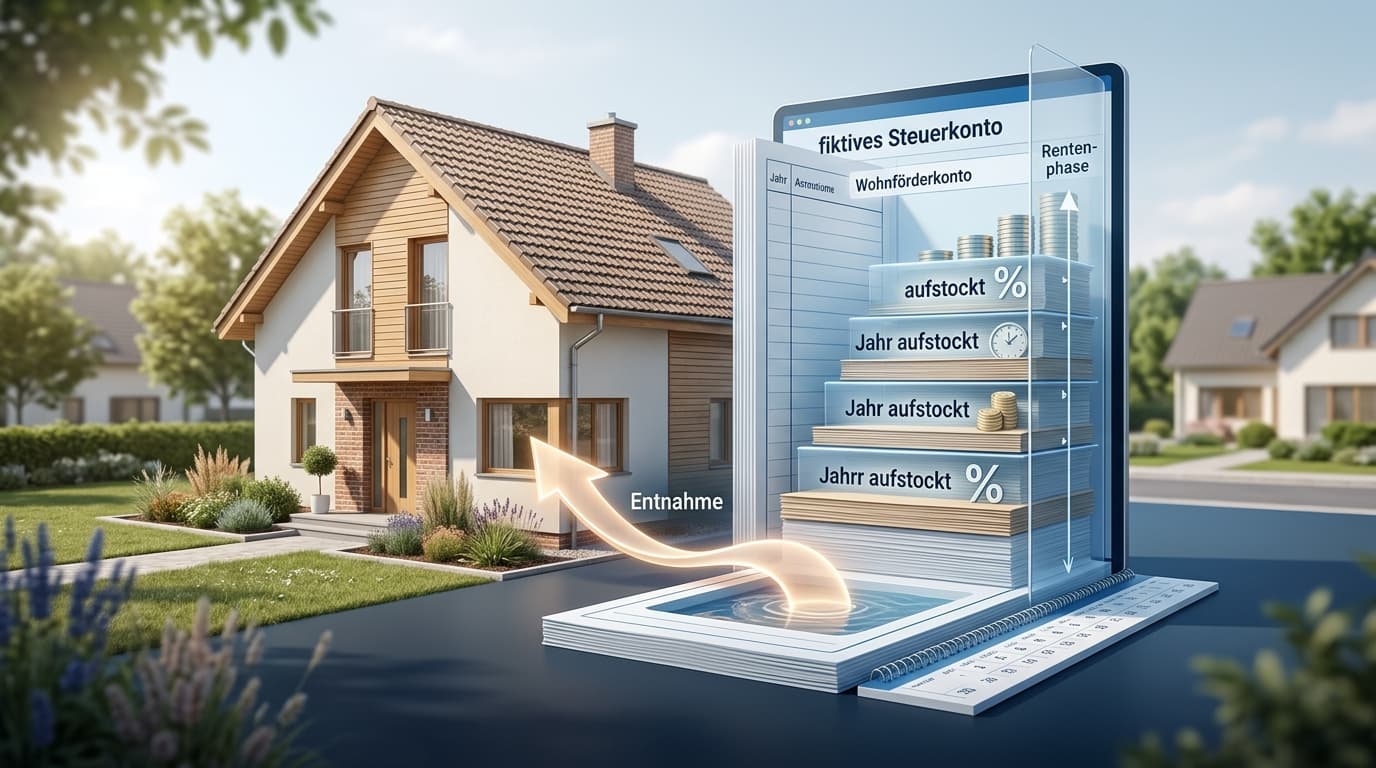
The Wohnförderkonto (home-ownership subsidy account) is a fictitious, contract-related account that the ZfA keeps for each contract. No money flows: the account serves as the tax base for deferred taxation in retirement[3].
- It records the Altersvorsorge-Eigenheimbetrag, subsidised repayments and the allowances granted for them[1].
- After the end of a contribution year the total amount increases by 2 percent, for the last time for the contribution year in which the payout phase starts[1].
- Payments into a certified retirement contract in your own name before the start of the payout phase reduce the account[1].
- You can find out the current balance at any time by applying to the ZfA for a determination of the Wohnförderkonto[3][5].
- At the start of the payout phase the ZfA sends you a notice stating the total amount to be taxed and the annual amount[3].
The start of the payout phase is the date agreed between you and the provider, between your 60th and 68th birthday; if nothing is agreed, your 67th birthday applies[1]. The longer the time between withdrawal and the start of retirement, the more often the account is increased.
An illustrative calculation: if you withdraw 10,000 euros and, simplified, 20 increases of 2 percent each occur before the payout phase starts, the Wohnförderkonto stands at 10,000 euros × 1.02 to the power of 20 = about 14,859 euros. This calculation is purely illustrative, depends on your assumptions and is not investment advice within the meaning of § 1 Abs. 1a Nr. 1a KWG.
How is the Wohnförderkonto taxed in retirement?
At the start of the payout phase you can choose between two routes: either the balance is spread evenly over the years up to your 85th birthday and you declare the annual amount in your tax return, or you apply to the ZfA for the account to be dissolved in one sum. With one-sum taxation only 70 percent of the balance is counted as a benefit, that is, with a discount of 30 percent[6]. Even with instalment taxation you can decide at any time to tax the open remainder in one sum[3].
| Feature | Instalment taxation | One-sum taxation |
|---|---|---|
| Period | Spread evenly over the years up to the age of 85 | In one sum when the account is dissolved |
| Amount counted | 100 percent of the balance, spread in annual amounts | 70 percent of the balance (30 percent discount) |
| Application to the ZfA | No, the ZfA states the annual amount in its notice | Yes |
| If you later stop living in the property | The remaining balance is dissolved and taxed in full in the year you stop | The discount is taxed retroactively if you stop within 20 years of the start of the payout phase |
In the example above (balance 14,859 euros, payout phase starting at 67), instalment taxation would mean 18 annual amounts of about 826 euros to be taxed. With one-sum taxation, 70 percent would be counted, about 10,402 euros. What tax falls on that depends on your personal tax rate in retirement. This calculation, too, is purely illustrative and not investment advice within the meaning of § 1 Abs. 1a Nr. 1a KWG.
What happens if you move out or sell?
If you no longer use the subsidised home yourself, other than temporarily, or give up the ownership, the Wohnförderkonto is dissolved. The dissolution amount counts as a benefit from the retirement contract and is taxable in the year you stop[1][2]. Not only temporarily means that giving up self-use lasts longer than a year[2]. You must notify this to the provider, or in the payout phase to the ZfA, stating the date[1].
The dissolution does not take place in these cases (§ 92a Abs. 3 EStG)[1]:
- Reinvestment: you use an amount equal to the balance not yet repaid within two years before and five years after the end of the year of last self-use for another eligible home[2].
- Repayment: you pay an amount equal to the balance into a certified retirement contract in your own name within one year after the end of that year[2].
- Divorce: the marital home is assigned to the other spouse by court decision[2].
- Illness or care: you no longer live in the home for that reason, remain the owner, the home is still available to you and is not used by third parties other than your spouse[2].
- Moving back: you resume self-use within five years after the end of the year of last self-use[1].
- Job-related move: on application to the ZfA, if you intend to move back by the age of 67 at the latest[2].
Reinvestment or repayment is harmless only if you state your intention when you notify that you have stopped self-use, and meet the deadlines[1].
If you chose one-sum taxation and give up self-use after the start of the payout phase, the discount is taxed retroactively: within the first ten years after the start of the payout phase one and a half times the amount not yet counted is taxed as a benefit, between the tenth and the 20th year the single amount[6]. In the example, 30 percent of 14,859 euros would not yet have been counted, that is about 4,458 euros; one and a half times that is about 6,687 euros.
How does repayment subsidy differ from withdrawal?
Besides the withdrawal there is the repayment subsidy (Tilgungsförderung): repayments on an annuity loan, a combined building-society financing or a building-society contract are subsidised like retirement contributions if the loan is used for an owner-occupied home[4]. The allowances flow directly into the repayment or the savings[4]. Here, too, repayments and allowances are recorded in the Wohnförderkonto[1]; taxation in retirement therefore works as described above. The Verbraucherzentrale advises checking every year that allowances have been booked correctly and that the amounts recorded in the Wohnförderkonto are right[4].
Does this still apply after the reform?
This article describes the law as it applies to your withdrawal today. The Altersvorsorgereformgesetz (pension reform act) changes the rules on the Wohnförderkonto. For withdrawals made before 1 January 2028, the Federal Ministry of Finance says the existing rules continue to apply for reasons of legitimate expectations[7]. What changes after that is explained in our overview of Wohn-Riester and the Altersvorsorgedepot. Existing Riester contracts, incidentally, are not converted automatically but enjoy grandfathering.
Frequently asked questions
- How much Riester capital can I withdraw for a home?
- The subsidised capital can be withdrawn in full or in part. For purchase, construction or loan repayment, at least 3,000 euros must be withdrawn; with a partial withdrawal, at least 3,000 euros of subsidised remaining capital must stay in the contract. For a barrier-reducing conversion or an energy-efficiency renovation, minimum amounts of 6,000 euros (within three years of purchase or construction) or 20,000 euros apply.
- By when do I have to apply for the withdrawal?
- The application must reach the ZfA at least ten months before the start of the payout phase of your contract. The costs must not be older than six months when you apply, and after the payout you have twelve months to use the money for the approved purpose.
- What happens to the Wohnförderkonto in retirement?
- The balance is taxed from the start of the payout phase, either spread evenly up to the age of 85 or in one sum with a discount of 30 percent, so that only 70 percent is counted. The ZfA notifies you of the amount to be taxed by notice. The actual tax burden depends on your individual tax rate.
- When does taxation of the Wohnförderkonto begin?
- With the start of the payout phase of your contract. It lies between your 60th and 68th birthday as agreed with the provider; if nothing is agreed, your 67th birthday applies.
- What happens if I sell the subsidised property or move out?
- If self-use is given up other than temporarily, the Wohnförderkonto is dissolved and the dissolution amount taxed in the year you stop. If you chose one-sum taxation, the discount is taxed retroactively within 20 years of the start of the payout phase, at one and a half times in the first ten years. Exceptions apply, for example, for reinvestment, moving out because of care needs or assignment of the marital home to the other spouse.
- Can I use Riester capital for an energy-efficiency renovation?
- Yes, since 1 January 2024. Examples given are insulation, new windows or a new heating system. The work must be carried out by a specialist company, the same minimum withdrawal applies as for conversions (6,000 euros within three years of purchase or construction, otherwise 20,000 euros), and no grants or tax reductions may be claimed for the same costs.
- Does the old law still apply to my Wohn-Riester withdrawal?
- Yes, for withdrawals before 1 January 2028 the Federal Ministry of Finance says the existing rules continue to apply for reasons of legitimate expectations. What the reform changes for later withdrawals is in the overview of Wohn-Riester and the Altersvorsorgedepot.
Sources
- [1]gesetze-im-internet.de
- [2]finanzamt.nrw.de
- [3]riester.deutsche-rentenversicherung.de
- [4]verbraucherzentrale.de
- [5]gesetze-im-internet.de
- [6]gesetze-im-internet.de
- [7]bundesfinanzministerium.de
- []Wohn-Riester and the Altersvorsorgedepot: what applies?
- []Will my Riester-Rente contract be converted automatically?
Riester-Rente or AVD - which fits you?
Wondering whether switching to the AVD makes sense? Let's work it out together.
Free and without obligation. Advice from an adviser in our independent network of 1,000+ vetted advisers.