How is the Altersvorsorgedepot taxed?

Published on · Updated on · Managing Director & Partner, Alsterspree Verlag GmbH
This article was written by an author with the support of AI.
How much of your AVD is left after tax?
A free, no-obligation conversation with an adviser from our independent network of 1,000+ vetted advisers.
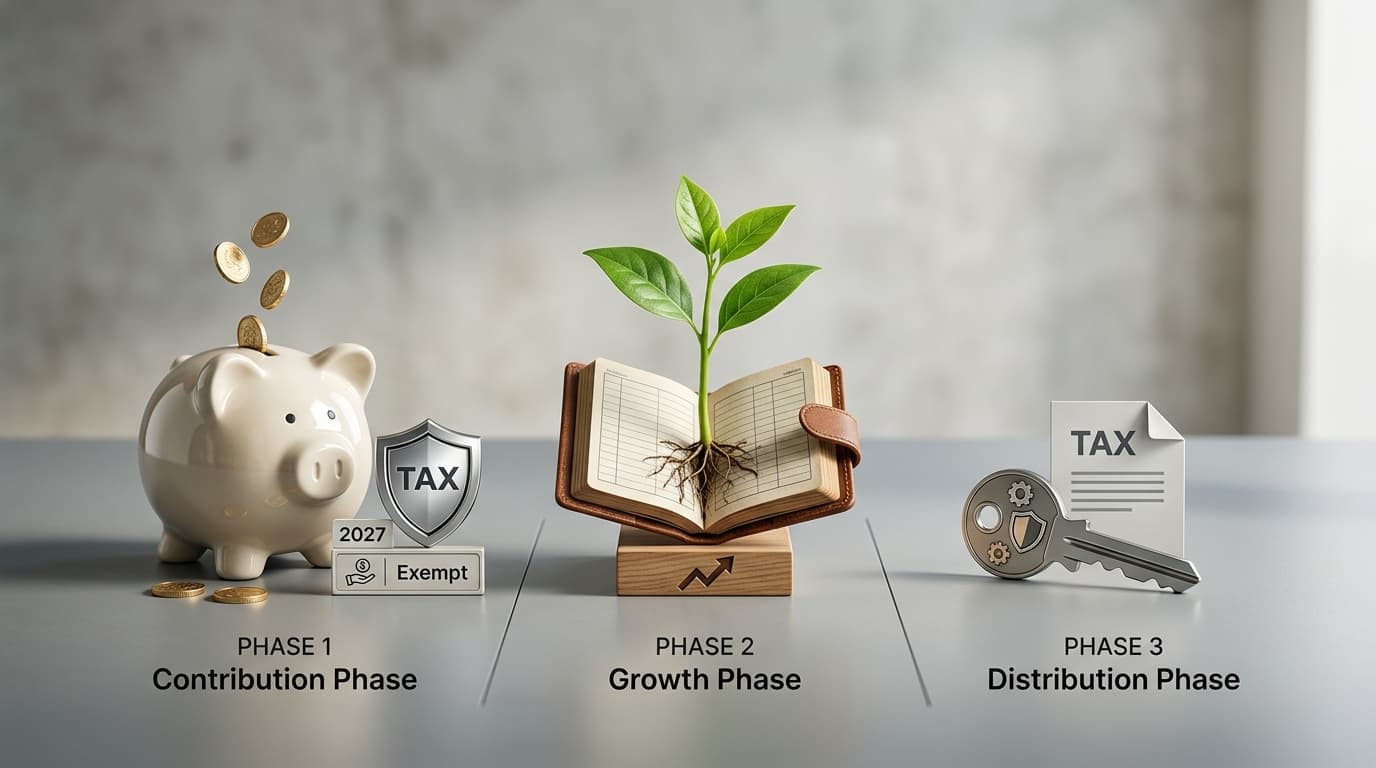
The three-phase tax model of the Altersvorsorgedepot at a glance
The new Altersvorsorgedepot is taxed on a deferred basis from 2027: in the payment phase, contributions are state-subsidised and deductible from tax under the Sonderausgabenabzug, while in the accumulation phase no ongoing tax is due on capital gains or dividends. Only the payout phase in retirement is subject to taxation at your personal income tax rate applicable at that time[1]. Because this personal tax rate is usually significantly lower in retirement than during active working life, you benefit from a substantial tax advantage compared with a regular, immediately taxed account. This three-phase model forms the tax foundation of subsidised private retirement provision.
The first two phases produce a strong compound-interest effect. Contributions can be deducted directly from taxable income, reducing the tax burden in the year of payment. In the subsequent accumulation phase, what's known as tax deferral applies: all returns, such as dividends or realised capital gains from ETFs, remain completely tax-free within the account and are reinvested without deduction of withholding tax[1]. Our subsidy calculator shows how this saving plays out over the years. You'll find further in-depth details on the statutory basis in our knowledge section.
| Provision phase | Tax treatment | Your advantage |
|---|---|---|
| 1. Payment phase | Contributions are tax-deductible within the maximum amounts (Sonderausgabenabzug). | Direct reduction of the annual income tax burden. |
| 2. Accumulation phase | No withholding tax on dividends, interest or capital gains within the account. | Full reinvestment of gains maximises the compound-interest effect. |
| 3. Payout phase | Deferred taxation of the payouts at your personal tax rate. | Usually a significantly lower tax burden in old age than during working life. |
In the third phase, the payout phase, deferred taxation finally applies. Every withdrawal in old age is calculated as taxable income at your then-applicable tax rate[1]. Because this tax rate in retirement is noticeably lower, due to usually lower total income, than during working life, you net more of your accumulated capital. For the precise design of your personal savings strategy, an early look at your individual income situation is advisable. Please note: all tax framework conditions presented here serve general information purposes only and do not constitute tax or financial advice (not investment advice within the meaning of § 1 Abs. 1a Nr. 1a KWG).
Phase 1: tax subsidy in the payment phase
The new Altersvorsorgedepot is treated according to the principle of deferred taxation. That means, for you: in the payment phase, you can claim your contributions for tax purposes; during the accumulation phase, growth remains tax-free; and only at payout in retirement does your personal tax rate become due. Through this state-subsidised three-phase model, you shift your tax burden into a life phase where your personal tax rate is usually significantly lower than during active working life.
| Phase | Tax treatment in the Altersvorsorgedepot | Comparison with a normal ETF savings plan |
|---|---|---|
| Payment phase | Contributions up to 1,800 euros are tax-deductible via the Sonderausgabenabzug or subsidised through state allowances. | Payments are made entirely from already-taxed net income. |
| Accumulation phase | Ongoing returns such as dividends and realised capital gains are completely tax-free (compound-interest effect without advance lump-sum tax). | Returns are subject to the annual advance lump-sum tax as well as withholding tax on reallocation. |
| Payout phase | Deferred taxation: payouts are taxed in retirement at the then-applicable personal income tax rate. | Capital gains are taxed on sale via withholding tax (possibly with partial exemption). |
In the first phase, the payment phase, you can claim your own contributions up to a maximum of 1,800 euros per calendar year as special expenses in your income tax return. The tax office automatically carries out what's called a Günstigerprüfung (favourability check). It determines whether the direct Sonderausgabenabzug or the granting of state allowances (such as the Grundzulage of up to 540 euros) is more tax-advantageous for you. To precisely simulate these various effects on your personal tax burden and final capital, you can use the subsidy calculator, which offers you a transparent comparison (the model calculations serve illustration purposes; not investment advice within the meaning of § 1 Abs. 1a Nr. 1a KWG).
In addition, the new statutory rules provide that you can pay a total of up to 6,840 euros a year into your Altersvorsorgedepot[1]. Even though the subsidised maximum amount for the Sonderausgabenabzug is capped at 1,800 euros, the portion above that offers substantial advantages. The amounts between 1,800 euros and 6,840 euros are not directly subsidised for tax purposes, but they still fully benefit from tax exemption on all returns generated during the subsequent accumulation phase. Compared with an unsubsidised securities account, this eliminates the annual burden of the advance lump-sum tax entirely, which considerably accelerates your long-term wealth building.
Phase 2: tax-free growth in the accumulation phase
The key advantage of the Altersvorsorgedepot over its decades-long term lies in the tax-free accumulation phase. Unlike a conventional account, where tax can fall due annually, your capital remains completely untaxed during this phase. Neither annual capital gains nor dividends or interest distributions are subject to the otherwise usual 25 percent withholding tax plus solidarity surcharge and, where applicable, church tax, nor does the annual advance lump-sum tax apply[1]. This exemption also applies if you carry out reallocations to adjust your portfolio. The entire performance thus remains undiminished within the account, allowing your assets to grow without interim tax deductions.
The maximum compound-interest effect in comparison
This tax advantage produces a maximum compound-interest effect, since reinvested gains and distributions are not reduced upfront by the tax office. With a regular ETF savings plan, you must pay annual tax on returns that exceed the statutory saver's allowance. With the Altersvorsorgedepot, by contrast, every euro earned stays in the investment cycle gross for net and generates further returns in subsequent years. How strongly this mathematical compound-interest effect affects your private pension over time can be determined transparently with the subsidy calculator. For a detailed comparison of the tax framework conditions, our knowledge section is also available to you.
| Tax component | Normal account (ETF savings plan) | Altersvorsorgedepot |
|---|---|---|
| Annual advance lump-sum tax | Yes, recorded for tax purposes and debited from the settlement account | No, no advance lump-sum tax is levied |
| Ongoing returns (dividends) | Yes, taxed with withholding tax after the allowance is used up | No, remain tax-free within the account |
| Reallocation of funds | Realising gains triggers immediate tax liability | Possible tax-free within the Altersvorsorgedepot |
It's important to note here that, legally, this is a pure tax deferral. The deferred tax is not eliminated permanently, but only becomes due at the start of the payout phase in old age. Because the personal income tax rate in retirement is usually significantly lower than during active working life, you get a double advantage: you benefit for decades from undisturbed compound interest on the deferred tax and pay tax on the returns in old age, often at a considerably more favourable rate.
Phase 3: deferred taxation in the payout phase
The core tax principle of the new Altersvorsorgedepot is what's known as deferred taxation. This means the state subsidy and the tax relief occur during your working life, while the actual tax assessment takes place only in retirement. Once you reach the payout phase and gradually withdraw your savings in old age, the amounts paid out are treated as taxable income. The decisive advantage of this system lies in tax progression: because your personal income tax rate in retirement is, in the vast majority of cases, significantly lower than during active employment, you end up paying less tax on your accumulated capital than with immediate taxation.
Under the Federal Ministry of Finance's reform of private retirement provision, the exact scope of this taxation depends on the extent to which your contributions received tax subsidy during the accumulation phase[1]. While with a conventional ETF savings plan you must pay ongoing withholding tax on distributions and partially tax gains on sale, the capital in the Altersvorsorgedepot remains completely free of tax deductions for decades. This tax deferral produces an enormous compound-interest effect, since the untaxed returns are reinvested directly. Only at the planned start of retirement does the state collect, with taxation precisely adapted to your individual financial situation in old age.
To precisely determine the long-term benefit of this model for your personal situation, you can use the subsidy calculator on our portal. It takes into account the interplay of all three phases and shows you transparently how the tax relief in the payment phase, together with the allowances, affects your expected final capital. For open detail questions and tailored planning of your retirement provision strategy, our independent advice service is also available to you, bringing you together with qualified, impartial experts.
| Provision phase | Tax treatment in the Altersvorsorgedepot |
|---|---|
| Payment phase | Contributions are tax-deductible and state allowances flow directly into the account. |
| Accumulation phase | Complete tax exemption for all capital gains, dividends and interest, with no annual tax deduction. |
| Payout phase | Full taxation of the amounts paid out at your then-applicable personal income tax rate. |
Please note that all tax calculations and projections in this guide are illustrative only. Not investment advice within the meaning of § 1 Abs. 1a Nr. 1a KWG.
The tax table: all phases of the Altersvorsorgedepot compared directly
The tax foundation of the new Altersvorsorgedepot rests on the principle of deferred taxation. This means that state subsidies and tax relief apply during the early phase of wealth building, while the tax liability is shifted entirely into retirement. This time delay means your capital can grow in the meantime without tax deductions. To give you precise orientation on these mechanisms, we have compiled the tax advantages in the individual life phases on a source basis.
| Life phase | Tax treatment with the Altersvorsorgedepot | Comparison with a conventional ETF savings plan |
|---|---|---|
| Payment phase | Contributions are tax-deductible as special expenses (state-subsidised). | Payments are made entirely from already-taxed income. |
| Accumulation phase | Completely tax-free. No withholding tax on dividends, and no annual advance lump-sum tax. | Ongoing taxation of distributions and an annual advance lump-sum tax above the saver's allowance. |
| Payout phase | Deferred taxation of the payouts at your personal tax rate in retirement. | Tax-free payout of the capital; only the accumulated gains are subject to withholding tax. |
During the decades-long accumulation phase, you benefit from a complete tax deferral with the Altersvorsorgedepot. Because the Federal Ministry of Finance confirms that no tax is due during this phase on value increases, distributions or the advance lump-sum tax[1], your entire balance stays invested and keeps working for you. You can determine this compound-interest effect directly via the subsidy calculator, to assess transparently the long-term impact on your final capital compared with an unsubsidised account.
Deferred taxation often proves, in practice, to be a substantial advantage, since the personal tax rate in retirement is usually lower than during active working life. For a detailed look at all the tax special cases and payout options, the knowledge section is available to you free of charge, with in-depth guides. If you would like a tailored tax assessment, our independent advice service helps you find a qualified expert for your personal situation.
Altersvorsorgedepot versus unsubsidised ETF savings plan: the tax comparison
In a direct comparison between the new Altersvorsorgedepot and a conventional, unsubsidised ETF savings plan, the decisive tax lever lies in the principle of tax deferral. While with a regular account you pay annual tax on distributed dividends or the advance lump-sum tax due, and withholding tax becomes due on later sale, your assets grow tax-free throughout the entire accumulation phase in the Altersvorsorgedepot[2]. Taxation is shifted entirely into the future: only in retirement is the capital paid out taxed, on a deferred basis, at your then-applicable personal income tax rate[2].
This deferral of the tax burden produces a mathematically measurable advantage for the compound-interest effect. Because no capital is withdrawn from the account for annual tax payments, the full return stays in the cycle and keeps working undiminished. This also applies to transactions: you can reallocate ETFs within the account completely tax-free[2]. By contrast, with a private ETF savings plan, the advance lump-sum tax is calculated annually and charged together with the 25% withholding tax plus solidarity surcharge[3]. How much this difference weighs over the years is illustrated by the source-based subsidy calculator on our portal.
| Phase | Altersvorsorgedepot (subsidised) | ETF savings plan (unsubsidised) |
|---|---|---|
| Payment | Contributions up to the statutory maximum amounts are tax-deductible as special expenses, or direct state allowances are received [2]. | Payments are made entirely from already-taxed net income, without tax subsidy. |
| Accumulation phase | Tax-free. No annual advance lump-sum tax, no withholding tax on dividends, and tax-free reallocations [2]. | Ongoing taxation. Distributions and the advance lump-sum tax are subject to withholding tax annually [3]. |
| Payout | Deferred taxation of the entire capital at the then-applicable personal tax rate [2]. | Only the realised capital gains are subject to withholding tax, taking the partial exemption into account. |
Which variant is more profitable for you depends on your individual income situation. Because the personal tax rate in old age is, in the vast majority of cases, significantly lower than during active working life, the Altersvorsorgedepot offers a substantial net advantage for very many savers. For a reliable, mathematically sound decision, you should examine your personal situation closely. Alongside the interactive calculator, our portal also offers an independent advice service that connects you with qualified, independent experts.
Special tax aspects: early withdrawal and change of provider
Anyone who closes their Altersvorsorgedepot or withdraws assets before turning 65, or before the statutory start of retirement, triggers, for tax purposes, a harmful use. In this case, the state subsidy status lapses retroactively. Savers must repay all state allowances received and pay back tax on the tax relief obtained via the Sonderausgabenabzug[4]. In addition, the capital gains and returns generated in the account are subject to full taxation on payout, which considerably reduces the long-term compound-interest effect. Details on these rules can be found in the knowledge section.
The tax-free change of provider
A change of account provider, by contrast, is tax-neutral. As long as the entire accumulated retirement assets are transferred directly from one certified provider to another provider's account, the process remains tax-neutral. No withholding tax or income tax is due at that moment. The legislator provides that fees of no more than 150 euros may be charged for such a switch during the first five years of the contract[4]. From the sixth year of the contract term onwards, the transferring provider must enable the account move completely free of charge[4].
| Event | Tax impact | Costs / repayments |
|---|---|---|
| Early withdrawal | Back-taxation of all gains and tax benefits | Repayment of all allowances and tax benefits |
| Change of provider | Completely tax-neutral, with no immediate tax liability | Maximum 150 euros in the first 5 years, free of charge thereafter |
Anyone unsure whether a change of provider or an early withdrawal makes sense in their individual case can use the subsidy calculator or draw on an independent advice service. Professional guidance can help avoid costly tax mistakes and make the most of the state subsidy. All calculations and comparisons are purely illustrative and do not constitute investment advice within the meaning of § 1 Abs. 1a Nr. 1a KWG.
Conclusion and next steps: decide for yourself, or get independent advice?
The new Altersvorsorgedepot from 2027 offers significant tax advantages through the three-phase model. In the payment phase, you benefit from state allowances and the Sonderausgabenabzug. During the accumulation phase, all capital gains and dividends remain tax-free, so no ongoing withholding tax erodes the compound-interest effect[1]. Only in the payout phase in retirement does deferred taxation apply, at your personal tax rate, which is usually significantly lower in old age than during working life.
To make the most of these tax advantages, two equally good routes are open to you on our Vorsorgedepot-Lotse portal. If you like to manage your finances independently, you can choose the right investment strategy yourself and implement it via a neobroker. If, on the other hand, you would rather discuss the complexity of the state subsidy and the Riester-switch question with an expert, our independent advice service helps you, free of charge, find the right partner for your personal financial planning.
| Route | Suitable for | Your tool on Vorsorgedepot-Lotse |
|---|---|---|
| Self-directed investors | Experienced savers who select and manage ETFs independently | Subsidy calculator, to determine the optimal savings amount |
| Advice seekers | People who want to secure the tax details and contract switch | Independent advice service for personal specialist advice |
Whichever route you choose: start planning in good time. With our subsidy calculator, you can simulate the individual effect of the subsidy in advance. For an in-depth, tailored analysis, we're happy to connect you with a licensed expert who structurally reviews your personal retirement-provision situation. This way, you make an informed decision for your financial future in old age.
Frequently asked questions
- Exactly when is the Altersvorsorgedepot taxed?
- The Altersvorsorgedepot is taxed on a deferred basis. That means no tax is due during the payment and accumulation phases. Only once you receive payouts from the account in retirement, from age 65 onwards, must you pay tax on them at your personal tax rate.
- How much is the Sonderausgabenabzug for the Altersvorsorgedepot?
- Under the reform of private retirement provision, savers can claim their contributions for tax purposes. The contributions paid in are made tax-free via the Sonderausgabenabzug under § 10a EStG. The subsidised maximum amount is 1,800 euros per year plus the state allowances received.
- Does an advance lump-sum tax apply during the accumulation phase?
- No, no advance lump-sum tax applies to the Altersvorsorgedepot during the accumulation phase. Capital gains, interest and dividends are also exempt from the annual withholding tax throughout the entire term. The capital can therefore grow unimpeded, with the full compound-interest effect.
- What happens for tax purposes with an early payout?
- A payout before age 65 generally counts as a harmful use. In that case, you must repay all state allowances received, as well as the tax benefits from the Sonderausgabenabzug, to the state. In addition, the gains are taxed at the regular rate.
- Is changing the account provider subject to tax?
- No, changing provider is tax-neutral, as long as the capital is transferred directly from one certified Altersvorsorgedepot to another. In this case, no harmful use occurs, and no tax is due on the gains accumulated so far.
- How does the taxation differ from a normal ETF savings plan?
- With a normal ETF savings plan, you pay the advance lump-sum tax annually and, on sale, 25 percent withholding tax plus solidarity surcharge on gains. With the Altersvorsorgedepot, the accumulation phase remains completely tax-free, and only the payouts are taxed, at the usually lower personal rate.
Sources
How much of your AVD is left after tax?
Taxation in the payout phase is complex. We'll work it out for your situation.
Free and without obligation. Advice from an adviser in our independent network of 1,000+ vetted advisers.