How much to pay into the AVD to close the pension gap?

Published on · Managing Director & Partner, Alsterspree Verlag GmbH
This article was written by an author with the support of AI.
Request a free consultation
A free, no-obligation conversation with an adviser from our independent network of 1,000+ vetted advisers.
Working out your personal pension gap: target pension minus statutory pension
Your personal pension gap is the financial difference between the net income you want in retirement and your actual net pension after tax, social contributions and lost purchasing power. To work out this gap precisely, subtract all expected income from statutory and occupational pension provision from your target monthly budget. The resulting uncovered monthly gap needs to be closed by the time you retire.
The illusion of the gross pension statement: factoring in deductions and inflation
The annual pension statement from the Deutsche Rentenversicherung (Germany's statutory pension insurer) shows only gross amounts, without factoring in future inflation or contributions. The statutory pension level is defined as a net value before tax and, under current law, guarantees only a basic level of provision ahead of individual taxation. From the figure shown, you need to deduct health and long-term care insurance contributions as well as your individual tax rate. On top of that, annual inflation of, say, two percent noticeably erodes real purchasing power over two to three decades. Anyone who plans around the nominal gross figure alone significantly underestimates their actual savings need.
| Calculation step | Calculation logic | Explanation |
|---|---|---|
| 1. Target net income in retirement | Set target amount | Target monthly budget for living costs |
| 2. Expected gross pension (DRV) | minus DRV figure | Amount shown in the current pension statement |
| 3. Deductions (health/long-term care insurance, tax) | minus estimated deductions | Actual net amount after contributions and tax |
| 4. Real net pension (purchasing power) | minus inflation discount | Purchasing-power-adjusted net figure at moderate inflation |
| 5. Monthly net pension gap | = Uncovered need | Need to be met by private provision such as the Altersvorsorgedepot |
The precise target back-calculation forms the solid framework for any sustainable retirement plan. Once you know your real net gap, you can work out exactly how much of your own contribution, together with state support, needs to be paid in to fully cover this difference by the time you retire. (Not investment advice within the meaning of § 1 Abs. 1a Nr. 1a KWG.)
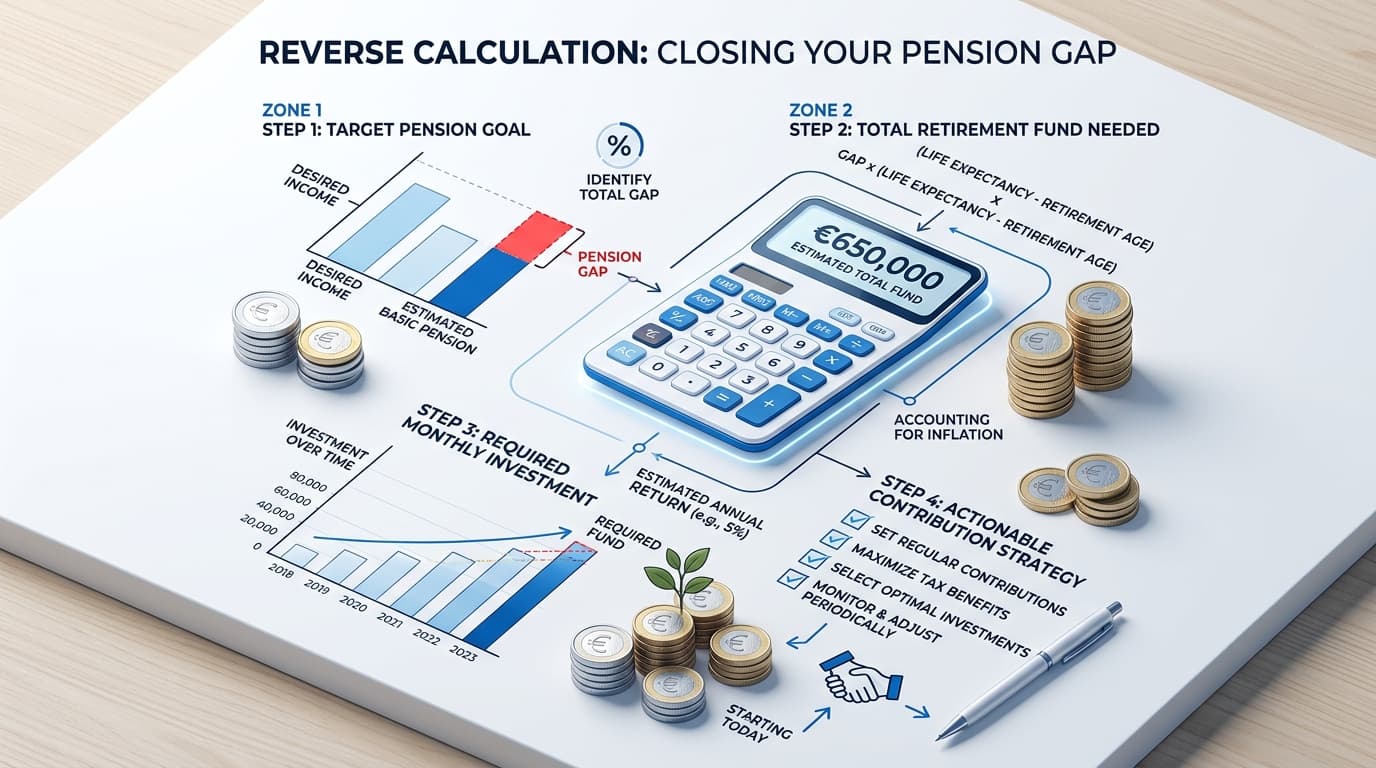
The backward calculation: from your target monthly amount to the required capital stock
To structure targeted retirement provision, we recommend the mathematical target back-calculation method. Rather than picking a random savings amount, we work out the capital stock needed at the start of retirement, starting from your target monthly top-up pension. Calculating with a generous pension payout duration of around 20 years gives a reliable basis for planning. Multiplying the desired monthly pension gap by this expected payout duration in months gives us the fundamental target figure for the assets you need to build up.
- Determining the monthly provision gap: you define the amount you'll be short of in retirement to cover your usual cost of living.
- Calculating the capitalisation factor: the assumed pension payout duration in years is multiplied by 12 months.
- Working out the base capital: the monthly gap is multiplied by the number of months to calculate the pure payout capital, assuming no interest is earned during the withdrawal period.
- Factoring in subsidy and return: the state-subsidised Altersvorsorgedepot makes it possible to build up this capital stock far more efficiently.
This target back-calculation illustrates the scale involved: a significant provision gap requires a corresponding volume of capital that covers the planned withdrawals over the whole pension period. The advantage of the new subsidy structure from 2027 is that you don't have to raise this amount through your net contributions alone. State allowances and the earning power of broadly diversified capital market investments substantially reduce the monthly contribution required to reach this target capital. Not investment advice within the meaning of § 1 Abs. 1a Nr. 1a KWG.
Savings term and compound interest: how time halves your monthly contribution
Anyone wanting to close a concrete pension gap in retirement faces the question of how much monthly capital needs to be planned for. The decisive lever in this target back-calculation is time. Thanks to the compound interest effect on return-oriented ETF portfolios within the Altersvorsorgedepot, the required monthly contribution falls drastically the earlier you start saving. State support acts as an additional lever over the decades, because not just your own contributions but also the allowances you receive generate returns. While the focus on maximum state support is covered in detail in a separate guide on the subsidy optimum, the target back-calculation is purely about covering your individual shortfall in retirement.
Target back-calculation: why does doubling your savings term halve your own contribution?
To work out the necessary savings amount, we calculate backwards from the target top-up pension in retirement to the required target capital. A longer investment horizon eases the burden on your monthly liquidity disproportionately, because the compound interest effect takes over most of the wealth building. The required own contribution relates to the savings term as follows:
- Short savings term: anyone starting late has to offset the lost time with a noticeably higher monthly contribution, because compound interest has less time to work.
- Long savings term: planning early lowers the required own outlay disproportionately. Over long terms, a large share of the total sum needed is generated by the compound interest effect alone.
- Effect of the subsidy rate: if annual Grundzulage and Kinderzulage payments also flow into the Altersvorsorgedepot, the net contribution retirement planners pay out of their own pocket falls even further.
These comparisons show that time has a stronger effect on closing the pension gap than simply raising your savings rate. Anyone who plans early secures the same top-up pension in retirement for a fraction of the monthly outlay. (Note: all mathematical model calculations and return assumptions are for illustrative purposes only. Not investment advice within the meaning of § 1 Abs. 1a Nr. 1a KWG.)
The leverage effect of AVD support: allowances lower your own savings rate
In a target-oriented back-calculation, the retirement goal you've worked out serves as a fixed anchor point. Instead of asking how much support is maximally possible, the focus is on closing your individual net pension gap. The state-subsidised Altersvorsorgedepot changes this calculation fundamentally: state allowances flow directly into your account balance, lowering the monthly contribution you need to raise from your net income to reach your planned monthly pension in retirement.
Grundzulage and Kinderzulage as direct deductions
From 2027, the state support architecture rests on two central building blocks that directly reduce the required own contribution. Depending on the contribution tier, the Grundzulage grants up to 540 euros a year.[1] In addition, eligible parents receive a Kinderzulage (the child allowance) of up to 300 euros per child per year.[1] Anyone who arithmetically needs a certain total monthly contribution to cover their pension gap doesn't have to save all of it themselves, because the state covers part of this target savings rate.
- Single people without children: the Grundzulage lowers the required monthly own outlay by up to 45 euros.
- Families with one child: Grundzulage plus Kinderzulage bring up to 840 euros of support a year, noticeably easing the monthly own contribution.
- Families with two children: with up to 1,140 euros in total allowances a year, the state contributes a substantial share towards the savings goal.
To build up a desired final capital sum over the accumulation phase, the Altersvorsorgedepot therefore requires far less of your own net savings than unsubsidised forms of saving. While the subsidy optimum is covered in a separate guide, the target calculation makes one thing clear: every euro the state contributes directly reduces the monthly burden on your own contribution on the way to your target pension.
Worked examples from practice: three savings paths for typical pension gaps
To specifically close an existing provision gap in retirement, the target back-calculation serves as a reliable point of reference. Rather than saving a flat-rate amount, it works out, starting from your target monthly pension, what total capital is needed by the time you retire and how large the necessary monthly contribution is after deducting state support[2]. State Grundzulage and Kinderzulage noticeably reduce your own monthly burden, as structured worked examples show.
| Monthly target gap | Model profile | Possible own contribution | State support effect |
|---|---|---|---|
| €200 | Career starter (age 25), single | approx. €45 / month | High Grundzulage & long compound interest effect |
| €500 | Family (age 35), 2 children | approx. €110 / month | Strong relief from Kinderzulagen |
| €800 | Self-employed (age 45), no children | approx. €240 / month | Higher own contribution, tax benefits apply |
Assuming a 30-year accumulation phase and typical market performance of the portfolio, the state support structure significantly lowers the required own outlay. Families and career starters in particular benefit from high relative subsidy rates on their contributions, so a two-digit monthly contribution is often enough for moderate gaps. As age increases, the accumulation phase shortens, which is why larger pension gaps of 800 euros require an adjusted savings path. All figures are illustrative model calculations and do not constitute investment advice within the meaning of § 1 Abs. 1a Nr. 1a KWG.
For your personal retirement planning, matching your target gap to your individual eligibility for support is decisive. Anyone who knows their exact entitlement to support can fine-tune their monthly contribution precisely to the pension they're aiming for. How you set your personal savings rate with the subsidy optimum in mind forms the basis for viable financial planning within the Altersvorsorgedepot.
Getting the tax treatment right in the payout phase
Anyone who works out their pension gap precisely must not neglect the later payout phase: payments from the subsidised Altersvorsorgedepot are treated as other income and are fully subject to deferred taxation in retirement[2]. This means the gross amount paid out does not translate one to one into your available net income in retirement. To actually close a target net pension gap of, say, 300 euros a month, you need to plan for a correspondingly higher gross payout amount during the accumulation phase.
Net pension gap versus gross payout requirement
For most pensioners, the individual tax rate in retirement is noticeably lower than the rate during their working life, but it's still often between 15 and 25 percent, plus health and long-term care insurance contributions. If you want to close a monthly gap of 300 euros net, this requires a monthly gross payout of around 375 euros, assuming an average deduction rate of 20 percent. In our mathematical target back-calculation, we therefore first work out the necessary gross capital, before determining the state allowances and the resulting own contribution.
- Determining the net pension gap: working out the monthly shortfall against your target income in retirement.
- Adding a margin for tax and contributions: applying the expected tax rate in retirement (e.g. 20 percent) to calculate the required gross amount.
- Determining the target capital: multiplying the gross requirement by the capitalisation factor for the planned pension duration.
- Deducting state support: crediting the annual Grundzulage and Kinderzulage payments to work out the effective monthly own contribution.
For accurately sizing your monthly savings rate, we recommend already calculating with realistic net values in the target back-calculation and factoring in the subsidy rate, for instance as part of optimising for maximum support. All model calculations are for guidance only and do not take individual future tax changes into account. Not investment advice within the meaning of § 1 Abs. 1a Nr. 1a KWG.
Subsidy optimum vs. target pension: setting the right own contribution
When planning private retirement provision, two different approaches meet: aiming for maximum state support, and aiming to close your individual pension gap. The subsidy optimum for the Altersvorsorgedepot is reached at an annual contribution of 1,800 euros (150 euros a month)[2]. Up to this limit, you fully draw on the state Grundzulage as well as any Kinderzulage payments. For goal-oriented retirement planning, however, looking at the subsidy limit alone is often not enough.
For retirement planners, the priority isn't the maximum subsidy rate but the actual difference between expected income in old age and the standard of living you want in retirement. If a target back-calculation shows that closing your personal pension gap requires, say, 300 euros a month, the subsidised maximum contribution of 150 euros covers only half the need. In such cases, combining the subsidised Altersvorsorgedepot with unsubsidised investment building blocks such as a flexible ETF savings plan is the financially consistent solution.
- Subsidised Altersvorsorgedepot (up to 1,800 euros p.a.): secures the full state allowances and tax relief at maximum subsidy efficiency.
- Free ETF savings plan (supplementary contribution): offers unlimited flexibility with no subsidy cap, to close the remaining pension gap precisely.
- Goal-oriented total contribution: combines the state subsidy with the capital formation needed for your target pension.
Using the subsidy calculator tool, you can work out your personal target pension and calculate the exact split between subsidised allowances and the necessary own contributions. This ensures your savings rate neither sits below your actual retirement need nor wastes potential. (Not investment advice within the meaning of § 1 Abs. 1a Nr. 1a KWG.)
The next step: calculating your individual monthly contribution with the subsidy calculator
Once you've worked out your monthly pension gap, the concrete target back-calculation follows. Rather than basing the contribution solely on maximum allowances, we calculate the necessary savings rate backwards from your target top-up income in retirement. Through the interplay of your own savings effort, state allowances and return opportunities on the capital market, the monthly own outlay falls significantly[2]. Our subsidy calculator handles this financial maths transparently and shows you exactly how much of your own capital is needed for your target pension.
| Monthly target gap | Accumulation phase | Monthly own contribution (approx.) | State support effect |
|---|---|---|---|
| €200 | 30 years | €65 | High (allowances + tax benefit) |
| €400 | 30 years | €145 | Medium to high |
| €600 | 25 years | €260 | Optimised via Sonderausgabenabzug (special-expense deduction) |
Note on the figures: illustrative model calculation, assuming 5% p.a. performance. Not investment advice within the meaning of § 1 Abs. 1a Nr. 1a KWG.
Once the required monthly contribution is set, you choose the implementation path that suits you. We offer two equally valid options: self-directed savers use the provider comparison to independently choose a low-cost account and set up savings plans. If you prefer personal guidance, the independent advice service puts you in touch with qualified experts for individual personal advice. Either way ensures you close your pension gap in a planned manner.
Frequently asked questions
- How do I calculate my personal pension gap?
- The pension gap is the difference between the net income you're aiming for in retirement and the guaranteed income from the statutory pension insurance. With a statutory pension level of around 48 percent, a noticeable provision gap arises without private provision.
- How much do I need to pay in each month to get a 500 euro top-up pension?
- For a 500 euro monthly top-up pension over 20.5 years, a capital stock of around 120,000 euros is needed. With 30 years remaining until retirement and an average return, an own contribution of under 150 euros a month is often enough thanks to compound interest and state support.
- How does state AVD support affect my own contribution?
- The state Grundzulage is up to 540 euros a year. This support flows directly into the Altersvorsorgedepot and reduces the amount you need to pay out of your own pocket to reach your capital target.
- What happens if the maximum contribution of 1,800 euros isn't enough?
- The state-subsidised maximum contribution is 1,800 euros a year. If the capital saved isn't enough to fully close the calculated pension gap, the Altersvorsorgedepot can be topped up on an unsubsidised basis or combined with a regular ETF savings plan.
- How is the payout from the Altersvorsorgedepot taxed in retirement?
- Payouts from the Altersvorsorgedepot are subject to deferred taxation in retirement at your individual income tax rate. Since this rate is usually lower in retirement than during your working life, the overall tax advantage is preserved.
Sources
- [1]allianz.de
- [2]bundesfinanzministerium.de
- [3]deutsche-rentenversicherung.de
- [4]destatis.de
- [5]destatis.de
- []Worked example: 100 euros a month into the Altersvorsorgedepot
- []Altersvorsorgedepot: app or advice?
- []Who does the Altersvorsorgedepot make sense for?
- []Does the Altersvorsorgedepot actually pay off?
- []Grundzulage for the Altersvorsorgedepot: amount & requirements
- []How much should I pay in to get the maximum subsidy?
- []Kinderzulage for the Altersvorsorgedepot: how much per child?
Request a free consultation
Free and without obligation. Advice from an adviser in our independent network of 1,000+ vetted advisers.