Who does the Altersvorsorgedepot make sense for?

Published on · Updated on · Managing Director & Partner, Alsterspree Verlag GmbH
This article was written by an author with the support of AI.
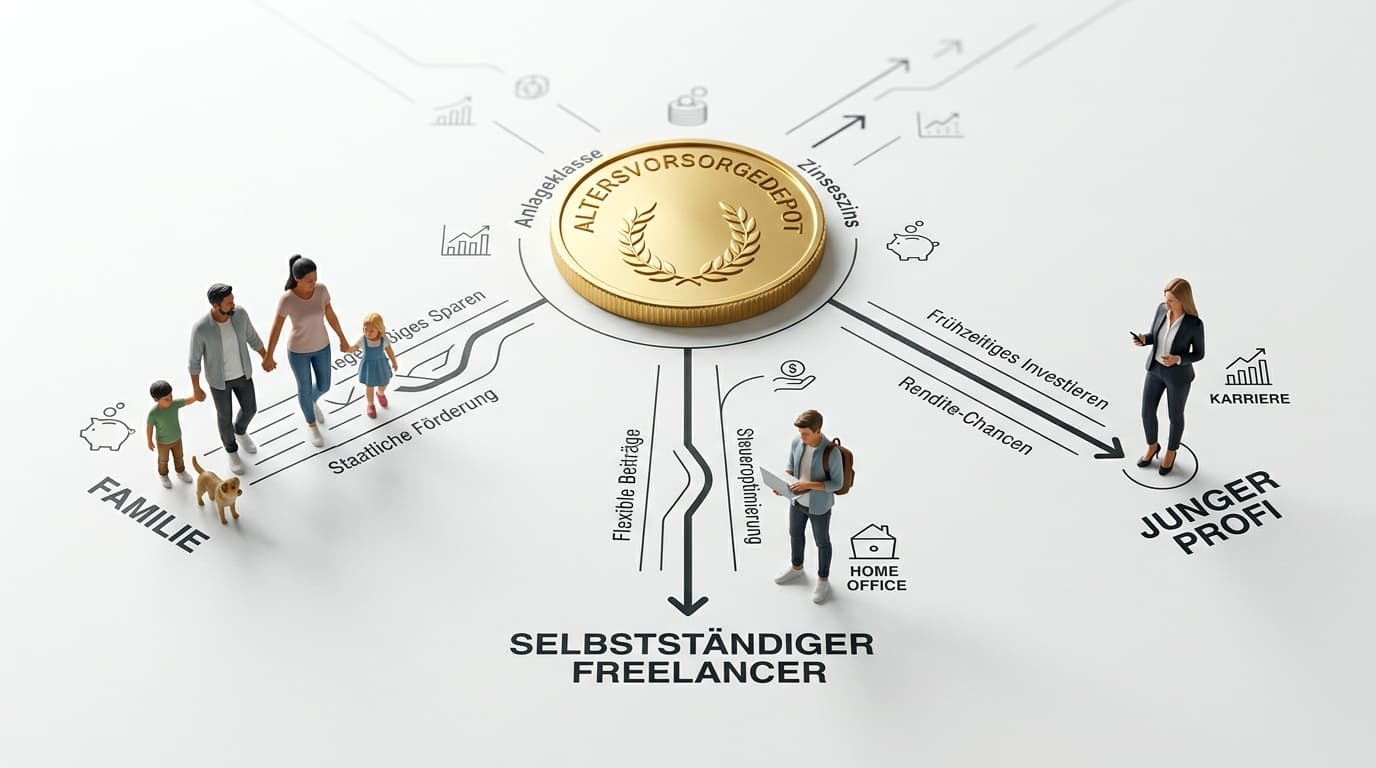
Is the AVD worth it for you?
A free, no-obligation conversation with an adviser from our independent network of 1,000+ vetted advisers.
The Altersvorsorgedepot from 2027: the new private provision at a glance
The state-subsidised Altersvorsorgedepot from 2027 makes particular sense for families with children, young career starters, higher earners, and, for the first time, the self-employed too. By deliberately dropping the rigid contribution guarantee, you can invest your savings directly in high-return ETFs and funds, making significantly higher long-term returns possible than with conventional Riester-Rente (Germany's existing subsidised private pension) contracts. This break from the old guarantee requirement means savers are no longer locked into low-interest bonds. As a neutral platform, we guide you along this path and prepare all the legal foundations for you, transparently and thoroughly, in the knowledge section.
Return focus without a guarantee requirement
The key change of approach lies in dropping the contribution guarantee, which often made earlier state-subsidised products unprofitable. Whereas providers used to be legally required to guarantee a hundred percent of contributions paid in, the new account model allows free allocation, right up to a pure equity allocation[1]. Your capital can therefore fully participate in long-term global economic growth and the compounding effect. With the subsidy calculator, you can compare and simulate the long-term effects of this reform on your personal provision situation even before the official start on 1 January 2027.
The state funding factors: how the allowances are calculated in detail
Private retirement provision in Germany is undergoing a fundamental reform of the funding system with the new Altersvorsorgedepot from 2027. In place of the previous Riester-Rente process, often seen as bureaucratic, the Federal Ministry of Finance is introducing a transparent matching system. Under it, the state allowances depend directly on your own contributions. The maximum annual Grundzulage will in future be 540 euros. To receive this full subsidy, an annual own contribution of 1,800 euros is required. The calculation is tiered and rewards even smaller savings amounts disproportionately strongly.
Tiered calculation of the Grundzulage
| Funding tier | Annual own contribution | State funding rate | Maximum allowance |
|---|---|---|---|
| First tier | The first 360 euros | 50 percent | 180 euros |
| Second tier | The next 1,440 euros | 25 percent | 360 euros |
| Overall total | 1,800 euros | Effectively 30 percent | 540 euros |
Alongside the Grundzulage, the reform provides for an attractive Kinderzulage. For every child entitled to Kindergeld, savers receive a state contribution of up to 300 euros a year, granted one-to-one (one euro of allowance per euro of own contribution)[2]. Young career starters under 25 also benefit from a one-off entry bonus of 200 euros, which further eases early wealth-building. Because income will no longer play any role in funding eligibility, this path is also fully open to the self-employed and higher earners.
For an exact calculation of your personal funding rate and remaining own contribution, using digital tools is worthwhile. With the subsidy calculator, you can interactively simulate different scenarios and calculate the long-term return trajectory. If you are unsure whether an independent account via the provider comparison or the route via independent advice service is more advantageous, our portal offers neutral guidance. Legal notice: not investment advice within the meaning of § 1 Abs. 1a Nr. 1a KWG.
Families and children: strong allowance leverage for parents
The new Altersvorsorgedepot offers a highly attractive state funding system, especially for families with children, which can significantly increase long-term returns. The key lever is the annual Kinderzulage of up to 300 euros per child, paid directly into your account as a state contribution[2]. Unlike the previous Riester-Rente system, this allowance is granted on a one-to-one basis against your own contributions. So if you pay in at least the corresponding own contribution, you receive the full state support for each child. With the subsidy calculator, you can easily calculate the exact allowances for your personal family situation. The subsidy is topped up by a tiered Grundzulage, made up of 50 percent on the first 360 euros and 25 percent on contributions above that.
| Household situation | Annual own contribution | State allowances (Grundzulage and Kinderzulage) | Allowance rate (funding lever) |
|---|---|---|---|
| Family with 1 child | 360 euros | 180 euros Grundzulage + 300 euros Kinderzulage = 480 euros | 133 percent |
| Family with 2 children | 600 euros | 240 euros Grundzulage + 600 euros Kinderzulage = 840 euros | 140 percent |
| Family with 3 children | 900 euros | 315 euros Grundzulage + 900 euros Kinderzulage = 1,215 euros | 135 percent |
These calculations impressively show how strongly the state lever works, especially for families with several children. A major advantage compared with the traditional Riester-Rente is the absence of rigid contribution guarantees and high insurance costs. Under the Altersvorsorgedepot, the allowances flow directly into high-return asset classes such as ETFs or equity portfolios. This lets families benefit substantially from the compounding effect over a long term through to retirement and build up stable wealth for the future. In our knowledge section, you will find further details and analysis on the tax treatment and the optimal fund selection for your family savings plan.
Note on the calculations: all figures, calculation examples and funding scenarios given are for demonstration purposes only; the enacted statutory provisions are authoritative. Not investment advice within the meaning of § 1 Abs. 1a Nr. 1a KWG.
Career starters and young savers: an early start with the entry bonus
For young savers and trainees, the new Altersvorsorgedepot offers a particularly attractive entry into long-term wealth-building from 2027. If you start private retirement provision early, you benefit from a longer accumulation phase and targeted state incentives. The Federal Ministry of Finance grants young savers under 25 a one-off Berufseinsteiger-Bonus (the career-starter bonus) of 200 euros, paid on top of the regular Grundzulage[2]. This financial contribution serves as a strong starting lever to fill the account early with state help and make optimal use of the compounding effect over decades.
- One-off bonus: an additional contribution of 200 euros for savers under 25 eases the initial contribution phase.
- Extremely long investment horizon: with a term often exceeding 40 years, interest and market returns can grow exponentially.
- High flexibility: in younger years, when income is irregular, the savings rate can be adjusted to match each life stage.
- High-return asset classes: dropping expensive contribution guarantees in the Altersvorsorgedepot allows full investment in high-return ETFs and equities.
A simple calculation example illustrates the long-term leverage effect for young career starters. If you pay in a modest monthly amount from age 20 and take the one-off bonus of 200 euros, the final capital at retirement can, thanks to the compounding effect, come out significantly higher than if you start saving at 35. To determine your individual entitlements and the expected state subsidy precisely, our neutral subsidy calculator is available to you. With this tool, you can easily compare the subsidised account variant with unsubsidised savings plans. Please note our legal disclaimer here: these calculations are for illustration only and do not constitute investment advice within the meaning of § 1 Abs. 1a Nr. 1a KWG.
Why the compounding effect works especially well for young savers
In financial mathematics, time is considered the most important factor for wealth growth. Because career starters typically still have several decades until the statutory retirement age, short-term market fluctuations can easily be ridden out. The state subsidy through the Grundzulage and the Berufseinsteiger-Bonus flows straight back into the chosen investment products within the Altersvorsorgedepot, so the compounding effect reinforces itself year after year. For young people who do not want to rely solely on the statutory pension, the subsidised account therefore represents a highly efficient foundation.
Higher earners and taxpayers: maximising the tax benefits
For taxpayers with a higher income, the Altersvorsorgedepot offers an attractive tax perspective from 2027. While families benefit chiefly from the direct state allowances, for higher earners the tax relief takes centre stage. Your own contributions can be claimed as special expenses in your income tax return up to a maximum of 1,800 euros a year[3]. As part of the income tax assessment, the responsible tax office automatically checks, through what is known as the Günstigerprüfung (more-favourable-treatment test), whether the tax deduction or the direct allowance funding is more advantageous for the taxpayer.
- Sonderausgabenabzug (deduction as a special expense): contributions to the Altersvorsorgedepot are tax-deductible up to an annual limit of 1,800 euros and directly reduce taxable income.
- Automatic Günstigerprüfung: the tax office independently calculates whether the tax relief via the Sonderausgabenabzug exceeds the value of the state Grundzulage.
- Netting the benefits: if the tax benefit is higher than the allowance, the difference is credited as an additional tax refund, so higher earners make full use of the maximum state subsidy.
At a personal marginal tax rate of, say, 42 percent, the Sonderausgabenabzug of 1,800 euros produces noticeable tax relief that considerably improves the account's profitability compared with an unsubsidised securities savings plan[5]. Because the accumulation phase is tax-free (dividends and capital gains within the account are therefore not taxed directly), a substantial tax-deferral effect results. Taxation only applies in the payout phase in old age, when the personal tax rate is typically lower than during active working life.
This tax-optimised foundation makes the Altersvorsorgedepot a valuable building block for higher earners who want to structure their retirement provision cost-efficiently. To calculate precisely the concrete tax relief and future final capital for your personal income situation, the subsidy calculator is available to you. The tool calculates the individual delta compared with an unsubsidised investment and helps you make an informed decision for your private retirement provision. For more complex tax questions or structured guidance, you can also use our independent advice service to get in touch with a qualified advisory partner.
Please note: all tax and mathematical calculations are purely illustrative and do not constitute tax or investment advice (not investment advice within the meaning of § 1 Abs. 1a Nr. 1a KWG).
The self-employed and freelancers: fully eligible for the first time
For the self-employed and freelancers, 2027 marks a historic turning point in state-subsidised private retirement provision. Whereas this group mostly missed out under the classic Riester-Rente, unless they were subject to compulsory insurance or eligible through a spouse, from 2027 all self-employed people and freelancers are directly eligible for the subsidy[6]. This new rule gives you full access to the state allowances and tax subsidy via the new Altersvorsorgedepot. In the knowledge section, we accompany this transition with source-based analysis.
The reform is particularly attractive because of its flexible contribution structure, which suits the irregular income patterns of many freelancers. Because contribution payments can be adjusted flexibly, provision can be matched precisely to your business's current liquidity. To see how fluctuating contributions affect your state subsidy, it is worth taking a look at the interactive subsidy calculator.
- Full state allowances: receiving the Grundzulage and, where applicable, the Kinderzulage, without needing compulsory insurance under the statutory pension insurance.
- Attractive tax benefits: contributions can be claimed directly for tax purposes under the Sonderausgabenabzug, noticeably reducing the tax burden in the relevant year.
- Flexibility with fluctuating income: contributions can be increased in economically strong periods and reduced or paused during weaker revenue periods.
- Protection from seizure during the accumulation phase: under BMF guidelines, capital saved in the Altersvorsorgedepot enjoys extensive protection against seizure and means-testing in situations of financial hardship.
With this reform, the often-criticised disadvantage faced by business founders and established self-employed people compared with employees falls away. The Altersvorsorgedepot therefore gives you a highly flexible, high-return, state-subsidised instrument for building a private pillar for your retirement. Please note: all calculations and illustrations on this platform are for general information and orientation. Not investment advice within the meaning of § 1 Abs. 1a Nr. 1a KWG.
Existing Riester-Rente savers: should you switch or wait?
Millions of savers in Germany currently hold a Riester-Rente contract, which, because of the statutory contribution guarantee, often generates only meagre returns, since providers have to invest the capital in low-risk bonds. From 2027, a legally regulated route opens up to escape this return trap: you can transfer your accumulated Riester-Rente capital tax-free into a new Altersvorsorgedepot and so invest it directly in high-return ETFs[2]. With this transfer, however, the old contract's nominal contribution guarantee lapses, which is why the step needs to be weighed carefully.
| Criterion | Classic Riester-Rente contract | New Altersvorsorgedepot |
|---|---|---|
| Contribution guarantee | 100 percent statutory contribution guarantee | No statutory minimum guarantee required |
| Return potential | Low, due to the high allocation to bonds | Very high, due to flexible ETF and equity investment |
| Cost structure | Often high set-up and administration costs | Typically very low account fees |
| Inheritability | Only inheritable without losing subsidy eligibility under strict conditions | Simple and flexible to inherit |
| Payout phase | A lifelong annuity is mandatory | Flexible drawdown plans possible |
Whether switching makes sense for you depends critically on how many years you have left until retirement and your appetite for risk. Young savers with more than ten or fifteen years of saving time ahead of them typically benefit strongly from switching, since the long-term return potential in equity markets usually clearly outweighs the risk of missing guarantees. If you are already close to retirement, on the other hand, keeping the old contract to protect your capital may be advisable. Use the subsidy calculator on our portal to get an initial, well-founded indication for your personal situation and the potential growth in your wealth.
Because existing Riester-Rente contracts are highly individual, switching fees from the old provider can sometimes be high, and tax details play a role, you should not make hasty decisions. If you are unsure or want a professional analysis of your existing contract, the independent advice service is there for you. We connect you with licensed experts who review your existing contract neutrally, analyse the switching costs, and work with you to determine the optimal path for your retirement provision.
Who does the account not make sense for? Limitations and cautious profiles
Although the new Altersvorsorgedepot promises attractive state allowances from its 2027 launch, it is by no means equally suited to every type of saver. As a neutral guide providing source-based information on the Vorsorgedepot-Lotse portal, we lay out the limitations transparently. The enacted reform deliberately drops the contribution guarantee for the state Standarddepot (the statutory default account), in order to allow a high-return investment in the equity market. This also means, however, an uncapped price risk that does not suit every personal need for security or every life situation.
A critical review is particularly advisable for age groups close to retirement, with less than ten years remaining until retirement. Because the subsidised investment is mostly in equity funds, short-term market fluctuations pose a risk that older savers simply lack the time to offset. In addition, the compounding effect barely has time to take hold over short terms, while the annual effective costs can weigh disproportionately on the accumulated capital[7]. For this group, continuing an existing, classic Riester-Rente contract with a guarantee commitment can be the safer option.
Very risk-averse investors who want absolute capital security and to rule out fluctuations in value should also be cautious. Anyone who feels uneasy when share prices fall will not find the security they want in a Standarddepot without guarantees. In our knowledge section, we show that guarantee contracts are possible, but that these reduce return potential through higher fees. You can use our neutral provider comparison tool to filter specifically for providers with contribution guarantees and make an informed decision.
| Saver type | Challenge from 2027 | Recommended strategy |
|---|---|---|
| Savers close to retirement (under 10 years to retirement) | Too short a term to offset equity market fluctuations. | Review existing Riester-Rente contracts with guarantees or choose conservative investments. |
| Very risk-averse investors | No statutory contribution guarantee in the subsidised Standarddepot. | Compare guarantee options or seek personal advice. |
Frequently asked questions
- From when can you open an Altersvorsorgedepot?
- Financial firms can officially offer the new Altersvorsorgedepot from 1 January 2027. That is when the reform of private retirement provision passed by the Bundestag and promulgated in May 2026 takes effect.
- How much is the state subsidy for the Altersvorsorgedepot?
- The state subsidy has two parts: you receive up to 540 euros a year in Grundzulage. This is made up of a 50 percent contribution on the first 360 euros of your own contribution and 25 percent on further payments up to 1,800 euros.
- Does the Altersvorsorgedepot make sense for families with children?
- Yes, the Altersvorsorgedepot is particularly attractive for families. On top of the Grundzulage, you receive an annual Kinderzulage of 300 euros per child, which sharply increases the effective funding rate on your own contributions.
- Is there a bonus for young career starters?
- Yes, savers who take out a retirement provision contract before their 25th birthday receive a one-off Berufseinsteiger-Bonus of 200 euros credited directly to their Altersvorsorgedepot.
- Are the self-employed and freelancers eligible for the subsidy on the account?
- Yes, with the reform from 2027, the self-employed and freelancers also become generally and directly eligible for the subsidy. They can therefore make full use of the state subsidy and the tax benefits of the Altersvorsorgedepot.
- What happens to an existing Riester-Rente contract?
- Existing Riester-Rente contracts do not have to be cancelled. From 2027, you can check whether suspending contributions or a transfer of the accumulated balance into the new Altersvorsorgedepot is worthwhile for you; in the first five years, switching costs may amount to at most 150 euros, after which switching is free of charge.
Sources
- [1]justetf.com
- [2]bundesfinanzministerium.de
- [3]union-investment.de
- [4]bundesfinanzministerium.de
- [5]perfinex.de
- [6]versicherungsmakler.ac
- [7]verbraucherzentrale.de
- []Vorsorgedepot-Lotse – understand, calculate and decide on the Altersvorsorgedepot
- []Altersvorsorgedepot subsidy calculator
- []Altersvorsorgedepot guides
Is the AVD worth it for you?
We'll help you find out whether the Altersvorsorgedepot fits your situation.
Free and without obligation. Advice from an adviser in our independent network of 1,000+ vetted advisers.