What documents do I need to open an Altersvorsorgedepot?

Published on · Updated on · Managing Director & Partner, Alsterspree Verlag GmbH
This article was written by an author with the support of AI.
Ready to open your AVD?
A free, no-obligation conversation with an adviser from our independent network of 1,000+ vetted advisers.
Opening an AVD at a glance: why preparation saves time and money
The nationwide launch of the new Altersvorsorgedepot on 1 January 2027 is expected to trigger enormous demand, as millions of savers in Germany want to take advantage of the state-subsidised ETF investment[1]. Given this rush, temporary system overloads at neobrokers and banks, along with delays at verification providers, are to be expected. If you prepare early as a self-directed investor and have the necessary documents ready, you avoid these bottlenecks and ensure swift identity verification.
A prompt start secures valuable financial advantages, since you participate in the capital market from the outset and avoid subsidy gaps. Every delay in activation means missed compound-interest effects and a later claim on the state allowances. For optimal preparation and guidance, the knowledge section is available to you as a neutral, source-based resource. With the guides provided there, you can plan your account-opening process precisely and avoid unnecessary hurdles.
| Document | Purpose when opening the account |
|---|---|
| Valid ID card or passport | Mandatory for the legally required identity verification via VideoIdent or PostIdent. |
| Tax identification number (tax ID) | The most important detail for the automated, error-free claiming of state allowances. |
| German bank account (IBAN) | Provided for collecting savings contributions, setting up savings plans and future payouts. |
| Social security number | Depending on your individual employment status, used to prove compulsory statutory pension insurance. |
| Children's details (date of birth) | Required for correctly claiming the state child allowance, if you're entitled to it. |
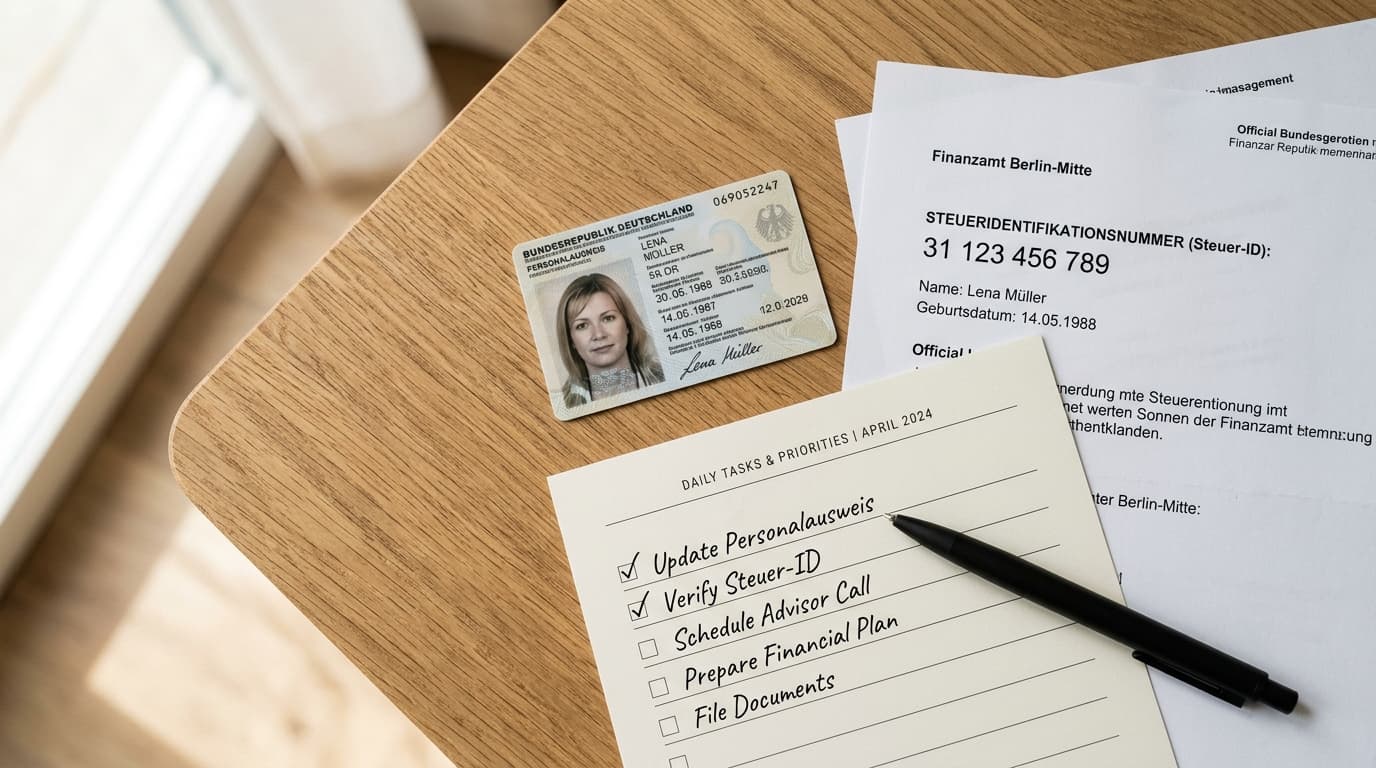
The tax identification number in particular is often overlooked in everyday life when opening an account, even though it's essential for the state subsidy. Without the correct tax ID, the provider cannot forward your data to the central office, which significantly delays the crediting of allowances. It's best to have these documents ready before the official start date to ensure a smooth opening of your Altersvorsorgedepot.
The mandatory identification document: ID card or passport
Anyone wanting to open a state-subsidised Altersvorsorgedepot in Germany cannot avoid the legally required identity check under the Geldwäschegesetz (anti-money-laundering act). You must provide a valid official identity document for this. The easiest way is with a German ID card, since it already contains your current residential address. If you use a passport instead, the address is missing. In that case, providers additionally require a current certificate of registration (Meldebescheinigung), usually no older than three months, to prove your residence beyond doubt.
| Document | Purpose | Key requirement |
|---|---|---|
| ID card | Proof of identity and home address | Must be valid and undamaged (front and back) |
| Passport | Identity proof only | Requires a supplementary certificate of registration to verify your address |
| Certificate of registration | Official proof of your current residence | Required if using a passport, usually no more than three months old |
Modern, time-saving ways to complete verification are available to you today. In the widely used VideoIdent procedure, you take a short video call via your smartphone or webcam, holding your ID document up to the camera and showing security features such as holograms[2]. If you prefer the traditional route, you can use the PostIdent procedure. Here, you verify your identity either directly at a Deutsche Post branch or digitally using the online ID function (eID) of your ID card via the corresponding app[3].
It's best to prepare these documents before opening the account, to avoid unnecessary delays. Our knowledge section contains further practical guides on how to complete the entire opening process without errors. Please note that all information in this guide is purely informational and does not constitute investment advice or legal advice.
The checklist at a glance: which document serves which purpose?
Anyone taking the opening of an Altersvorsorgedepot into their own hands benefits from streamlined digital processes. To open the account, you essentially need a valid identity document, your tax identification number (tax ID), a bank account (IBAN) and, where applicable, your social security number and details of your children[4]. To ensure the setup of your subsidised account goes smoothly, you should have this data ready in advance, since the tax ID in particular is mandatory for claiming the state allowance. Incomplete data submission can mean state subsidies don't flow, or have to be laboriously applied for afterwards. So use our structured overview as a practical guide to systematically prepare all the required documents.
| Document or detail | Purpose in the opening process | Special note for savers |
|---|---|---|
| Valid ID card or passport | Legally required identity check via VideoIdent or PostIdent | Check the remaining validity of the document. |
| Tax identification number | Mandatory for automated claiming of allowances and tax allocation | Most commonly forgotten during the opening process, delaying the state subsidy. |
| Bank account | Setting up savings plans and processing future payments in or out | This generally needs to be a SEPA account in your own name. |
| Social security number | Proof of subsidy status for compulsorily insured people and data matching with the pension insurance fund | Found on your social security card or your annual pension information statement. |
| Children's details | Applying for and allocating the state child allowance | Important for families to make the most of the subsidy in the Altersvorsorgedepot. |
| Income details | Determining the optimal own contribution and proof for the self-employed | The self-employed should additionally have income proof or their latest tax assessment ready. |
Once you have all the necessary documents together, nothing stands in the way of comparing the available account providers. Since the cost structures and ETF portfolio offerings of neobrokers can differ significantly, a systematic look at the market is worthwhile. Our digital provider comparison helps you find the provider that fits your personal investment strategy. For further details and in-depth analysis of the legal rules, our knowledge section is a reliable resource. You can also use the subsidy calculator in advance to calculate how the state allowances will affect your future pension assets, before starting the opening process.
The 11-digit tax identification number: the key to the state allowance
When systematically preparing to open an Altersvorsorgedepot, one detail is especially often forgotten, even though it's essential for the success of the entire state subsidy: your personal, 11-digit tax identification number (tax ID). This identifier serves as the unmistakable link between your private account and the state authorities in the state-coordinated allowance procedure. Without the tax ID, the Zentrale Zulagenstelle für Altersvermögen (ZfA, the central allowance office) cannot correctly assign your pension contributions or your allowance entitlements. As a result, an automated crediting of the annual basic allowance or any child allowance to your account becomes technically impossible. We explicitly point out that the legislature makes providing this number mandatory for smooth claiming of allowances.
| Document / step | Purpose and significance | Where to find it as a self-directed investor |
|---|---|---|
| Tax identification number | Mandatory for the automated claiming of state allowances via the ZfA. | Income tax assessment, wage tax statement, or information letter from the Bundeszentralamt für Steuern. |
| Checking allowance entitlement | Determining the exact subsidy amount based on individual prior-year income. | Use the digital subsidy calculator for this. |
Providing institutions such as banks or neobrokers are subject to strict statutory reporting duties and must transmit the data electronically. They are required to report the contractual payments made each calendar year directly to the ZfA, so that the relevant top-ups, such as the maximum basic allowance of up to 540 euros, can be correctly calculated and credited. For this official communication, your tax ID is the legally anchored key identifier. If you don't have the 11-digit number to hand, it can be found easily: it's shown on every income tax assessment in the upper left area, as well as on your employer's annual wage tax statement. Our knowledge section offers further independent guidance and neutral instructions to help self-directed investors navigate the digital opening process transparently[5].
The social security number: proof of subsidy entitlement for employees
If you're an employee wanting to set up a state-subsidised Altersvorsorgedepot, your social security number forms the crucial link to the statutory pension insurance. Your future account provider needs this personal identifier to electronically match your direct subsidy entitlement fully automatically via the Zentrale Zulagenstelle für Altersvermögen (ZfA). Without this detail, your status cannot be checked, which blocks the crediting of state allowances. Our knowledge section provides comprehensive guides that illustrate this exact account-opening process step by step.
The difference between a tax ID and a social security number
In practice, many savers confuse the personal tax identification number with the classic social security number, often also called the pension insurance number. However, the two identifiers serve entirely different purposes. While the tax ID is primarily needed for tax registration, claiming allowances and reporting contribution data to the relevant tax office, the social security number serves as proof of your active compulsory pension insurance[6]. It therefore documents in black and white that as an employee you have a direct entitlement to the state subsidy.
| Identifier | Responsible authority | Main function in the Altersvorsorgedepot |
|---|---|---|
| Tax identification number (tax ID) | Bundeszentralamt für Steuern | Enables the claiming of allowances and tax treatment at the tax office. |
| Social security number (pension insurance number) | Deutsche Rentenversicherung | Used to match contribution data to verify direct subsidy entitlement. |
For all compulsorily insured employees, this automated matching of contribution data is the absolute prerequisite for receiving state support. The provider forwards your data collectively to the relevant allowance office, which in turn checks in the background whether compulsory contributions were actually paid into the statutory pension fund in the relevant contribution year. If you're unsure about your exact subsidy amount or the optimal own contribution, our digital subsidy calculator helps you calculate your individual state subsidy precisely in just a few clicks.
Children's details: how to secure the lucrative child allowances
For families, the state subsidy is one of the most attractive aspects of private pension provision. With the new Altersvorsorgedepot, parents secure substantial financial support for their children on top of the basic allowance: up to 300 euros in state child allowance flows into your account each year per child, provided you make the required own contribution. To claim these lucrative bonus payments correctly from the very first day the account is opened, you need to provide the chosen provider with the relevant details of your children. With well-structured document preparation, you avoid later bureaucratic delays or even the unintended loss of state subsidy money in the automatic annual allowance process.
| Required detail | Purpose | Important for claiming the allowance |
|---|---|---|
| Child's tax identification number | Unique identification of the child at the Bundeszentralamt für Steuern | Mandatory for the automated application procedure |
| Child's date of birth | Checking the age limits and general subsidy entitlement | Determines the duration of the entitlement to child allowance |
| Kindergeld reference number | Additional proof of the existing entitlement to Kindergeld | Ensures error-free communication with the relevant Familienkasse |
The allowance is claimed fully automatically through a direct data exchange between your account provider, the Zentrale Zulagenstelle für Altersvermögen and the relevant Familienkasse[5]. One of the most commonly forgotten documents when opening an account is the child's tax ID, the absence of which can block the whole process. For married parents, also pay attention to the statutory allocation of the allowance: by default, the allowance is allocated to the mother, but it can be transferred to the father's account on a joint application from the parents. You can use our subsidy calculator to work out the exact mathematical effects of the allowance allocation on your personal savings rate and expected final capital in detail. We explicitly note that these model calculations are purely illustrative and do not constitute investment advice within the meaning of the law.
Special considerations for the self-employed: proof of income and minimum own contribution
With the reform of private pension provision from 2027, self-employed people and freelancers in Germany become directly entitled to the state-subsidised Altersvorsorgedepot for the first time[7]. Since this group has no automatic electronic transmission of salary data by an employer, you as a self-employed person must provide the relevant proof yourself. These documents are essential to prove your subsidy entitlement and set the optimal level of your own payments. For a detailed advance calculation of your allowances, you can use the subsidy calculator.
Income tax assessment and determining the minimum own contribution
Unlike with the Riester-Rente, there is no longer an income-dependent minimum own contribution for the Altersvorsorgedepot: the state allowances are based solely on your own payments of up to 1,800 euros a year.[9] Your most recent income tax assessment from the tax office nevertheless remains important for the self-employed, as it legally documents income from self-employment or a trade and thus evidences your subsidy entitlement and the basis for the special-expense deduction as part of the best-outcome check.[8] If this proof is missing when opening the account or during a contribution check, this can lead to delays or, in the worst case, the loss of state top-ups.
| Proof / criterion | Employees | Self-employed / freelancers |
|---|---|---|
| Data transmission | Automatic and electronic via the employer | Manual submission by the account holder |
| Primary proof of income | December payslip or annual earnings notification | Latest legally binding income tax assessment |
| Basis for calculation | Current gross salary from the previous year | Income from self-employment or a trade |
Dealing with fluctuating income
Fluctuating income presents a particular challenge for the self-employed. Since the final income tax assessment is often issued with a considerable delay, the most recent available tax assessment always applies for the contribution calculation. If your income changes drastically during the year, it's advisable to flexibly adjust your monthly payments or your annual lump sum. This way you make sure you neither tie up too much liquidity nor fall short of the state subsidy through too low an own contribution. Further well-founded details on the regulatory framework are available on the knowledge section.
Transferring an old contract: documents needed by Riester switchers
If you want to transfer an existing Riester balance into a new Altersvorsorgedepot tax-free and without losing the state allowances already received, this is generally possible from 2027[5]. For self-directed investors who want to complete this switch independently, structured preparation is the decisive lever for a smooth process. The new provider needs precise information about your old contract to process the transfer. Once you've opened the new account, the new provider initiates the transfer process directly with your previous provider. This means you generally don't need to draft complicated termination letters yourself. To speed up this process, you should have the relevant documents from your old contract ready in advance.
Before initiating the switch, a precise calculation is advisable. Through the knowledge section, you can inform yourself thoroughly, while our subsidy calculator helps you work out the long-term effect of a switch mathematically. For the actual technical processing of the transfer, you primarily need to have data from your last annual Riester account statement or the original contract confirmation ready. Key information includes the exact Riester contract number as well as the full address and provider identifier of the previous institution.
| Required detail or document | What it's needed for | Where to find this information |
|---|---|---|
| Riester contract number | Unique allocation of the existing balance at the previous provider for the tax-free transfer | Annual account statement or original contract confirmation |
| Address of the previous provider | Addressing the official transfer application by the new account provider | Contract documents or the previous provider's legal notice page |
| Tax identification number (tax ID) | Mandatory for allocating the account and seamless claiming of allowances | Income tax assessment or notification from the Bundeszentralamt für Steuern |
| Social security number | Proof of subsidy status and verification of allowance entitlement at the allowance office | Social security card or payslip |
Once you've completed the account opening and filled in the transfer form, communication runs directly between the two providers. Statutory deadlines ensure the process isn't unnecessarily delayed. The legislature requires the previous provider to complete the transfer within a set deadline. In addition, a statutory fee cap protects those wanting to switch from disproportionately high switching costs charged by the previous provider, further securing the financial appeal of the move. Please note in all comparisons that these calculations and figures are illustrative and do not constitute individual investment advice within the meaning of § 1 Abs. 1a Nr. 1a KWG.
Frequently asked questions
- Which documents are needed simply to open the Altersvorsorgedepot?
- For the basic account opening, you need a valid identity document (ID card or passport) for identity verification, as well as a German current account (IBAN) for contribution payments. At neobrokers or banks, identity is usually verified quickly and digitally via VideoIdent or the eID function. PostIdent at a post office branch is also possible.
- Why is the tax ID so important for the Altersvorsorgedepot?
- The tax identification number (tax ID) is a lifelong, 11-digit number. It's legally mandatory for the Altersvorsorgedepot so your provider can transmit your contribution data to the Zentrale Zulagenstelle für Altersvermögen (ZfA). Without the tax ID, the state allowances and the special-expense tax deduction cannot be processed.
- Where can I find my tax identification number?
- Your tax ID is shown on your latest income tax assessment, on your employer's annual wage tax statement, or on the information letter you received from the Bundeszentralamt für Steuern (BZSt). If you can't find it, you can request a new copy of the tax ID online from the BZSt.
- What additional details are needed for the child allowance?
- If you're entitled to the state child allowance for your Altersvorsorgedepot, you need to provide the tax identification number and date of birth for each child. The allowance office matches this data with the Familienkasse to make sure Kindergeld is still being paid for the child in question.
- What documents do the self-employed need for the Altersvorsorgedepot?
- Self-employed people and freelancers who become entitled to the subsidy from 2027 usually need their most recent income tax assessment alongside their ID and tax ID. This serves as proof of your self-employed activity and your income, for example for the special-expense deduction; the level of the state allowances in the new account depends solely on your own payments.
- What do I need if I want to transfer an old Riester contract?
- To switch an existing Riester contract into the new Altersvorsorgedepot, you need the old account's contract number as well as the name and address of the previous provider. You enter these details in the transfer application, which you submit to your new account provider.
Sources
Ready to open your AVD?
Opening an account is easier than you think. We'll guide you through the process.
Free and without obligation. Advice from an adviser in our independent network of 1,000+ vetted advisers.