What is the Standarddepot? Structure, costs and subsidy

Published on · Managing Director & Partner, Alsterspree Verlag GmbH
This article was written by an author with the support of AI.
Request a free consultation
A free, no-obligation conversation with an adviser from our independent network of 1,000+ vetted advisers.
Definition and purpose of the Standarddepot
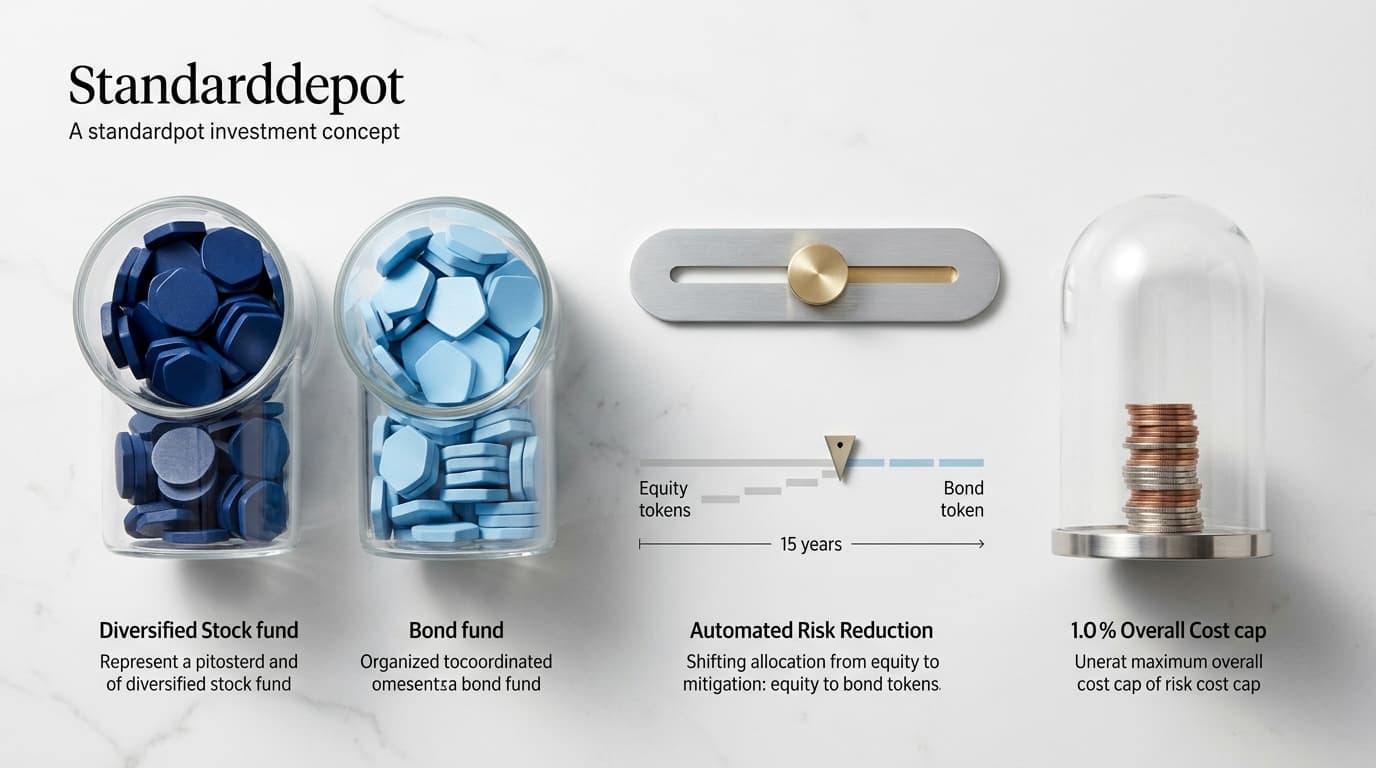
The Standarddepot is the statutorily defined base variant of the Altersvorsorgedepot, newly introduced as part of the private pension reform. As a ready-made "no-decision product", it is designed to give people simple, low-threshold access to return-oriented capital investment without prior knowledge, from January 2027. The relevant provider selects exactly two investment funds in advance: a return-oriented portfolio with a higher equity allocation for long-term wealth building, and a lower-risk portfolio with reduced growth potential for protection[1]. These defaults make things especially easy for investors, since they do not have to make any complex fund or ETF selections themselves.
The no-decision product principle
Many savers in Germany feel lost when it comes to financial decisions and shy away from choosing shares, ETFs or funds themselves. The Standarddepot addresses this barrier as a genuine no-decision product: once you sign a contract, the entire investment runs fully automatically during the accumulation phase, according to statutorily regulated rules. The concept fully relieves investors of the need to build their own portfolios, rebalance, or manage risk themselves, while still leaving room for individual adjustments if you want to deviate from the standard settings.
- Guided two-fund selection: By default, investors pay into two investment funds chosen by the provider, each with a different risk profile.
- Automatic maturity protection: In the years before retirement, the provider gradually and automatically shifts the capital into the lower-risk fund.
- Full state subsidy: The Standarddepot benefits from state allowances and tax advantages to the same extent as a freely configured Altersvorsorgedepot.
Compared with the conventional pension contracts of the past, the Standarddepot is built on transparency and reliability. Where previous Riester products (part of Germany's existing subsidised private pension scheme) often ate up a large share of returns through opaque cost structures and expensive contribution guarantees, the Standarddepot captures market opportunities without a costly guarantee requirement. By combining a cost cap, an automatic lifecycle model and full state allowance support, it closes the gap between the overwhelming self-direction of a neobroker and complex financial advice.
The statutory 1.0 percent cost cap
A major weakness of the classic Riester-Rente lay in opaque cost structures that ate up substantial parts of the state subsidy. With the reform of subsidised private pensions, the legislator is introducing a statutory ceiling for the Standarddepot: the average annual reduction in return caused by costs, known as effective costs, is capped at a maximum of 1.0 percent for standard-product contracts.[2] We look at how this cap is made up and what it means for your net return.
What does the effective-cost cap under the Federal Ministry of Finance (BMF) rules mean?
Effective costs (reduction in yield, RIY) bring together every type of cost in a pension contract into a single percentage figure. Under the Federal Ministry of Finance's rules, this figure includes both the provider's account management fees and the ongoing administration and product costs of the underlying investment funds. A ceiling of 1.0 percent ensures that fees cannot reduce your gross return, before costs, by more than one percentage point per year. This gives the statutory rules noticeably more transparency than the previous Riester cost structures, where set-up and administration costs often amounted to more than 1.5 to 2.5 percent of the contribution or asset total. You can find detailed information on individual fee types in our overview of costs within the Altersvorsorgedepot.
- Statutory cap: Effective costs in the Standarddepot are capped by law at no more than 1.0 percent per year.
- Comprehensive scope: The calculation fully includes account fees, distribution costs and ongoing fund costs (TER).
- Higher net return: Thanks to the reduced cost burden, a larger share of the compound-interest effect and the state allowances remains in your savings.
Thanks to this clear cap, the Standarddepot protects investors from carelessly chosen contracts with high distribution mark-ups. That said, it is still worth looking at freely configurable Altersvorsorgedepots: choosing broadly diversified ETFs with total expense ratios of around 0.15 to 0.20 percent can sometimes push the overall cost burden even lower. (This does not constitute investment advice within the meaning of § 1 Abs. 1a Nr. 1a KWG.)
How it works: the two-fund investment concept
The Standarddepot relies on a clear, predefined two-fund investment concept that removes all the effort of product selection from investors. Unlike the freely configurable Altersvorsorgedepot, you do not choose the asset classes yourself here, but instead use a structure set by the relevant provider. The system combines two basic building blocks to link return opportunities on the capital markets with targeted risk reduction.
The two components at a glance
- Growth-oriented building block: This fund invests predominantly in higher-return securities such as global equity funds. It drives performance in the early phase of wealth building and taps into the long-term growth of global financial markets.
- Low-risk building block: This fund relies on low-risk financial instruments such as high-credit-quality government bonds or money market funds. It primarily serves to preserve value and protects the assets from sharper market swings.
The interplay between the two building blocks follows an automated logic: in your younger years and at the start of the accumulation phase, most contributions flow into the growth-oriented fund. As you get older and approach retirement, the provider gradually shifts the capital into the low-risk fund[3]. This statutorily anchored maturity management locks in gains reached towards the end of the term, without you having to take any action yourself. If you want to deviate from this default, you can adjust the split individually with your provider. We look at how the statutory cost rules affect net returns in our knowledge section.
By capping effective costs at a maximum of 1.0 percent per year, this standard product offers transparency and planning certainty for all savers. Anyone who would rather put together suitable ETFs independently will find neutral comparisons of all available options on our portal. Please note: model calculations and figures are for illustration only and do not constitute investment advice within the meaning of § 1 Abs. 1a Nr. 1a KWG.
Automatic risk reduction through the lifecycle model
With the Standarddepot, you do not need to make your own investment decisions during the accumulation phase, since the system relies on a predefined two-tier fund concept. The relevant provider selects exactly two investment funds in advance: a return-oriented portfolio with a higher equity allocation for long-term wealth building, and a lower-risk portfolio with reduced growth potential to avoid losses[4]. This removes the need for investors to select suitable ETFs themselves or carry out regular rebalancing.
How risk adjustment works in the lifecycle model
- Gradual reallocation of the capital pool: In the contractually defined years before the transition into retirement, the provider gradually moves the balance into the lower-risk fund.
- Protection against market volatility: Systematic lifecycling protects the retirement assets built up over decades from abrupt price slumps on the financial markets immediately before the payout phase.
- Individual right to object: If you want to keep the capital you have saved in the growth-oriented fund for longer, you can object to the automatic reallocation with your provider at any time.
The statutorily anchored lifecycle model thus offers reliable guidance for all savers who want to benefit from the capital markets' return potential without constantly watching the markets. We see this automatic mechanism as a key protective feature, since it reduces the typical decision uncertainty in the final working years. Even so, your freedom to control your own finances remains fully intact thanks to the statutory opt-out option.
State subsidy in the Standarddepot
Exactly the same statutory subsidy rules apply to the Standarddepot as to freely configured Altersvorsorgedepots. Choosing the pre-configured base variant, with its statutorily anchored cost cap of 1.0 percent in effective costs, involves no reduction whatsoever in state allowances or tax benefits. Anyone who chooses this simplified investment concept still receives the full subsidy entitlement under the private pension reform[5]. The comprehensive Altersvorsorgedepot framework anchors the legislator's guarantee of strict equal treatment for all account types certified under the Altersvorsorgereformgesetz (the pension reform act).
The subsidy structure in the Standarddepot
The financial subsidy in the Standarddepot is made up of direct state allowances and two key tax advantages. This subsidy structure fits together seamlessly to support your long-term wealth building without extra administrative effort. We have summarised the key elements of the subsidy for you below.
- Grundzulage and Kinderzulagen (the basic allowance and child allowances): You receive a state Grundzulage (the basic state allowance) on your own savings contributions. In addition, the state grants a specific Kinderzulage (the child allowance) for every child entitled to Kindergeld, which is credited directly to your Standarddepot as investment capital and benefits from the compound-interest effect.
- Tax-deferral effect during the accumulation phase: All investment income, dividends and capital gains remain tax-free within the account during the accumulation phase. The gradual shifts into lower-risk investments before retirement that are built into the Standarddepot do not trigger capital gains tax (Abgeltungsteuer) either.
- Deferred taxation: Returns and subsidised contributions are only taxed in the payout phase in retirement. Because your personal income tax rate in retirement is usually lower than during your working life, this produces a noticeable net tax advantage.
The Standarddepot thus combines full state subsidy support with a strictly regulated fee structure. If you want to calculate exact subsidy amounts for your personal family situation, the subsidy calculator offers source-based guidance. Note: this does not constitute investment advice within the meaning of § 1 Abs. 1a Nr. 1a KWG.
Difference between the Standarddepot and the free Altersvorsorgedepot
The state-subsidised Altersvorsorgedepot is available to savers in two basic product variants: as a pre-configured Standarddepot or as a freely configurable Altersvorsorgedepot. While the Standarddepot is designed for investors who want to benefit from the state subsidy without making their own financial decisions, the free account offers full flexibility in putting together a portfolio. Both variants use the same tax subsidy logic and allowance structure, but differ substantially in fund selection, lifecycle management and cost structure.
Investment selection, cost cap and lifecycle compared
| Criterion | Standarddepot | Free Altersvorsorgedepot |
|---|---|---|
| Investment structure | Two investment funds set by the provider (growth-oriented and low-risk) | Individual ETF selection from the statutory approved list |
| Statutory cost cap | Maximum 1.0% p.a. effective costs | No statutory cap (market-standard competitive pricing) |
| Risk management | Automatic maturity management before retirement | Self-directed rebalancing and reallocation |
| Decision-making required | One-off selection, no ongoing adjustments needed afterwards | Continuous monitoring of portfolio allocation |
At its core, the choice between the two options comes down to your personal need for control versus convenience. The Standarddepot protects newcomers from poor decisions through the statutory cost ceiling of 1.0 percent in effective costs and automatic maturity management. Anyone who brings capital-market experience, on the other hand, will find that the free Altersvorsorgedepot offers the option to put together a broadly diversified world portfolio of low-cost ETFs independently. Both paths lead to the full state subsidy, which is why the decision depends primarily on your existing knowledge and the level of administrative effort you want.
Transparency note: all figures and statutory provisions shown are for neutral guidance and information purposes. This does not constitute investment advice within the meaning of § 1 Abs. 1a Nr. 1a KWG.
Who is the Standarddepot suitable for?
The Standarddepot was designed by the legislator to give every citizen straightforward access to state-subsidised retirement provision[7]. This pre-configured base product offers a reliable structure, especially for savers who do not want to engage intensively with financial markets, individual securities or putting together their own ETF portfolios. In practice, we see that the predefined split and the cap on administration fees are particularly effective at removing orientation hurdles for newcomers.
Decision matrix: Standarddepot versus free product choice
Whether the Standarddepot is the optimal choice for your personal retirement strategy depends primarily on how much individual control you want and your existing experience with capital-market investments. To weigh this up systematically, a comparison of the key requirement profiles helps assess who the Altersvorsorgedepot suits.
- Ideal for newcomers without stock-market experience: Predefined investment-profile building blocks take complex portfolio decisions off your hands.
- Suits savers who want to save time: The automated reallocation system gradually reduces maintenance risk in the years before retirement, without you having to intervene manually.
- Cost-conscious savers: Thanks to the statutorily anchored effective cost cap, cost structures remain transparent and easy to follow.
- Limited for experienced self-directed investors: Anyone who wants to invest specifically in sector ETFs, particular sustainability criteria or individual securities will run into limits with the Standarddepot and will find more flexibility with a freely configured account.
The statutory guidelines and standard settings serve purely for transparent guidance in choosing a product. Note: all comparisons and examples are for illustration only (this does not constitute investment advice within the meaning of § 1 Abs. 1a Nr. 1a KWG).
Providers' duty to offer it, and the publicly organised option
To guarantee every citizen simple, transparent access to subsidised retirement provision, the law imposes a strict duty on financial institutions to offer it. Every certified provider that carries the new Altersvorsorgedepot in its product range is required to offer its customers a pre-configured Standarddepot.
Obligations, cooperation arrangements and the state alternative
- Statutory duty to offer it: Financial institutions that distribute tax-subsidised account products must, as a rule, also provide a standard variant. The only providers exempt from this rule are those that specialise exclusively in Eigenheimrenten (home-ownership pension) subsidies.
- Distribution partnerships as a flexibility option: Banks and brokers do not necessarily have to develop the Standarddepot themselves. They can distribute the standard product of a partner they cooperate with, provided it meets all the statutory criteria.
- Publicly organised offering: Alongside private financial service providers, the legislator is planning a publicly or state-organised account option. This is intended to anchor a reliable, low-cost alternative in the market.
While the key parameters for private-sector providers are already fixed, the concrete organisational structure of the publicly organised offering is still being worked out. This two-track structure guarantees that savers always have access to a regulated base product with a cost cap, regardless of which institution they choose.
Frequently asked questions
- What is the difference between a Standarddepot and a regular Altersvorsorgedepot?
- The Standarddepot offers fixed defaults with no individual selection of your own, and is subject to a statutory cost cap of 1.0 percent in effective costs. A free Altersvorsorgedepot, by contrast, allows you to choose individually from a broad approved list of ETFs and funds, but has no statutory cost cap.
- How high are the costs for a Standarddepot?
- The effective costs of a Standarddepot are capped by law at a maximum of 1.0 percent per year. This figure indicates how much the annual return is reduced by all product and account costs combined.
- What investment options does the Standarddepot offer?
- The Standarddepot pays into two investment funds set by the provider: a growth-oriented fund for building wealth and a low-risk fund for protection before retirement.
- Does every provider have to offer a Standarddepot?
- Yes, providers of tax-subsidised retirement products are legally required to offer their own Standarddepot or to enter into a partnership with a provider that offers one.
- Do I receive the same state subsidy in a Standarddepot?
- Yes, the state allowances and tax advantages in the Standarddepot are exactly the same as those of a freely configured Altersvorsorgedepot.
- Can I adjust the default settings in a Standarddepot?
- Savers can deviate from the standard settings, such as automatic reallocation before retirement, if they explicitly notify their provider.
Sources
- [1]bundesfinanzministerium.de
- [2]verbraucherzentrale.de
- [3]verbraucherzentrale.de
- [4]bundesfinanzministerium.de
- [5]bundesfinanzministerium.de
- [6]verbraucherzentrale.de
- [7]bundesfinanzministerium.de
- [8]bundesfinanzministerium.de
- [9]verbraucherzentrale.de
- [10]verbraucherzentrale.de
- [11]verbraucherzentrale.de
- [12]verbraucherzentrale.de
- []From what age can I have the Altersvorsorgedepot paid out?
- []Altersvorsorgedepot 2027: all the key facts at a glance
- []Altersvorsorgedepot: app or advice?
- []Who does the Altersvorsorgedepot make sense for?
- []Which ETFs for the Altersvorsorgedepot? The selection guide
- []What does an Altersvorsorgedepot cost?
Request a free consultation
Free and without obligation. Advice from an adviser in our independent network of 1,000+ vetted advisers.