Accumulating or distributing in the Altersvorsorgedepot?

Published on · Updated on · Managing Director & Partner, Alsterspree Verlag GmbH
This article was written by an author with the support of AI.
Which ETFs fit your AVD?
A free, no-obligation conversation with an adviser from our independent network of 1,000+ vetted advisers.
Introduction: the system question in the new Altersvorsorgedepot
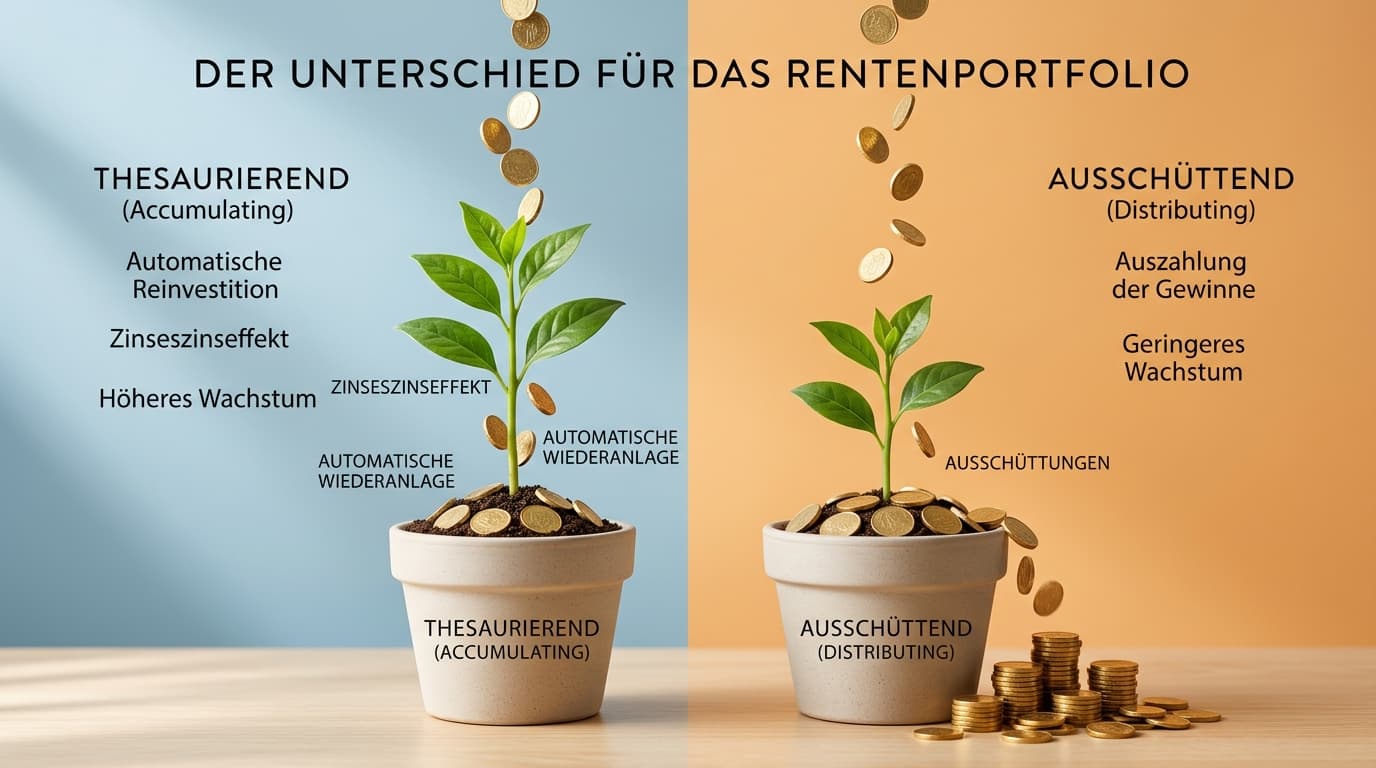
In the subsidised Altersvorsorgedepot (AVD), the choice between accumulating and distributing ETFs is less tax-driven than in a conventional account, since no ongoing capital gains tax applies throughout the entire accumulation phase[1]. For independent decision-makers, accumulating ETFs are usually the more convenient choice, since they reinvest proceeds automatically and maximise the compound-interest effect without manual effort. Distributing funds, by contrast, require active, manual reinvestment within the account to achieve comparable long-term growth.
This equal tax treatment during the accumulation phase fundamentally changes the classic investment logic. While a standard account often has tax-free allowances or advance lump-sum taxes shaping the choice, complete tax neutrality prevails before retirement in the state-subsidised Altersvorsorgedepot. All dividends and capital gains remain untouched by tax during this phase[1]. In our knowledge section, we help you, neutrally, understand these fine distinctions and choose the right strategy for your private retirement provision. For the concrete mathematical effect of your savings rates and the state subsidy, you can also use our subsidy calculator to run various scenarios on a source-based footing.
| Criterion | Accumulating ETF (reinvesting) | Distributing ETF |
|---|---|---|
| Ongoing taxation (accumulation phase) | Tax-free (tax due only in the payout phase) | Tax-free (tax due only in the payout phase) |
| Reinvestment of proceeds | Automatic and free of charge, directly within the fund | Manual reinvestment required by the investor |
| Compound-interest effect | Maximum effect through immediate reinvestment | Depends on how quickly the investor reinvests manually |
| Effort for independent decision-makers | Very low (fully automated) | Higher (distributions need to be monitored) |
For long-term retirement planning in the Altersvorsorgedepot, convenience therefore moves to the forefront. Anyone who wants to build wealth passively and efficiently is generally best served by the accumulating variant. It removes the risk of distributed amounts sitting unused in the settlement account and losing you return in the process. Please always bear in mind: all calculations and scenarios are for illustration only. Not investment advice within the meaning of § 1 Abs. 1a Nr. 1a KWG.
The classic tax rules: how ETFs are taxed in a standard account
In a conventional, unsubsidised securities account, how income is used plays a central role in your annual tax bill. Distributing ETFs pay dividends directly to you, while accumulating ETFs reinvest these gains automatically. Both variants are subject in Germany to Abgeltungsteuer of 25 percent, plus the solidarity surcharge and, where applicable, church tax. To prevent unequal taxation, the legislator introduced the Vorabpauschale. This levies a minimum annual tax on as-yet-unrealised capital gains of accumulating funds. Savers often use a Freistellungsauftrag (exemption order) to make optimal use of the Sparer-Pauschbetrag of 1,000 euros per person and to defer or bring forward tax in a targeted way[2].
| Criterion | Standard account (unsubsidised) | Altersvorsorgedepot (subsidised) |
|---|---|---|
| Ongoing tax | Tax on distributions and the Vorabpauschale above the Freistellungsauftrag | Complete tax exemption throughout the accumulation phase |
| Sparer-Pauschbetrag | Requires active use and a Freistellungsauftrag of 1,000 euros a year | No relevance in the accumulation phase, thanks to tax deferral |
| Reinvestment | Has to be done manually on distributions, sometimes incurring transaction costs | Happens automatically and free of charge for accumulating funds |
In the subsidised Altersvorsorgedepot (AVD), this tax-optimisation complexity disappears entirely. Because no tax is levied on distributions or capital gains during the accumulation phase, the annual calculation of a Vorabpauschale is dropped too. For independent decision-makers, this represents a substantial simplification. Instead of tax-motivated reallocation, purely practical aspects move to the forefront, in particular the automation of your retirement provision. To calculate the long-term effect of this tax-free compounding for your personal situation, you can use the subsidy calculator, which transparently shows you the advantages over an unsubsidised savings plan.
Anyone who wants to look more closely at the regulatory detail of the reform will find deeper guides on all the tax rules from 2027 in the knowledge section. Because of the tax neutrality during the accumulation phase, the key question for investors shifts from How do I save tax? to How do I keep my effort as low as possible?. In the state-subsidised account, compound interest can work unimpeded by annual tax deductions, which massively accelerates long-term wealth building.
The AVD tax privilege: complete tax exemption during the accumulation phase
Anyone building private wealth with ETFs today is often faced with the question: accumulating or distributing? In the new, state-subsidised Altersvorsorgedepot (AVD), which launches on 1 January 2027, this otherwise strongly tax-driven question loses its edge. Because all proceeds and capital gains remain entirely tax-free during the AVD's accumulation phase, tax-optimisation strategies no longer play a role[3]. The choice between the two ETF types therefore shifts from tax optimisation to purely practical questions, such as automatic reinvestment.
Specifically, this means that as an independent decision-maker, neither the Abgeltungsteuer nor the Vorabpauschale becomes due[4]. Because reallocations within the subsidised account are also possible tax-free, the traditional debate about the most tax-efficient use of proceeds loses its relevance. You do not need to park capital in the settlement account for potential tax payments. Every conventional tax-optimisation model, such as deliberately using up the tax-free allowance via distributing ETFs before switching to accumulating variants, becomes superfluous in the Altersvorsorgedepot. This lets you choose your ETFs entirely independently of fiscal constraints, based purely on pragmatic aspects such as automatic reinvestment and the fee structure.
| Tax factor | Classic account | Altersvorsorgedepot (AVD) |
|---|---|---|
| Vorabpauschale | Levied annually and draws on liquidity | Fully suspended throughout the accumulation phase |
| Ongoing dividends | Subject to Abgeltungsteuer once the tax-free allowance is used up | Remain tax-free and flow into the account undiminished |
| Reallocations | Gains trigger Abgeltungsteuer immediately on sale | Can be carried out tax-neutrally, with no tax deduction |
This complete tax deferral means your retirement capital can grow without friction from the tax office, which maximises the compound-interest effect over the years. If you want to calculate how this tax privilege, combined with the state allowances, affects your future final capital, you can use our source-based subsidy calculator. For a deeper look at the optimal investment strategy, our knowledge section offers neutral, evidence-based guides and comparisons. Note: the model calculations and comparisons provided are for information purposes only. Not investment advice within the meaning of § 1 Abs. 1a Nr. 1a KWG.
Accumulating ETFs in the AVD: the best route to maximum compound interest
In the new, state-subsidised Altersvorsorgedepot (AVD), the classic tax debate between accumulating and distributing ETFs loses its relevance. While investors in a standard account often have to weigh tax aspects such as the Sparer-Pauschbetrag or the Vorabpauschale, complete tax neutrality prevails in the AVD throughout the accumulation phase[5]. This means neither ongoing dividends nor capital gains have to be taxed each year. In our knowledge section, we summarise this advantage in detail.
Automation beats manual effort
Because of the tax exemption, purely practical criteria move to the forefront. Accumulating ETFs reinvest all proceeds automatically and free of charge directly within the fund's assets. For you as an independent decision-maker, this means maximum convenience: your compound-interest effect works uninterrupted, and you avoid any reinvestment risk as well as the extra transaction fees that can arise from manually reinvesting distributed proceeds. Anyone who chooses distributing funds instead has to keep an eye on the proceeds in the account's settlement account themselves and reinvest them manually.
Securing compound interest over the long term
For long-term wealth building in private retirement provision, compound interest is the most important return lever. Because the Altersvorsorgedepot is designed for decades of saving, even small delays or amounts that are not reinvested add up to noticeable losses over time. If you want to calculate the exact dynamics of your subsidised account, our subsidy calculator offers a precise decision aid, transparently mapping the interplay between state allowances and long-term compound interest.
| Feature | Accumulating ETFs | Distributing ETFs |
|---|---|---|
| Ongoing taxation | Tax-free in the accumulation phase (no Vorabpauschale) | Tax-free in the accumulation phase (distributions tax-neutral) |
| Use of proceeds | Automatic reinvestment directly within the fund | Credited to the account's settlement account |
| Compound-interest effect | Optimal, since compound interest works without interruption | Delayed, unless reinvested manually |
| Fees and effort | No effort, no transaction costs | Manual effort, possibly purchase fees on reinvestment |
Note: all calculations and tax comparisons are for illustration. Not investment advice within the meaning of § 1 Abs. 1a Nr. 1a KWG.
Distributing ETFs in the AVD: the reinvestment trap for independent decision-makers
In the subsidised Altersvorsorgedepot, the otherwise tax-driven debate between accumulating and distributing ETFs falls away, since no tax applies throughout the entire accumulation phase[6]. Neither capital gains tax on distributions nor the annual Vorabpauschale on unrealised gains plays a role here. For independent decision-makers, purely practical aspects, which determine long-term investment success, move to the forefront instead.
If you choose distributing ETFs, the dividends flow directly into your account's non-interest-bearing settlement account. Without a manual or automatic reinvestment instruction, there is a risk of unwanted liquidity building up, which reduces long-term returns through what is known as cash drag. Every manual reinvestment also requires personal discipline and can, depending on the provider, incur additional transaction fees.
| Feature | Accumulating ETF | Distributing ETF |
|---|---|---|
| Tax in the accumulation phase | Completely tax-free (no Vorabpauschale) | Completely tax-free (no capital gains tax) |
| Reinvestment of proceeds | Automatic and free of charge, directly within the fund | Manually, or via an automatic broker instruction |
| Risk of cash drag | Excluded | High if manual reinvestment is missed |
To make the best use of the compound-interest effect, the accumulating variant is recommended for the accumulation phase in the Altersvorsorgedepot[7]. It reinvests proceeds automatically within the fund's assets, entirely without effort or extra fees. If you are looking for more in-depth comparisons, our knowledge section will help with neutral guides. The subsidy calculator also lets you calculate the exact leverage effect of the state subsidy on your private retirement provision.
Direct comparison: accumulating vs. distributing in the subsidised account
When investing long term in ETFs for retirement, private investors in a standard account often face a complex tax question: should proceeds be distributed directly or automatically reinvested? Under the new, state-subsidised Altersvorsorgedepot, however, this tax debate loses its relevance. Because all realised capital gains, dividends and interest remain, by law, entirely tax-free throughout the accumulation phase, the usual pressure to optimise for tax falls away[5]. Neither the annual Vorabpauschale nor capital gains tax reduces your wealth during this phase, which considerably simplifies the choice of ETF.
This statutory tax neutrality shifts the focus for independent decision-makers to purely practical and economic aspects of running the account. Instead of laboriously optimising tax-free allowances or lump sums, administrative automation, potential transaction costs for manual reinvestment and the undisturbed dynamics of compound interest now take centre stage. For investors who want to look more deeply into the new statutory basis of the Riester reform, our knowledge section offers well-founded, neutral orientation.
| Criterion | Accumulating ETFs in the AVD | Distributing ETFs in the AVD |
|---|---|---|
| Ongoing taxation | Completely tax-free in the accumulation phase (no Vorabpauschale) | Completely tax-free in the accumulation phase (no Abgeltungsteuer) |
| Reinvestment of proceeds | Automatic and free of charge, directly within the fund | Manual reinvestment by the investor is required |
| Compound-interest effect | Maximum and uninterrupted through immediate automatic reinvestment | Depends on discipline and the timing of manual reinvestment |
| Transaction costs | No costs or fees for reinvestment | Possible broker fees for manual repurchases |
| Administrative effort | Minimal (optimal set-and-forget principle for savers) | Regular account monitoring and manual order placement needed |
Overall, accumulating ETFs are, for most independent decision-makers, the most profitable and convenient option in the Altersvorsorgedepot. They ensure every dividend payment immediately, and without deduction of order fees, keeps driving the compound-interest effect. Distributing funds are only worth considering if investors deliberately want to collect regular proceeds in the settlement account, for example to set new priorities manually within the portfolio. To precisely calculate the long-term effects of different savings rates and state allowances, the subsidy calculator is available to you at any time as a neutral tool.
The switch to the payout phase: what happens in retirement?
Once you reach retirement age, as an independent decision-maker you enter the payout phase of your subsidised Altersvorsorgedepot. From this point, the statutory principle of deferred taxation applies: all proceeds and gains in value that grew tax-free in the account over decades of accumulation are now taxed on actual payout at your then-applicable personal income tax rate[3]. Because taxation is only triggered once you leave the account's tax shelter, the final tax outcome in retirement is identical for both ETF types. Choosing one form of proceeds use over the other within the account creates no tax disadvantage.
The key difference between accumulating and distributing ETFs therefore lies not in tax law, but purely in the practical payout mechanics. While distributing funds let dividends flow directly into the Altersvorsorgedepot's settlement account, with accumulating variants these remain within the fund's assets and continuously increase the value of your units[8]. To draw a regular amount from an accumulating ETF in retirement, you consequently need to sell fund units via an automated drawdown plan. With the distributing variant, by contrast, you can use the dividends credited directly for your living costs.
| Criterion in the AVD | Accumulating ETFs | Distributing ETFs |
|---|---|---|
| Payout mechanics | Units are sold successively and specifically via a drawdown plan. | Dividends flow directly into the account and can be withdrawn. |
| Tax treatment | Your personal income tax rate applies only when you withdraw from the account. | Your personal income tax rate applies only when you withdraw from the account. |
| Predictability of the pension | Very high, since you steer the sale amount and intervals precisely yourself. | Variable, since distributions depend on dividend decisions. |
For independent decision-makers who prefer a precisely calculable, automated pension, accumulating ETFs usually prove the more convenient solution. Within a drawdown plan, you can define exactly the monthly amount you need for your living costs, without depending on fluctuating distribution dates or dividend yields. Further comparisons and detailed guides on the payout options of the new account model can be found in the Altersvorsorgedepot guides.
Important legal note: all tax and mathematical explanations are provided solely to illustrate how the Altersvorsorgedepot works and reflect the current legal position. They do not constitute tax or financial advice. Not investment advice within the meaning of § 1 Abs. 1a Nr. 1a KWG.
Conclusion and recommendation: how to make the right decision for your account
For long-term retirement provision in the subsidised Altersvorsorgedepot (AVD), the classic tax debate between accumulating and distributing ETFs loses its relevance. While tax aspects such as the Vorabpauschale or tax-free allowances play a role in a conventional account, complete tax exemption on all proceeds and capital gains generated prevails during the accumulation phase of the subsidised Altersvorsorgedepot[9]. Taxation only occurs later, on retirement, in the payout phase. As a result, purely practical criteria, which decide how efficient your savings path is, move to the forefront.
| Criterion | Accumulating ETF | Distributing ETF |
|---|---|---|
| Ongoing taxation | No Vorabpauschale in the accumulation phase | No Abgeltungsteuer on distributions |
| Use of proceeds | Automatic reinvestment within the fund's assets | Payout to the account |
| Compound-interest effect | Optimal through immediate, uninterrupted reinvestment | Risk of return losses through delayed reinvestment |
| Manual effort | Minimal, since no action of your own is needed | High, since proceeds have to be reinvested manually |
For most independent decision-makers, an accumulating ETF proves the significantly more convenient and rational option during the accumulation phase. Because distributed dividends land in the account, you would need to regularly reinvest these proceeds yourself, so as not to diminish the compound-interest effect. This manual effort not only carries the risk of investment delays, but can also, depending on the provider, incur additional order fees. An accumulator, by contrast, reinvests all dividends fully automatically and free of charge at fund level, guaranteeing continuous, maintenance-free wealth building.
Make your decision based on your personal savings goals and preferences. If you want to compare the concrete effects of different accumulation strategies, the subsidy calculator helps you precisely determine the state subsidy and the expected final capital. Further information and in-depth comparisons can also be found in the knowledge section. Please note: all calculations and figures shown are for illustration only. Not investment advice within the meaning of § 1 Abs. 1a Nr. 1a KWG.
Frequently asked questions
- What is the difference between accumulating and distributing ETFs?
- Accumulating ETFs reinvest dividends automatically, while distributing ETFs pay the proceeds out to the investor.
- Does the Altersvorsorgedepot incur a Vorabpauschale?
- No. No ongoing tax applies in the Altersvorsorgedepot during the accumulation phase, so the Vorabpauschale falls away entirely too.
- Do I have to manually pay tax on distributions in the Altersvorsorgedepot?
- No, all proceeds remain tax-free during the accumulation phase. Deferred taxation only applies on payout in retirement.
- Can I switch between the ETF types within the Altersvorsorgedepot?
- Yes, within the account you can generally reallocate free of charge or at low cost, without triggering any tax.
- How high is the Sparer-Pauschbetrag in the Altersvorsorgedepot?
- The Sparer-Pauschbetrag of 1,000 euros plays no role in the Altersvorsorgedepot, since the entire accumulation phase is tax-free anyway.
- Which ETF type is better suited to an automatic drawdown plan?
- Accumulating ETFs are usually more practical, since units are liquidated in a targeted way on sale, rather than depending on irregular distributions.
Sources
Which ETFs fit your AVD?
We'll help you choose the right funds for your Altersvorsorgedepot.
Free and without obligation. Advice from an adviser in our independent network of 1,000+ vetted advisers.