Does the cost cap apply to every Altersvorsorgedepot?

Published on · Managing Director & Partner, Alsterspree Verlag GmbH
This article was written by an author with the support of AI.
AVD or ETF savings plan - which pays off more?
A free, no-obligation conversation with an adviser from our independent network of 1,000+ vetted advisers.
The statutory framework: the 1.0 percent cost cap in law
The statutory cost cap of a maximum 1.0 percent in effective costs[1] by no means applies across the board to every Altersvorsorgedepot. This ceiling is reserved exclusively for the state-defined standard product (the "Standarddepot"). For freely configured, individually structured Altersvorsorgedepots, however, this statutory price limit does not apply. Anyone who deviates from the standardised path must analyse the provider's specific cost structure themselves.
The regulatory distinction between the standard and individual account
| Regulatory parameter | Statutory Standarddepot | Free Altersvorsorgedepot |
|---|---|---|
| Statutory effective-cost ceiling | Statutorily capped at a maximum of 1.0% p.a. | No ceiling (free pricing) |
| Investment selection & automation | Standardised portfolio rules (lifecycle) | Free choice from the approved list (ETFs, funds) |
| Provider obligation | Mandatory offering for approved providers | Voluntary product offering from market participants |
The effective-costs metric under the pension reform law measures the average annual reduction in returns from all product, account and administration costs combined. If an investment generates a gross return of 6.0 percent a year before costs, for example, then once the maximum permitted Standarddepot costs are fully applied, a net return of exactly 5.0 percent remains[3]. The cost cap ensures that excessive fee structures are ruled out for the standardised direct product.
Switching to a freely configured Altersvorsorgedepot creates a twofold dynamic for investors. On one hand, lean neobroker models with pure ETF savings plans can achieve total cost ratios well below the 1.0 percent mark. On the other hand, actively managed fund products or service-intensive account variants, with no statutory brake, can also carry significantly higher fees. For sound guidance, it's therefore worth looking at the adopted 2027 key facts. The statutory cap protects the standard route, but for an individual investment decision it is by no means a substitute for your own market comparison.
The Standarddepot: definition and statutory purpose
The statutory Standarddepot was created as part of the reform of subsidised private retirement provision to give citizens a particularly low-threshold way into the system. To reduce barriers to decision-making, this product is targeted specifically at investors without deep experience of the capital markets. It acts as a ready-made basic option: the structure requires no constant monitoring of market developments or manual adjustment of savings plans from the saver. This closes an important gap for anyone who wants to make use of state support without putting together their own Altersvorsorgedepot portfolio.
Key features and statutory safeguards
- Statutory cost cap: the average annual reduction in returns from product and administration costs (effective costs) is statutorily limited to a maximum of 1.0 percent for the Standarddepot.
- Preselected fund structure: as a rule, the capital is split between two broadly diversified standard funds, ensuring a balanced mix of return potential and risk spreading.
- Automatic lifecycle management: before retirement is reached, capital is gradually shifted into lower-risk assets, to protect the accumulated capital against short-term fluctuations.
- Standardised online sign-up: the reduced complexity allows for an uncomplicated, digital contract sign-up, even without prior in-depth financial advice.
The fixed cap of 1.0 percent in effective costs is meant to ensure that the state allowances and tax advantages aren't eaten up by excessive product fees. This statutory price limit, however, applies exclusively to the certified standard product. If you opt for a freely configurable Altersvorsorgedepot — for example, to choose individual ETFs or a specialist strategy — this cost ceiling legally does not apply. For self-directed investors, as well as with flexible broker models, a detailed comparison of the actual cost structures therefore remains essential.
Freely configured Altersvorsorgedepots: why no cap applies
The statutory cost cap does not protect investors across the board in every variant of the new Altersvorsorgedepot. The ceiling on effective costs, averaging 1.0 percent a year, applies exclusively to the state-defined standard product[5]. If you decide, as a self-directed investor, on a freely configured Altersvorsorgedepot, this price ceiling doesn't apply. Providers are free to calculate their own fees for individual account models, free fund selection, or additional administrative services.
Reasons for unrestricted pricing on individual account models
The legislature deliberately distinguishes between consumer-protecting basic solutions and flexible market offerings. While the Standarddepot, with fixed asset classes and automated risk reduction, is designed as a lean product, freely configurable accounts offer maximum room for customisation. Investors can put together individual ETF portfolios or make use of additional services. Because product choice and administration scenarios vary widely among free variants, they are subject to open competition. The actual cost structure is made up of account-management fees, trading fees, and ongoing fund costs (TER).
- Standarddepot for retirement provision: statutory cap on effective costs of a maximum of 1.0 percent a year, with a predefined investment structure.
- Freely configured Altersvorsorgedepot: no statutory price ceiling; fees depend on the chosen provider, the ETFs and any additional features.
- Difference in requirements: for free accounts, responsibility for transparency and fee control rests entirely with investors.
For your decision, this split has a clear consequence: anyone who wants to use the flexibility of an individual Altersvorsorgedepot should absolutely carry out their own cost comparison. Higher ancillary costs from an unsuitable account provider can noticeably reduce the return advantage of a well-chosen ETF strategy over the course of the accumulation phase.
How effective costs are calculated and disclosed
The effective-cost ratio is the key measure for determining the actual reduction in returns of an Altersvorsorgedepot. It combines all account fees, administration and product costs incurred, and states by how many percentage points the annual gross return of the chosen investment is reduced. While the statutory Standarddepot has an enshrined ceiling of a maximum of 1.0 percent in effective costs, this cap does not apply to freely configured Altersvorsorgedepots. To make the long-term picture more transparent, the statutory framework requires providers to disclose a uniform effective-cost ratio under § 7d AltZertG.
| Account model | Cost structure | Effect on net return |
|---|---|---|
| Standarddepot (statutorily capped) | Max. 1.0% effective costs | Limited deduction from returns |
| Freely configured account (neobroker) | Often cheaper than the Standarddepot | Potentially higher net return |
| Freely configured account (premium/guarantee) | Effective costs above 1.0% possible | Greater reduction in returns |
This comparison illustrates how contract costs affect your savings outcome. For freely configured tariffs with no ceiling, costs vary depending on provider structure, trading venues and fund choice. If the cost burden under the free model is below the Standarddepot's limit, a higher net return remains. With more cost-intensive providers, such as premium tariffs, returns fall noticeably by contrast. An independent comparison of effective costs is therefore essential for self-directed investors, to identify unfavourable fee structures early.
In practice, this means: the effective-cost ratio disclosed in the Produktinformationsblatt (product information sheet) significantly simplifies comparability between different market offerings, since it converts all recurring and one-off cost components into a single annual rate. A detailed fee breakdown also helps shed light on any hidden components. For individual projections, use the subsidy calculator. Please note: all calculations shown are illustrative model calculations only and do not constitute investment advice within the meaning of § 1 Abs. 1a Nr. 1a KWG.
Cost structures compared: Standarddepot versus free account
According to the guidance of the Bundesfinanzministerium (BMF, Federal Ministry of Finance), the statutory cost cap of a maximum of 1.0 percent in effective costs applies exclusively to the state-predefined Standarddepot. Freely configurable Altersvorsorgedepots are subject to no statutory price ceiling. For you as a self-directed investor, this means that with individual account models, pricing is set by the financial services provider. Effective costs describe the average annual reduction in total returns from all fees incurred. To compare offers properly, four separate cost blocks need to be distinguished: ongoing account-management fees, variable transaction fees for executing savings plans or rebalancing, the internal product and administration costs of the investment funds (TER), and any arrangement or advisory fees.
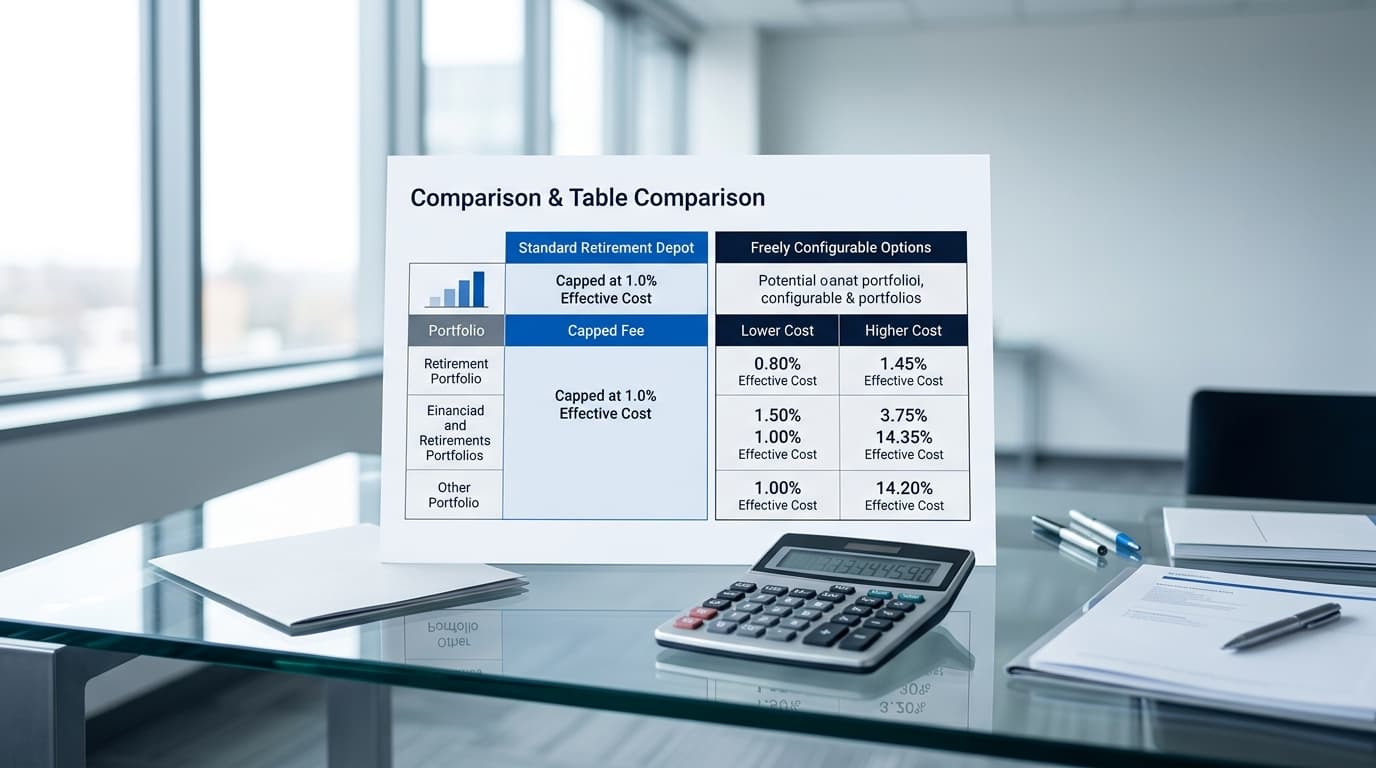
| Cost category | Standarddepot for retirement provision | Free Altersvorsorgedepot |
|---|---|---|
| Statutory cost cap | Maximum 1.0% p.a. effective costs | No statutory price ceiling |
| Account management & transactions | Included as a flat rate within the ceiling | Provider-dependent (often free with neobrokers) |
| Product costs (funds/ETFs) | Standardised fund selection | Freely selectable (e.g. low-cost world ETFs) |
| Distribution & advisory fees | Low-threshold direct online sign-up | Optional, with personal advice or brokerage |
The ceiling on the Standarddepot reliably protects beginners without prior experience from surprisingly high fee structures. At the same time, the free Altersvorsorgedepot allows for targeted optimisation: anyone who independently manages a portfolio of broadly diversified, low-cost ETFs, for example, can in some cases push the total effective cost ratio well below the 1.0 percent mark. A transparent view of providers' specific cost structures is therefore the key to a well-founded decision. A systematic comparison of all contract terms helps with this assessment, to consistently avoid unnecessary return losses during the accumulation phase. (Not investment advice within the meaning of § 1 Abs. 1a Nr. 1a KWG.)
Why free accounts can be cheaper despite having no cap
The fact that the statutory cost cap of 1.0 percent in effective costs[8] applies exclusively to the Standarddepot by no means implies that freely configurable models turn out more expensive. On the contrary: direct banks and neobrokers let self-directed investors, by independently selecting extremely low-cost index funds, achieve a total cost ratio that lies noticeably below the statutory ceiling. While the standard product serves as a protected point of orientation for less experienced savers, intense price competition unfolds among free accounts.
| Criterion | Standarddepot (statutory) | Free Altersvorsorgedepot |
|---|---|---|
| Statutory ceiling | Maximum 1.0% effective costs p.a. | No statutory cap |
| Product costs (TER) | Included in the effective costs | Freely selectable (e.g. broad world ETFs) |
| Account management & processing | Standardised rules | Fee-free at many direct banks and neobrokers |
| Effective cost burden | Capped by the effective-cost cap | Often very low-cost, depending on portfolio choice |
Anyone who opts for an individually assembled portfolio benefits over the long term from the strong compound-interest effect of the fees saved. Because no statutory safety net applies to free accounts, however, self-directed investors bear the responsibility for consistently avoiding cost-intensive active funds or hidden transaction fees. A systematic provider comparison therefore forms the necessary basis for transparently analysing the true reduction in returns. Our provider comparison helps you identify favourable terms in a targeted way.
Not investment advice within the meaning of § 1 Abs. 1a Nr. 1a KWG. All figures and worked examples are for illustration only and do not constitute any promise of returns.
Transparency and pitfalls in comparing costs
While the statutory cost cap limits the average annual reduction in returns on state Standarddepots to 1.0 percent in effective costs[10], this protection explicitly does not apply across the board to every Altersvorsorgedepot. Freely configurable account models are subject to no statutory price ceiling. For investors and self-directed savers, this means that with individual investment strategies, an independent, detailed cost comparison is essential. To ensure full transparency, the regulator requires all providers to provide a standardised Produktinformationsblatt (product information sheet) before the contract is signed. When reviewing these documents, however, it pays to look closely, since alongside the regular account fees, hidden costs can also noticeably reduce the long-term compounding dynamic and hence the total return.
Specific points to check in the Produktinformationsblatt
- Effective-cost ratio: shows the total impact of all calculable costs on the annual return, in percentage points. It's the key figure for comparing individual account offers directly with the statutory 1.0 percent limit for the Standarddepot.
- Fixed and percentage-based account fees: distinguish precisely between fixed annual flat amounts and volume-dependent administration costs. Especially in the early accumulation phase, when capital is lower, fixed annual fees weigh especially heavily in percentage terms.
- Transaction and rebalancing fees: check the execution fees charged for monthly savings instalments, as well as any fees for automatic portfolio rebalancing over the full investment horizon.
- Product costs of the target investments (TER): alongside the pure account-management fees, ongoing administration costs apply for the chosen ETFs or investment funds, which are taken directly from the fund's assets.
Deliberately choosing a freely configured Altersvorsorgedepot gives investors the chance to push effective costs well below the Standarddepot's 1.0 percent mark, through the targeted use of very low-cost ETFs. Set against this is the increased risk of higher cost structures with complex, actively managed fund solutions. We therefore advise self-directed investors to thoroughly check every individual component before signing. This way, you can reliably identify a low-cost Altersvorsorgedepot and protect your retirement capital from unnecessary deductions.
Recommendation for self-directed investors: choosing the right account variant
For self-directed investors, the choice between the Standarddepot and a freely configured Altersvorsorgedepot depends largely on their own capital-market experience and their willingness to compare tariffs themselves. Through its ceiling of 1.0 percent in effective costs a year, the statutory Standarddepot offers reliable basic protection and predefined investment structures. Anyone who invests specifically in broadly diversified index funds, however, can often achieve total costs with freely configured variants that lie well below this statutory cap.
Decision criteria for choosing your account
- Standarddepot: recommended for savers who prefer an uncomplicated solution without choosing their own funds. The statutory cost cap protects against unexpected fees.
- Freely configured Altersvorsorgedepot: ideal for self-responsible investors seeking maximum flexibility in assembling their portfolio. A careful provider comparison is essential here, since no price ceiling applies.
- Personal advice: worthwhile for people who want individual clarification on complex retirement-planning questions, or on transferring existing Riester-Rente contracts.
To work out the precise cost impact on your personal support-adjusted return, it's worth calculating a side-by-side comparison of the offers. A genuinely low-cost Altersvorsorgedepot is characterised by low administration and product costs. For a transparent overview, tools such as the subsidy calculator and our provider comparison are available to you. (Not investment advice within the meaning of § 1 Abs. 1a Nr. 1a KWG.)
Frequently asked questions
- Does the 1.0 percent cost cap apply to every Altersvorsorgedepot?
- No, the statutory cost cap on effective costs of a maximum of 1.0 percent p.a. applies exclusively to the Standarddepot. For freely configured Altersvorsorgedepots, the respective providers set the fee structure independently.
- What are effective costs in the Altersvorsorgedepot?
- Effective costs indicate by how many percentage points an investment's annual return is reduced by all fees incurred. A figure of 1.0 percent, for example, means that of a gross return of 5.0 percent a year, a net return of 4.0 percent effectively remains.
- Can free Altersvorsorgedepots be cheaper than the Standarddepot?
- Yes, that's possible. Anyone who invests with a low-cost neobroker in broadly diversified ETFs with a low total cost ratio often achieves total costs noticeably below the ceiling of 1.0 percent a year.
- Does every Altersvorsorgedepot provider have to offer a Standarddepot?
- Yes, providers of tax-subsidised retirement products are legally required to offer a standard product with the 1.0 percent cost cap, alongside their free offerings. Only pure Bausparkassen (building societies) are exempt.
- Which types of fees are included in the effective-cost ratio?
- The calculation includes all ongoing product and account-management costs, as well as the administration costs of the underlying funds. Any agreed arrangement or distribution costs are also converted into the effective-cost ratio.
- Why did the legislature lower the cost cap to 1.0 percent?
- The original government draft still provided for 1.5 percent in effective costs. The legislature lowered the ceiling to 1.0 percent during the parliamentary process, to guarantee consumers reliable protection against excessive product costs on the Standarddepot.
Sources
- [1]verbraucherzentrale.de
- [2]verbraucherzentrale.de
- [3]verbraucherzentrale.de
- [4]verbraucherzentrale.de
- [5]verbraucherzentrale.de
- [6]verbraucherzentrale.de
- [7]verbraucherzentrale.de
- [8]bundesfinanzministerium.de
- [9]verbraucherzentrale.de
- [10]verbraucherzentrale.de
- [11]bundesfinanzministerium.de
- [12]verbraucherzentrale.de
- [13]verbraucherzentrale.de
- []Altersvorsorgedepot 2027: all the key facts at a glance
- []Altersvorsorgedepot explained simply
- []Avoiding hidden costs in the Altersvorsorgedepot
- []What does an Altersvorsorgedepot cost?
- []How much do fees reduce returns in the Altersvorsorgedepot?
- []How can I tell if an Altersvorsorgedepot is good value?
- []What to watch for when choosing an AVD provider? The checklist
AVD or ETF savings plan - which pays off more?
We'll show you the difference in returns for your specific situation.
Free and without obligation. Advice from an adviser in our independent network of 1,000+ vetted advisers.