How much do fees reduce returns in the Altersvorsorgedepot?

Published on · Updated on · Managing Director & Partner, Alsterspree Verlag GmbH
This article was written by an author with the support of AI.
AVD or ETF savings plan - which pays off more?
A free, no-obligation conversation with an adviser from our independent network of 1,000+ vetted advisers.
Compound interest in reverse: how fees weigh on retirement provision
Fees drastically reduce returns in the new Altersvorsorgedepot (the new state-subsidised retirement investment account) over long periods. Even a difference of one percentage point in annual total costs can, over a term of 30 years, reduce the final capital by a substantial five-figure amount. That is because costs deducted no longer share in the investment's performance, and skim off the valuable compound-interest effect year after year. In our neutral knowledge section we set out all the legal details transparently for you. Please note: all model calculations shown are for illustration and do not constitute investment advice within the meaning of § 1 Abs. 1a Nr. 1a KWG.
The mathematical reality: one percentage point decides tens of thousands of euros
A simple worked example helps illustrate the leverage of costs. Suppose you save 150 euros a month over a period of 30 years, with an assumed gross market return of 6.0 percent a year. If the total cost ratio for the account and the ETFs used is a very low 0.5 percent a year, the real net return is 5.5 percent. In this scenario, the projected final capital comes to around 137,000 euros. If costs rise to 1.5 percent a year, though, the net return shrinks to 4.5 percent and the final capital falls to only around 114,000 euros. A difference of just one percentage point therefore costs you around 23,000 euros in private retirement savings, because these fees are permanently withheld from the compound-interest effect[1]. With the interactive subsidy calculator you can calculate this fee impact in real time for your personal savings rate and term.
| Total cost ratio p.a. | Net return p.a. (at 6.0% gross) | Projected final capital (after 30 years) | Loss due to fees |
|---|---|---|---|
| 0.2% | 5.8% | approx. €145,000 | approx. €6,000 |
| 0.5% | 5.5% | approx. €137,000 | approx. €14,000 |
| 1.0% | 5.0% | approx. €125,000 | approx. €26,000 |
| 1.5% | 4.5% | approx. €114,000 | approx. €37,000 |
While the legislator prescribes a maximum effective cost cap of 1.0 percent for certified standard products[2], savvy independent investors can undercut their costs considerably further still by choosing low-cost ETFs and providers. Since every euro you save on fees flows directly into your personal net return, consistently minimising costs is the safest and simplest way to maximise your long-term retirement savings with the Altersvorsorgedepot.
The law behind the Altersvorsorgedepot: what cost caps does the legislator provide for?
From 1 January 2027, the new Altersvorsorgedepot (AVD) will fundamentally modernise private retirement provision in Germany[2]. The model, initiated by the Federal Ministry of Finance (BMF), does away with rigid contribution guarantees and opens the way to higher-return investments in ETFs and investment funds. To support citizens in building wealth, an attractive state subsidy is being introduced: alongside a Kinderzulage (the child allowance) of up to 300 euros, an annual Grundzulage (the basic state allowance) of up to 540 euros is granted[3]. To ensure that these state allowances and the returns generated are not eroded in the long run by excessive product and account fees, setting statutory cost caps in law was a central point of contention in the reform.
At the centre of the debate was the statutory standard product that providers are required to offer to all savers. While the original draft of the Altersvorsorgereformgesetz (the Altersvorsorgedepot reform act) still provided for a cost cap of up to 1.5 percent a year in effective costs for this standard account, this limit was lowered to a maximum of 1.0 percent effective costs per year in the act as passed[4]. Consumer advocates[5] such as the Bürgerbewegung Finanzwende are calling for a considerably stricter limit of no more than 0.5 percent a year. They argue that even a cap of 1.0 percent is still too high, since a broadly diversified ETF portfolio can already be achieved today for total annual costs of under 0.2 percent. They say every extra tenth of a percent dramatically reduces the long-term maturity value through the negative compound-interest effect.
| Cost ratio (p.a.) | Projected final capital (€150/month, 30 years) | Effect on net return |
|---|---|---|
| 0.5% p.a. (consumer-protection target) | approx. €137,000 | Minimal reduction of the compound-interest effect |
| 1.0% p.a. (statutory cost cap) | approx. €125,000 | Loss of more than €12,000 in final capital |
This model comparison illustrates the scale of the fee impact: even half a percentage point of difference in annual costs adds up, over the decades, to a considerable five-figure sum. For independent investors, choosing an extremely low-cost provider is therefore the most effective lever for building wealth. With the subsidy calculator you can easily work out and compare different cost scenarios yourself (Important note: this model calculation is an illustrative representation and does not constitute investment advice within the meaning of § 1 Abs. 1a Nr. 1a KWG).
The 50,000-euro trap: one percentage point of difference in a detailed worked example
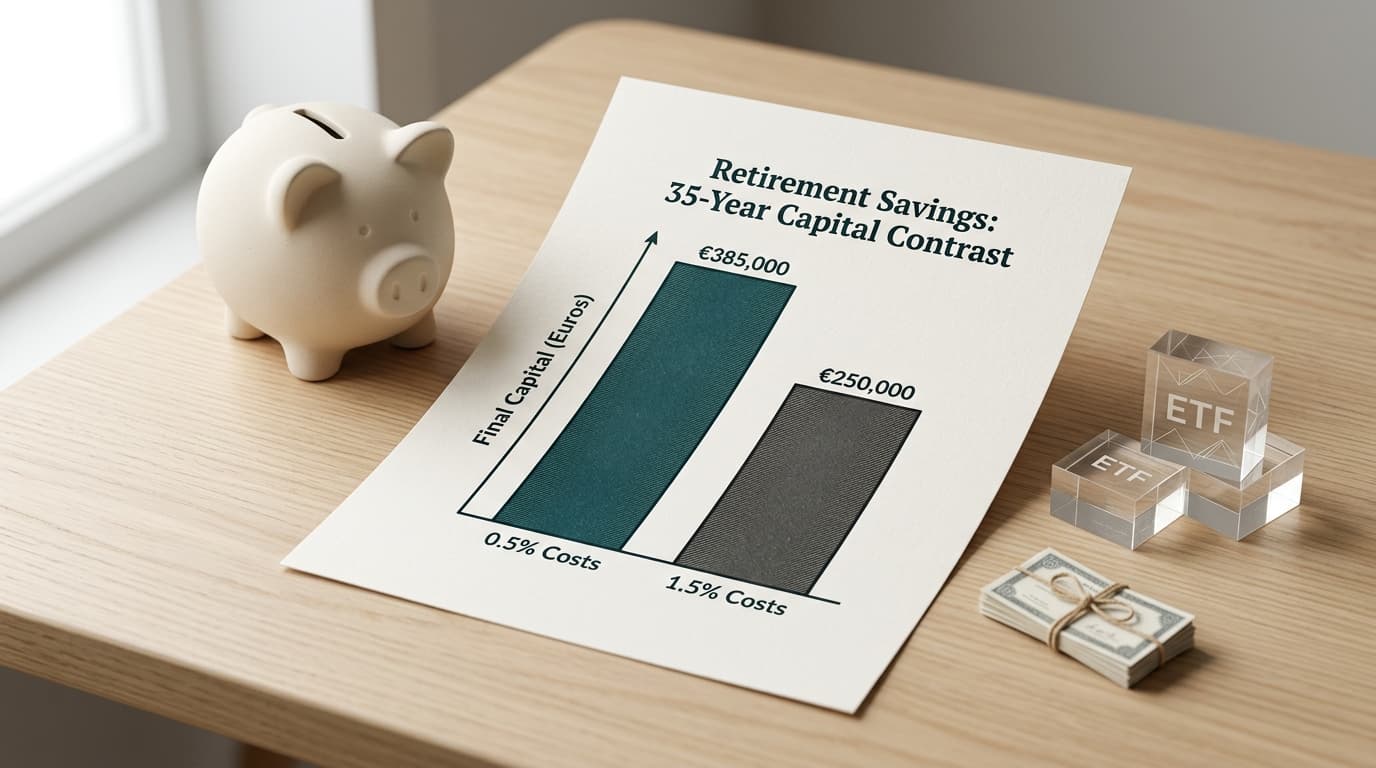
How much do fees reduce returns in the Altersvorsorgedepot? A single percentage point of difference in annual total costs can cost a fortune over a long term. Anyone saving 200 euros a month over 35 years feels the compound-interest effect intensely: while a low cost ratio of 0.5 percent a year only slightly dampens the return, a more expensive cost ratio of 1.5 percent a year eats up a substantial share of the final capital[6].
| Parameter | Low-cost account (0.5% fees) | Expensive account (1.5% fees) |
|---|---|---|
| Monthly savings rate | 200 euros | 200 euros |
| Term | 35 years | 35 years |
| Assumed gross return | 6.0% p.a. | 6.0% p.a. |
| Effective net return | 5.5% p.a. | 4.5% p.a. |
| Expected final capital | approx. 254,000 euros | approx. 203,500 euros |
| Cost-related shortfall | 0 euros (reference) | approx. 50,600 euros |
This calculation illustrates the enormous leverage of low costs: one percentage point of higher fees reduces the accumulated savings in this case by around a fifth. For independent investors who want to optimise their retirement provision, low-cost ETFs and providers with minimal fees are therefore the most effective lever for successful wealth building. If you want to know how different fee levels affect your individual state subsidy and your pension expectations, you can simulate these scenarios in detail yourself with our subsidy calculator. You can also find further detailed analyses and comparisons in our knowledge section.
Not investment advice within the meaning of § 1 Abs. 1a Nr. 1a KWG. All mathematical calculations and projections are for illustration only and are not a guarantee of future performance.
The different types of costs in the Altersvorsorgedepot, broken down
Fees dramatically reduce returns in the Altersvorsorgedepot over long periods: a single percentage point of difference in annual total costs alone reduces the final capital after 30 years by a substantial five-figure amount[7]. While modern, self-directed investment models allow for extremely low-cost terms without expensive insurance wrappers and upfront fees, unfavourable fee structures systematically erode the valuable compound-interest lever[8]. A source-based, deliberate choice of provider is therefore the most effective lever for putting your private retirement provision on the best footing.
- Account management fees charged by the provider: annual or monthly fixed fees, or volume-based charges, for the pure administration and custody of your Altersvorsorgedepot.
- Order and transaction fees: one-off costs incurred when buying or selling ETF units (for example as a fixed flat fee per trade, or as a percentage of the order volume).
- Ongoing fund costs (TER): the Total Expense Ratio refers to the internal annual management fees of the chosen ETF, which are taken directly from the fund's assets and are usually between 0.05% and 0.40%.
A simple financial-mathematics model calculation shows what a devastating quantitative effect seemingly small cost differences have over long periods. If you invest 150 euros a month over a typical 30-year accumulation phase in a broadly diversified world ETF, and assume an average gross return of 6.0% a year, your provider's cost ratio has a decisive influence on your eventual retirement savings. A cost-efficient account with total costs of just 0.5% a year here stands against a classic, more expensive standard product with total costs of 1.5% a year.
| Scenario | Total costs p.a. | Net return p.a. | Final capital after 30 years |
|---|---|---|---|
| Low-cost provider | 0.5% | 5.5% | approx. €137,042 |
| More expensive provider | 1.5% | 4.5% | approx. €113,908 |
| Cost delta | 1.0 percentage point | - | approx. €23,134 |
This clear difference of more than 23,000 euros vividly shows that a single percentage point of cost saving massively increases your freely available final balance in retirement. You can easily calculate the exact effects on your personal wealth, and the potential benefit of state allowances, transparently with the subsidy calculator. Please note: this worked example is for illustration purposes only and does not constitute investment advice within the meaning of § 1 Abs. 1a Nr. 1a KWG.
Subsidy versus costs: when high fees completely eat up your state allowance
The annual Grundzulage of up to 540 euros is meant to boost your private retirement provision. But as your account grows, a mathematical cost trap looms that many savers underestimate. If your provider's effective costs sit at the statutory standard cap of 1.0 percent a year, these fees neutralise the entire state Grundzulage of 540 euros once your account reaches a value of 54,000 euros. Every additional year, and every further euro in the account, lets the cost ratio eat further into your return. For independent investors who want to manage their investment themselves cost-efficiently, choosing an extremely low-cost partner is therefore the decisive lever. A transparent provider comparison helps you consistently avoid expensive tariffs.
| Cost ratio per year | Expected final capital (€200/month, 40 years) | Loss due to fees |
|---|---|---|
| 0.5 percent (low-cost ETF provider) | approx. 348,000 euros | 0 euros (reference value) |
| 1.0 percent (statutory maximum cap) | approx. 305,000 euros | approx. 43,000 euros |
This calculation illustrates the long-term leverage of account fees: even half a percentage point of difference in annual costs reduces the final capital over a working life by a significant five-figure amount.[9] Anyone who carelessly picks expensive standard products transfers a substantial share of their hard-earned return and their state subsidy directly to the custodian bank. With the subsidy calculator you can precisely simulate these cost effects for your personal savings rate and make well-founded decisions. Not investment advice within the meaning of § 1 Abs. 1a Nr. 1a KWG.
- Protect the compound-interest effect: low ongoing fees ensure your returns compound exponentially over the decades.
- Make full use of the allowances: only with low costs does state support remain a genuine return booster for your account.
- Compare providers: use the knowledge section to identify commission-free neobroker offers with low costs.
ETF savings plan versus Altersvorsorgedepot: the role of tax treatment compared
Two main routes compete for long-term retirement provision: the self-managed, unsubsidised ETF savings plan and the new, state-subsidised Altersvorsorgedepot. While a classic securities savings plan offers maximum flexibility, the Altersvorsorgedepot scores with substantial tax advantages during the accumulation phase. In particular, the complete removal of the annual Vorabpauschale (advance lump-sum tax) and of capital gains tax on rebalancing protects the compound-interest effect from premature deductions[10].
| Feature | Unsubsidised ETF savings plan | Altersvorsorgedepot (from 2027) |
|---|---|---|
| Tax during the accumulation phase | Capital gains tax and the Vorabpauschale apply | Completely tax-free (no Vorabpauschale) |
| Rebalancing / reallocations | Taxable (immediate capital gains tax) | Tax-free (no tax charge on switching) |
| Taxation in retirement | Effectively approx. 18.5 percent (partial exemption) | Deferred taxation at your income tax rate |
| State allowances | No subsidy | Up to 540 euros annual Grundzulage |
Tax exemption during the accumulation phase acts as a powerful lever that can at least partly offset an account's ongoing cost burden. Because no Vorabpauschale or tax on dividends reduces the invested capital in the Altersvorsorgedepot during this build-up period, the entire balance keeps working undisturbed[11]. Tax only becomes due when payouts are made in retirement. This tax-deferral effect can make a considerable difference over a term of 30 years, especially if you want to reallocate within the account, which would be taxable every time in a private account.
By contrast, the Altersvorsorgedepot applies deferred taxation: payouts in retirement are subject to your personal income tax rate, which is usually lower in retirement than during your working life[10]. With the unsubsidised ETF savings plan, on the other hand, capital gains tax applies to the profits, less the partial exemption. To check whether the tax relief during the accumulation phase outweighs a provider's possible extra fees, a mathematical calculation is advisable. Use our subsidy calculator for this, to compare your individual savings path transparently. We offer additional analyses in our knowledge section (Note: the calculations are for illustration; not investment advice within the meaning of § 1 Abs. 1a Nr. 1a KWG).
Choosing a provider as a return lever: how to compare accounts effectively
For self-directed savers, choosing the account provider is the most important lever after the ETF selection itself. While traditional branch banks often still charge flat account fees and high transaction costs, modern neobrokers and direct banks stand out for free account management and fee-free savings-plan execution. This cost saving flows directly into your wealth building. The impartial knowledge section helps you analyse the fee structures of the various market participants transparently.
A simple financial-mathematics model calculation over a 30-year savings period, with a monthly savings rate of 200 euros and an assumed gross return of 6.0% p.a., shows the leverage the cost ratio has on your final capital. Even a difference of one percentage point in annual costs reduces the end result by tens of thousands of euros, because the compound-interest effect is dampened massively over the decades. To run such calculations for your own situation, it is worth looking at the interactive subsidy calculator, which visualises the cost impact in real time (Not investment advice within the meaning of § 1 Abs. 1a Nr. 1a KWG).
| Total cost ratio p.a. | Net return p.a. | Expected final capital | Cost-related loss |
|---|---|---|---|
| 0.5% | 5.5% | €182,720 | €0 (reference) |
| 1.0% | 5.0% | €166,450 | €16,270 |
| 1.5% | 4.5% | €151,876 | €30,844 |
Minimising annual fees is the most effective and reliable return lever for your long-term final capital.
A systematic cost comparison shows that switching to a low-cost provider, one that waives account fees and offers free ETF savings plans, maximises your net return[12]. Use the provider comparison to specifically filter out the neobrokers and direct banks that combine minimal fees with maximum flexibility.
Switching from Riester to the Altersvorsorgedepot: costs and statutory switching terms
For millions of savers who hold an existing Riester balance, the introduction of the new subsidised product landscape raises a key question: is it worth transferring the capital to a new Altersvorsorgedepot? With many traditional Riester contracts, high setup and administration costs noticeably reduce the long-term return. A systematic switch lets you move your accumulated balance into a more flexible, higher-return ETF investment. To keep this transition economically worthwhile for you, the Federal Ministry of Finance has issued clear protective rules that effectively prevent excessive switching fees.
These statutory protective rules regulate the switching terms strictly in favour of consumers. If your existing Riester contract has a term of under five years at the time of transfer, the provider surrendering the funds may charge at most a flat fee of 150 euros for administering and transferring the balance[2]. If the term of your existing contract is already five years or more, switching is by law completely free of charge for you. Thanks to this cap on switching costs, high fee barriers are prevented from blocking the necessary step towards a more modern form of retirement provision.
| Term of the existing Riester contract | Maximum statutory switching fee | Legal basis |
|---|---|---|
| Less than 5 years | No more than 150 euros, one-off | Statutory fee cap under BMF requirements |
| 5 years or longer | Completely free of charge (0 euros) | Statutory switching guarantee with no deductions |
This guaranteed cost certainty makes switching a particularly effective way for cost-conscious independent investors to optimise their pension returns themselves. To determine the exact financial difference between your existing Riester tariff and the new account model, you can use our interactive subsidy calculator. In addition, our source-based knowledge section offers detailed guides in the Altersvorsorgedepot guides for a smooth transfer process. Please also note our legal notice: all model calculations shown are for illustration purposes only and do not constitute investment advice within the meaning of the Kreditwesengesetz.
Frequently asked questions
- How high can the fee be in the standard Altersvorsorgedepot?
- The act as passed provides for a cost cap of 1.0 percent effective costs per year for the standard product; the original draft had still provided for 1.5 percent. Consumer advocates and experts, however, are pushing hard for a further reduction of this limit to a maximum of 0.5 percent, to ensure that the return is not eroded by high fees.
- What difference does one percentage point in costs make to my pension?
- A single percentage point of difference in annual costs, say 1.5 percent instead of 0.5 percent, sounds small, but has a massive effect over 35 years. At a monthly savings rate of 200 euros and a gross return of 6.0 percent, the difference in final capital can amount to more than 50,000 euros, because the fees erode the compound-interest effect.
- What fees apply to the Altersvorsorgedepot?
- The total costs are usually made up of three components: the provider's account management fees, the transaction or order costs for buying securities, and the ongoing fund costs of the ETFs, expressed as the Total Expense Ratio (TER).
- Can I transfer my existing Riester-Rente to the new account free of charge?
- A switch is legally regulated. If the contract has run for less than five years, switching costs are legally capped at a maximum of 150 euros. After a term of five years, switching to a new provider is completely free of charge for you.
- Do account fees eat up my state subsidy?
- Yes, that can happen with expensive contracts. If you receive the maximum state Grundzulage of 540 euros, but your account value is already high, annual fees of 1.0 to 1.5 percent can completely neutralise this subsidy amount in value terms. Low-cost providers are therefore crucial.
Sources
AVD or ETF savings plan - which pays off more?
We'll show you the difference in returns for your specific situation.
Free and without obligation. Advice from an adviser in our independent network of 1,000+ vetted advisers.