Altersvorsorgedepot vs. Riester: the complete comparison

Published on · Updated on · Managing Director & Partner, Alsterspree Verlag GmbH
This article was written by an author with the support of AI.
AVD or an alternative - which fits you?
A free, no-obligation conversation with an adviser from our independent network of 1,000+ vetted advisers.
The 2027 system change: from Riester contract to Altersvorsorgedepot
The Altersvorsorgedepot and the classic Riester-Rente differ mainly on four key points: while Riester guarantees the contributions paid in, the new Depot model does without this rigid requirement. As a result, the Altersvorsorgedepot can invest more broadly in high-return ETFs and equities, which enables significantly higher long-term return potential. The Depot is also generally cheaper and more flexible to handle, while the tax-subsidy logic, with allowances and the Sonderausgabenabzug (deduction as a special expense), is similar in many respects. Which route is more advantageous for you therefore depends heavily on your personal need for security and your investment horizon.
Political background and the goals of the reform
With the Altersvorsorgereformgesetz (Retirement Provision Reform Act) taking effect on 1 January 2027, the federal government is drawing the consequences from the sustained criticism of the previous Riester system[1]. The rigid contribution guarantee forced providers to invest substantial parts of the capital in low-risk but low-return interest-bearing securities. In times of low interest rates, the high product costs often ate up the state allowances. The new Altersvorsorgedepot is meant to correct this design flaw and give private savers direct, state-subsidised access to the capital markets. As a Riester saver, you'll benefit from comprehensive grandfathering from 2027: you can continue your old contract unchanged, suspend contributions to it, or transfer the capital directly into a new Altersvorsorgedepot[2].
To make the concrete financial impact of such a switch tangible for your personal situation, our subsidy calculator offers a transparent basis for calculation. The provider-independent knowledge section continually tracks all legal developments, so you can make an informed decision. The criteria matrix below gives you a structured overview of the fundamental system change up front. Not investment advice within the meaning of § 1 Abs. 1a Nr. 1a KWG.
| Criterion | Riester-Rente | Altersvorsorgedepot |
|---|---|---|
| Contribution guarantee | 100 percent mandated by law | No guarantee mandated (return-focused) |
| Investment type | Cover pool assets, classic annuities | Equities, ETFs and funds of your choice |
| Cost structure | Often high upfront and administrative costs | Low account fees and ETF costs |
| Grandfathering | Contracts protected and continuable from 2027 | New investment possible from 1 January 2027 |
The contribution guarantee compared: security vs. return potential
The key distinguishing feature between the classic Riester-Rente and the new Altersvorsorgedepot lies in how the statutory contribution guarantee is handled. While Riester contracts mandate a 100 percent guarantee of the contributions paid in at the start of the pension, the new reform breaks with this dogma. This rigid protection has so far forced Riester providers to invest most of the capital in low-interest bonds. That left little financial room for high-return equity ETFs. In its return-oriented model, the Altersvorsorgedepot deliberately does without such guarantees, to enable an equity allocation of up to 100 percent, letting investors benefit fully from the long-term return potential of the global capital markets[3].
| Criterion | Classic Riester-Rente | Altersvorsorgedepot |
|---|---|---|
| Statutory guarantee | 100 percent contribution guarantee mandated | Free choice: no guarantee level, or optionally 80 or 100 percent |
| Investment focus | Predominantly fixed-income securities | Broad equity ETFs and funds with high return potential |
| Equity allocation | Very low or heavily limited in practice | Up to 100 percent possible |
Deliberately doing without rigid guarantees opens up substantial return advantages for long-term-oriented savers. Anyone who invests broadly in global equity markets over decades reliably offsets short-term fluctuations, historically, and secures the full compound-interest effect. For security-conscious investors, the new system still offers the option of choosing regulated products with 80 or 100 percent protection, though that reduces the long-term return potential. Many existing Riester savers now face the question of whether switching is worthwhile for them, or whether they should stick with their old contract. In our knowledge section, you'll find deeper analyses on this. With the interactive subsidy calculator, you can simulate the different dynamics for your personal situation. Please note: calculation examples are for illustration and do not constitute investment advice within the meaning of § 1 Abs. 1a Nr. 1a KWG.
State subsidies: allowances and subsidy rates under scrutiny
The reform of private retirement provision brings a fundamental system change with it. While the classic Riester system grants a fixed Grundzulage of 175 euros a year, tied to the condition that savers pay in at least 4% of their prior-year income subject to statutory pension insurance, the new Altersvorsorgedepot relies on a proportional subsidy model. This new structure largely decouples the subsidy from income and ties it directly to the personal contribution actually paid in. For Riester savers, this means more transparency, since calculating the state contributions becomes simpler[4]. To work out the exact personal impact of this system change, our digital subsidy calculator is available, directly comparing both subsidy scenarios (note: all calculations are for illustration; not investment advice within the meaning of § 1 Abs. 1a Nr. 1a KWG).
In detail, the new subsidy breaks down into three core components. First, a proportional Grundzulage of up to 540 euros a year is granted[4]. This splits as follows: on the first 360 euros of personal contribution, the state pays an allowance of 50% (up to 180 euros); on every further euro up to the ceiling of 1,800 euros, 25% (up to 360 euros) of subsidy flows in. For families, the Kinderzulage remains an important lever. Per child, a subsidy of up to 300 euros a year is paid out, with the state matching every euro paid in with a further euro. Young savers under 25 also benefit from a one-off Berufseinsteigerbonus (the career-starter bonus) of 200 euros[4]. This structured allowance system makes wealth building considerably easier. Further detailed explanations can also be found in the knowledge section. For Riester savers, it's important to compare these new rates carefully with their existing entitlements, in order to make an informed decision.
| Criterion | Riester system | Altersvorsorgedepot |
|---|---|---|
| Grundzulage | Fixed amount (175 euros a year), tied to 4% of income | Proportional (max. 540 euros a year), independent of income |
| Kinderzulage | Up to 300 euros per child (born from 2008), regardless of personal contribution | 1:1 subsidy (max. 300 euros per child a year), tied to personal contribution |
| Career-starter bonus | One-off 200 euros for savers under 25 | One-off 200 euros for savers under 25 |
| Minimum personal contribution | Base amount of 60 euros a year for the full allowance | No fixed minimum amount; the subsidy applies from the first euro |
Tax treatment: the Sonderausgabenabzug and deferred taxation
The tax logic of the new Altersvorsorgedepot builds on the proven principle of the Riester-Rente, but offers significant enhancements during the savings phase. Contributions to the Altersvorsorgedepot can be claimed as special expenses (Sonderausgaben) in your income tax return, up to a statutory maximum amount[2]. This tax relief directly reduces your taxable income, which lowers the effective cost to you during your working life. A key advantage during the savings period is also the tax-free reinvestment of returns: dividends and capital gains within the Depot remain exempt from the annual Abgeltungsteuer, so the compound-interest effect can work at full strength without tax deductions.
| Criterion | Riester-Rente | Altersvorsorgedepot |
|---|---|---|
| Sonderausgabenabzug | Up to 2,100 euros a year tax-deductible. | Deductible up to 1,800 euros of personal contribution plus allowances from 2027; payments of up to 6,840 euros a year possible. |
| Returns in the savings phase | Tax-free (the compound-interest effect is fully preserved). | Tax-free (dividends and gains are reinvested without deduction). |
| Taxation in retirement | Deferred taxation at your personal tax rate. | Deferred taxation of payouts at your personal tax rate. |
Both retirement-provision routes are taxed on a deferred basis, that is, only during the payout phase in retirement[2]. Since your personal tax rate in retirement is usually significantly lower than during your active working life, this creates a noticeable tax advantage for you. While Riester benefits are paid out as a lifelong pension and taxed accordingly, the Altersvorsorgedepot allows more flexible drawdown plans, which are likewise subject to deferred taxation. For a precise calculation of your individual subsidy and tax effects, the subsidy calculator is available to you, letting you simulate the long-term impact precisely. Please note that all calculations and tax comparisons are purely illustrative and do not constitute individual advice (not investment advice within the meaning of § 1 Abs. 1a Nr. 1a KWG).
Cost structures: how fees affect your retirement provision
The conventional Riester-Rente has always suffered from a heavy burden: high upfront and administrative costs charged by insurance companies eat back up a substantial share of the state allowances. Many Riester savers find that, despite the state subsidy, net returns fall short of expectations because of the fee burden. With the new Altersvorsorgedepot from 2027, that changes fundamentally, as the expensive insurance layer disappears and low-cost capital-market investments move into focus[3].
| Cost item | Classic Riester policy | Altersvorsorgedepot (AVD) |
|---|---|---|
| Upfront fees | Often high distribution and brokerage costs at the start | No upfront fees for a standard account opening |
| Ongoing account fees | Included in the insurance contract costs | Usually free account management with modern brokers |
| Product costs (TER) | Actively managed funds, often 1.5% to 2.0% a year | Broadly diversified ETFs from under 0.2% a year already[3] |
| Statutory cap | No direct cost cap for overall contracts | Statutory cap of 1.0% for certified standard products |
To protect consumers from overpriced offers, the legislature is introducing a strict fee cap for certified standard products in the Altersvorsorgedepot: total annual costs may not exceed 1.0% of the Depot's value[3]. Since broadly diversified ETFs on global indices are often available on the open market for well under 0.2% a year, a self-directed investment leaves plenty of room for the compound-interest effect. Riester savers considering a switch should also note that switching costs are legally capped at 150 euros and are waived entirely after five years. You can transparently simulate and compare how much these fee differences affect your final capital over the long term with our subsidy calculator. For further in-depth details, our Altersvorsorgedepot guides are also available to you.
Please note: all comparisons and cost examples shown are for illustration only and do not constitute investment advice within the meaning of § 1 Abs. 1a Nr. 1a KWG.
Flexibility and access: how adaptable are the systems?
When choosing the right retirement provision, the ability to adapt to changing life circumstances plays a decisive role. Riester savers are often locked into rigid contract structures that make flexible handling difficult. With the new Altersvorsorgedepot, this changes fundamentally from 2027. The system is designed to integrate more agilely into different life phases, without savers being immediately blocked by bureaucratic hurdles. The direct comparison shows how the two models differ in withdrawal, savings rate and inheritability.
| Criterion | Riester-Rente | Altersvorsorgedepot |
|---|---|---|
| Early withdrawal | Partial withdrawal is possible for Wohn-Riester (home-ownership Riester); otherwise, cancelling leads to repayment of all allowances and tax benefits. | Withdrawals are possible, but for the subsidised portion they likewise trigger a proportional repayment of the subsidy and retrospective taxation. |
| Adjusting savings rates | Tied to the 4-percent rule for the full subsidy; changes often require written notice to the provider. | Highly flexible, similar to an ETF savings plan; rates can be adjusted, paused or increased at any time. |
| Inheritability | Transfer without losing the subsidy is only possible to a spouse's Riester contract; otherwise, allowances must be refunded. | The accumulated securities balance passes into the estate on death and remains intact as a real asset for the heirs. |
The greater flexibility of the Altersvorsorgedepot shows up especially with changes in income or during periods of self-employment. While the rigid Riester system is closely tied to the previous year's income subject to social insurance contributions, with the Altersvorsorgedepot you can adjust your savings rate without complications[4]. For many Riester savers considering a switch, this is a key aspect for bridging financial squeezes without losing the entire retirement-provision plan. To gain well-founded insight into your personal situation, it's worth taking a look at our knowledge section.
When it comes to inheritability too, the Depot model offers substantial advantages for families. The accumulated capital, in the form of ETFs or funds, passes to the heirs as a real asset on death and doesn't necessarily have to be transferred into a new, state-certified contract to keep the subsidy. This considerably freer structure, compared with classic pension insurance, makes the Altersvorsorgedepot a contemporary option for modern savers. For a precise calculation of the subsidy effect and possible advantages of switching, our subsidy calculator is also available to you free of charge.
Switch or keep: options for existing Riester savers
For millions of citizens with an existing Riester contract, the launch of the new Altersvorsorgedepot in 2027 raises a central question: is switching worthwhile, or is keeping the old model more advantageous? The Bundesministerium der Finanzen (Federal Ministry of Finance, BMF) has created clear statutory rules for this transition, giving you various options to flexibly adapt your subsidised retirement provision to your life situation[2]. Depending on your individual need for security, three basic courses of action are open to you.
- Continue saving unchanged: you keep your existing contract going and continue to receive the full state allowances as well as the contribution guarantee. This is particularly suitable if you're already close to retirement or want to lock in high guaranteed interest rates from older contract terms.
- Suspend contributions: you stop future payments into the Riester contract, so no new contributions are tied up. The accumulated balance remains in place until payout and keeps working, while you can invest new savings more flexibly in the higher-return Altersvorsorgedepot.
- Tax-free transfer: you transfer your accumulated Riester balance directly into a new Altersvorsorgedepot. According to the BMF, this transfer is possible tax-free. A switching-cost cap of at most 150 euros applies for a contract term of under five years, while the switch is even completely free of charge after that.
Please note: each of these options has long-term effects on your tax burden and your pension amount. These comparisons are for illustration only (not investment advice within the meaning of § 1 Abs. 1a Nr. 1a KWG). To find out which route is cheapest for you, a precise model calculation helps. Our digital subsidy calculator helps you directly compare the state subsidies, the expected final capital, and the fee impact of switching. For detailed guidance, our knowledge section is also here for you as a neutral guide.
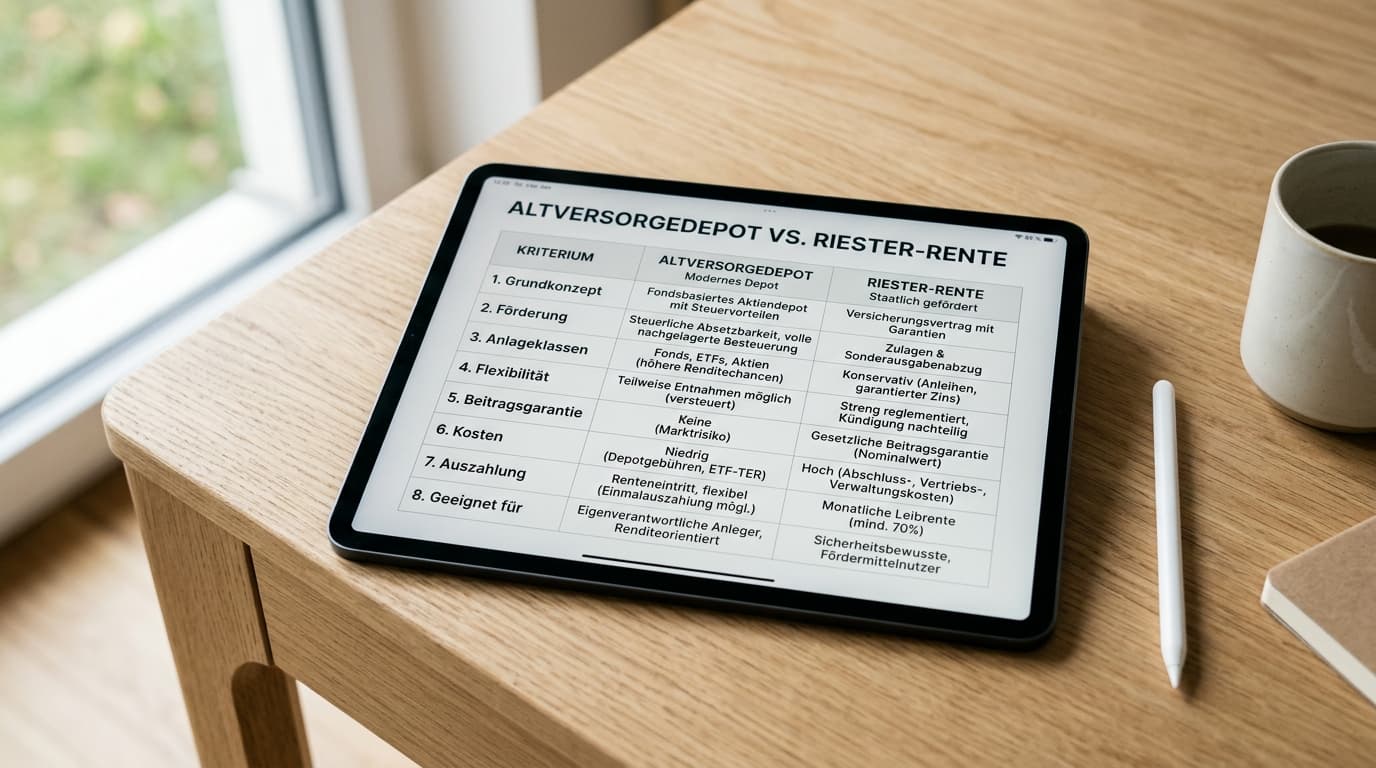
The complete criteria matrix: Altersvorsorgedepot vs. Riester
The Altersvorsorgedepot and the Riester-Rente differ fundamentally in their investment structure and guarantee obligation: while Riester contracts mandate a contribution guarantee, the Altersvorsorgedepot does without this requirement, so it can invest broadly in high-return ETFs. The state subsidy is retained in both models via allowances and tax benefits, but is simplified and structured proportionally in the Depot. According to the Bundesministerium der Finanzen (Federal Ministry of Finance, BMF), the reform is meant to make private retirement provision simpler and more attractive for all income groups[5]. Which model suits you better depends on your personal need for security.
| Criterion | Altersvorsorgedepot (AVD) | Riester-Rente |
|---|---|---|
| Contribution guarantee | No statutory guarantee obligation, allowing a free equity allocation; 80 percent or 100 percent can optionally be chosen | A statutory contribution guarantee of at least 80 percent or 100 percent sharply limits the equity allocation |
| Capital investment | Broad ETF and equity investments possible for higher long-term return potential | Often security-oriented mixed funds, expensive bonds, or classic pension insurance policies |
| Product costs | Low account and ETF fees; a cost-capped standard product is mandatorily provided for | Often high upfront, distribution and ongoing administrative costs weigh on the real return |
| State subsidy | A contribution-proportional allowance of up to 540 euros a year plus additional child allowances | A fixed Grundzulage of 175 euros a year plus additional child allowances for eligible persons |
| Payout phase | Flexible drawdown plans up to age 85, with no mandatory lifelong annuitisation | Mandatory annuitisation via a lifelong Leibrente (life annuity) from the start of retirement |
The mathematical breakdown shows clear differences for different saver profiles. Anyone with a long investment horizon who prioritises return over absolute guarantees generally benefits from the Depot's higher-return equity investment. In our knowledge section, you'll find deeper guides on detailed tax questions and the legal framework. For existing Riester savers, the question from 2027 is whether switching is worthwhile, taking into account allowances received so far and any switching fees. With the subsidy calculator, we offer you a transparent way to work through this decision based on your individual contracts. For particularly complex contracts or uncertainties, our independent advice service is available to arrange a free conversation with licensed experts. Not investment advice within the meaning of § 1 Abs. 1a Nr. 1a KWG.
Frequently asked questions
- When does the new Altersvorsorgedepot start?
- The new Altersvorsorgedepot starts on 1 January 2027 as the official, state-subsidised successor to Riester, under legislation from the Bundesfinanzministerium (Federal Ministry of Finance).
- How high is the maximum Grundzulage under the Altersvorsorgedepot compared with Riester?
- Under Riester, the Grundzulage was a flat 175 euros a year. Under the new Altersvorsorgedepot, the maximum Grundzulage is up to 540 euros a year, if you pay in the annual maximum contribution of 1,800 euros.
- Does the Altersvorsorgedepot have a contribution guarantee like Riester?
- Unlike the Riester-Rente, the Altersvorsorgedepot has no mandatory guarantee; optionally, a contribution guarantee of 80 or 100 percent can be agreed. Without a guarantee, your contributions can flow 100 percent into high-return ETFs or equities.
- What happens to my existing Riester contract from 2027?
- From 2027, you have three options: you can keep saving into your Riester contract unchanged, let it rest contribution-free, or transfer the accumulated balance tax-free into the new Altersvorsorgedepot.
- How high is the Kinderzulage under the Altersvorsorgedepot?
- The state Kinderzulage for the Altersvorsorgedepot is up to 300 euros per child per year. This requires a personal contribution of at least 300 euros for the respective child.
- Can self-employed people use the new Altersvorsorgedepot?
- Yes, the Altersvorsorgedepot significantly widens the circle of people eligible for the subsidy. Unlike the classic Riester-Rente, the self-employed and freelancers will be directly eligible for the subsidy from 2027.
Sources
AVD or an alternative - which fits you?
We'll compare the Altersvorsorgedepot with your current or planned alternative.
Free and without obligation. Advice from an adviser in our independent network of 1,000+ vetted advisers.