Frühstart-Rente vs. Altersvorsorgedepot: the difference

Published on · Updated on · Managing Director & Partner, Alsterspree Verlag GmbH
This article was written by an author with the support of AI.
Request a free consultation
A free, no-obligation conversation with an adviser from our independent network of 1,000+ vetted advisers.
The basic concept: children's provision versus the adult account
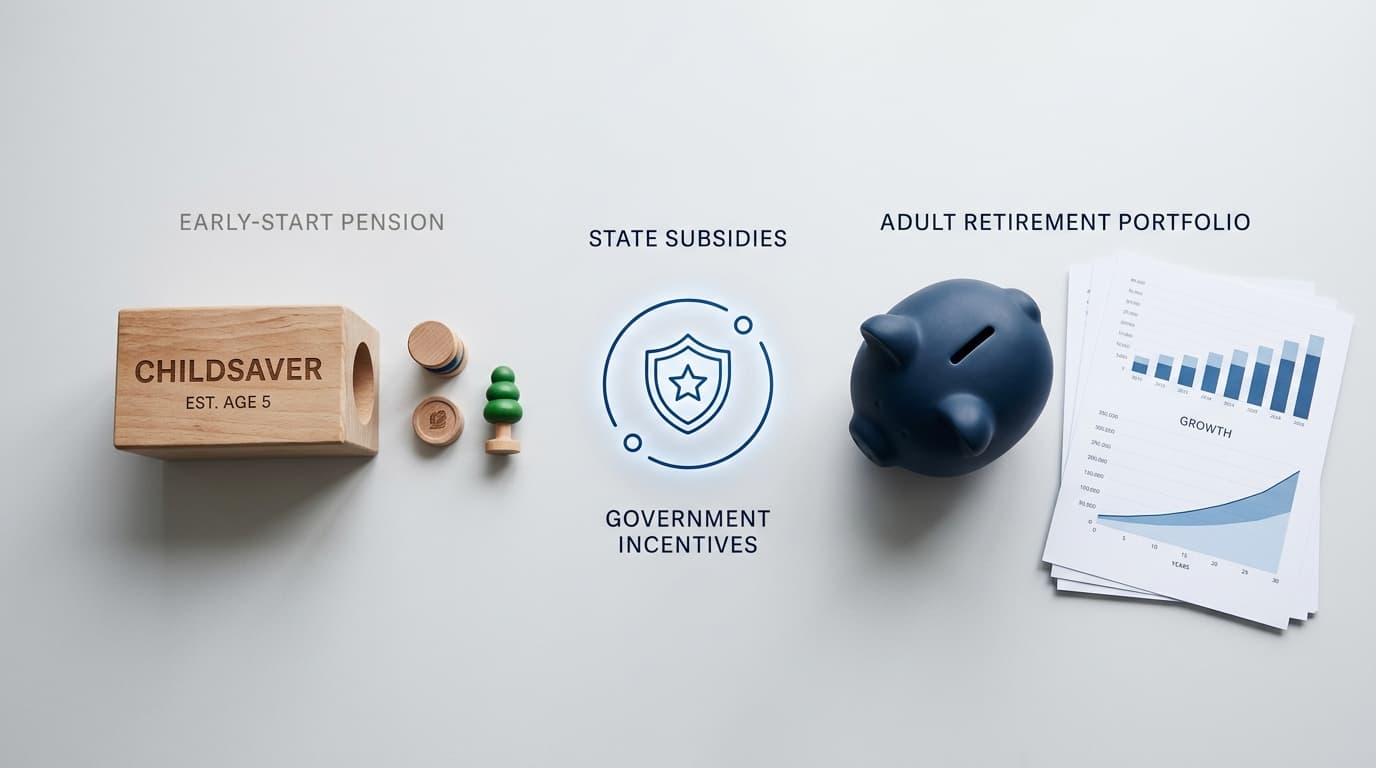
The Frühstart-Rente and the Altersvorsorgedepot are two coordinated building blocks of subsidised private retirement provision. While the Frühstart-Rente secures state-subsidised starting capital for children from age 6 to 18, the Altersvorsorgedepot serves adults from age 18 for self-directed provision. Both models build on return-oriented capital-market investments such as ETFs and allow for a tax-free accumulation phase. Important context: the Altersvorsorgedepot has been enacted in law, whereas the Frühstart-Rente so far rests only on policy points adopted by the federal cabinet; a bill has merely been announced[11].
The key difference lies in the target group, the contribution structure and the funding logic. For the Frühstart-Rente, the federal government is to pay a flat 10 euros a month directly into the account for eligible children. For the Altersvorsorgedepot for adults, by contrast, the state subsidy is tied to the account holder's own contributions. On reaching the age of majority, the children's account is transitioned seamlessly into a regular Altersvorsorgedepot, so the compounding effect works across an entire lifetime.
| Criterion | Frühstart-Rente (children & teenagers) | Altersvorsorgedepot (adults) |
|---|---|---|
| Eligible group | Children aged 6 to 18 | Adults from age 18 |
| State premium | 10 euros a month, flat rate | Percentage-based allowance on own contributions |
| Maximum contribution / additional payment | Additional own contributions up to 6,840 €/year | Subsidised own contributions under the law |
| Investment form | Certified provision account / ETFs | Certified Altersvorsorgedepot / ETFs |
Because the two systems are directly interlinked, there is no need for a manual contract switch on reaching adulthood. We help you structure the optimal provision strategy for your family early on. Note: not investment advice within the meaning of § 1 Abs. 1a Nr. 1a KWG.
Target groups and age limits: when each model applies
The state-subsidised provision models are aimed at different life stages and are systematically designed to build on one another. While the Frühstart-Rente is designed specifically for children and teenagers, the Altersvorsorgedepot applies to savers who have reached the age of majority. The aim of this design is to build up capital in the markets early and continue that process into adulthood without a break in the system. Under the cabinet policy points, the Frühstart-Rente is to apply to children and teenagers from the completed age of 6 to 18, provided there is an entitlement to Kindergeld (child benefit)[1]. From the 18th birthday, the regular Altersvorsorgedepot takes over the active accumulation phase through to retirement.
| Feature | Frühstart-Rente | Altersvorsorgedepot |
|---|---|---|
| Target group | Minors (children and teenagers) | Working adults and savers of legal age |
| Age limit | Age 6 to the completed age of 18 | From age 18 to retirement |
| State base amount | €10 / month (€120 / year) | Allowance and matching system |
| Own contributions | Optional, up to €6,840 / year | Flexible, with a minimum contribution (€120 / year) |
| Administration | Parents' account or collective investment | Independently managed account |
The transition at the age-of-majority threshold happens seamlessly: the assets accumulated in the Frühstart-Rente up to age 18 remain invested tax-free and form the foundation for the subsequent Altersvorsorgedepot. For families with children, this creates an unbroken chain of state support and personal wealth-building. Our subsidy calculator helps you trace transparently the precise effect of own contributions and state allowances for your family's individual situation.
Note: the figures and comparisons given serve to neutrally illustrate the statutory framework and do not constitute financial or investment advice within the meaning of § 1 Abs. 1a Nr. 1a KWG.
State subsidy: monthly premium versus allowance system
The funding logic of the two instruments differs fundamentally in its financing structure and objective. While the Frühstart-Rente serves children as state-funded starting capital, the Altersvorsorgedepot for adults from age 18 relies on an incentive system of own contributions, a Grundzulage and tax savings. For parents, this separation of systems marks a clear methodological break in the family's long-term provision plan once the child reaches the age of majority.
Direct payment for children versus proportional funding of own contributions
With the Frühstart-Rente, the federal government provides the entire initial funding with no obligation to contribute personally. For every child from the completed age of 6 to 18, 10 euros a month - so 120 euros a year - flows directly from federal funds into the child's account. Parents do not have to make their own contributions for this, though they can optionally top up the balance with private savings. For the Altersvorsorgedepot for adults, the mechanics change fundamentally. The system requires own contributions, but rewards them with a state Grundzulage (the basic state allowance) of up to 540 euros a year. For families, this funding lever increases significantly through the Kinderzulage (the child allowance), which is worth up to 300 euros per child a year. This requires meeting the necessary own contribution.
| Funding feature | Frühstart-Rente (age 6 to 18) | Altersvorsorgedepot (from age 18) |
|---|---|---|
| State premium | €10 / month (€120 / year) directly from the state | Grundzulage of up to €540 / year |
| Obligation to contribute | No obligation to make additional payments | Tied to own savings contributions |
| Kinderzulage | Not provided for | Up to €300 per child a year |
| Tax effects | Tax-exempt during the accumulation phase | Allowance or Sonderausgabenabzug (deduction as a special expense) |
Please note that all calculations and funding figures are purely illustrative and do not constitute financial or investment advice within the meaning of § 1 Abs. 1a Nr. 1a KWG. Because the two systems interlock seamlessly, parents build a solid foundation from the start, which transitions into the Altersvorsorgedepot on reaching the age of majority without any break in funding.
Own contributions and additional payments: scope for families
In how contributions are structured, the Frühstart-Rente and the Altersvorsorgedepot differ fundamentally in their systematics. While the state guarantees a fixed base amount of 10 euros a month (120 euros a year) for the Frühstart-Rente from the sixth year of age, this funding is entirely independent of parents' own payments. Even so, the model offers families considerable financial scope: parents, grandparents or godparents may voluntarily pay up to 6,840 euros a year (equivalent to 570 euros a month) into the child's account to strengthen the compounding effect early on[2].
| Criterion | Frühstart-Rente (age 6 to 18) | Altersvorsorgedepot (from age 18) |
|---|---|---|
| State base amount | €10 monthly (guaranteed without an own contribution) | Allowance funding tied to own contribution |
| Voluntary additional payments | Up to €6,840 / year possible from family | Own contribution determines the funding rate and tax benefit |
| Income means-testing | No, the subsidy is independent of income | Yes, tax savings via the more-favourable-treatment test |
| Minimum own contribution | No own contribution required | Statutory minimum contribution for the full allowances |
For the Altersvorsorgedepot from age 18, the logic shifts to an allowance-based self-provision model. Here, the size of your own contribution directly determines the state funding rate and the tax effect via the Sonderausgabenabzug. For adult savers and young families, this means every euro paid in optimises both the total allowance and the tax benefit. Parents who later want to provide additionally for their own children benefit, within the Altersvorsorgedepot, from targeted family support through Kinderzulagen.
Combining the two instruments therefore allows a seamless path across generations: over the first twelve years, the Frühstart-Rente builds up an initial capital cushion with no obligation to contribute, which can be scaled up through voluntary family payments. From the age of majority, the Altersvorsorgedepot takes over, to make the most of the funding levers through your own savings rates. Our subsidy calculator is available to help you determine your optimal own-contribution rate. Please note: all contribution and calculation examples are for orientation only and do not constitute investment advice within the meaning of § 1 Abs. 1a Nr. 1a KWG.
Investment forms and the state Standarddepot
Both for the Frühstart-Rente for children and the Altersvorsorgedepot for adults, the legislature is making a fundamental shift in approach. The central innovation in both models is dropping the rigid contribution guarantee. Whereas previous Riester-Rente (Germany's existing subsidised private pension) products had to guarantee 100 percent of the capital paid in, forcing much of the money into low-interest bonds, the new system allows for full investment in real assets. Savings can therefore be invested directly, without an artificial guarantee brake, in promising ETFs and global equity funds. This secures a noticeably higher expected return, especially over long time horizons such as for children from their sixth year of age.
Investment options and the Standarddepot compared directly
- Growth-oriented index funds: savers, as well as parents saving for their children, benefit from a broad choice of certified ETFs and funds without expensive guarantee components.
- No guarantee constraint: the mandatory contribution guarantee is dropped, so invested capital benefits continuously from the return potential of global financial markets.
- State Standarddepot (the statutory default account) as a fallback: for people who make no choice of their own or do not actively assign their contract to a private provider, the state provides a low-cost, collective Standarddepot.
- Transparent cost structure: the Standarddepot guarantees lean administration and protects assets from excessive product and set-up fees.
The state Standarddepot thus acts as a collective safety net for unanswered applications or passive savers. It ensures that contributions automatically flow into a standardised, low-cost portfolio structure, with no bureaucratic disadvantage for the individual. For families and self-directed savers, this brings real peace of mind: the Frühstart-Rente's state allowances are not lost even if no decision has yet been made in favour of a particular neobroker or financial services provider.
A seamless transition on the 18th birthday
On reaching the age of majority, an automatic system switch is envisaged for the provision model. The Frühstart-Rente children's account is to be converted seamlessly, on the 18th birthday, into a full Altersvorsorgedepot for adults[3]. The accumulated provision capital, together with all accrued interest and capital gains, is preserved in full, down to the cent. No securities are sold, which avoids any taxable realisation of gains; returns remain tax-free during the accumulation phase.
Because of this fluid transition, young adults take over full administration and decision-making power over the subsidised balance. From this point on, the funding logic and contribution structures change too: in place of the state premium of 10 euros a month comes the regular adult funding of the Altersvorsorgedepot. From age 18, personal funding eligibility depends on your own contributions and circumstances, for example through Grundzulagen or Berufseinsteiger-Boni (career-starter bonuses).
- Automatic account conversion: on the 18th birthday, the children's account is transitioned into a regular Altersvorsorgedepot with no loss of capital.
- Taking over account management: the assets previously managed by the parents pass into the sole control of the saver, now of legal age.
- Activating adult funding: the fixed state amount of 10 euros a month ends; the regular allowance funding on own savings contributions applies instead.
- Flexible continued saving: the contract can be continued independently with monthly savings rates, adjusted, or transferred to a different certified provider if needed.
Even in cases where parents did not open an individual account during the child's minority and the money was invested through the state's collective solution, the starting capital remains secure[4]. Once they reach the age of majority, young people can straightforwardly transfer the funds accumulated up to that point into their personal Altersvorsorgedepot. We recommend that young adults check their contract details right after their 18th birthday and adjust the savings plan to match their own training or employment income.
Tax treatment during the accumulation phase and in retirement
Both for the Frühstart-Rente for children and the Altersvorsorgedepot for adults, the tax treatment follows the principle of deferred taxation[5]. Throughout the entire accumulation phase, you benefit from a full tax exemption: all returns, dividends and realised capital gains remain free of the standard capital gains tax and the solidarity surcharge. The accumulated capital can therefore grow through the compounding effect over decades without annual tax deductions. Detailed information on this is provided under state subsidies.
| Phase | Frühstart-Rente (childhood) | Altersvorsorgedepot (adulthood) |
|---|---|---|
| Accumulation phase | Tax-free dividends and capital gains | Tax-free dividends and capital gains |
| Payout phase | No payout possible before retirement age | Deferred taxation at your personal tax rate |
Only in the payout phase, in retirement, are the pension payments received subject to tax. Because the Frühstart-Rente transitions seamlessly into the Altersvorsorgedepot on reaching the age of majority, the entire balance counts as taxable income in old age. The payouts are then subject to your individual income tax rate in retirement, which is typically considerably lower than during your active working life. (Not investment advice within the meaning of § 1 Abs. 1a Nr. 1a KWG.)
Orientation for parents: how to plan provision for your child
For families, the comprehensive reform of subsidised private retirement provision opens up two powerful, coordinated building blocks. To make the most of the compounding effect over several decades, parents can use the Frühstart-Rente for their child from the completed age of 6 as soon as it has been introduced[6]. Under this planned form of provision, the state is to pay 10 euros a month directly into an account running in the child's name until the child turns 18. Because the savings can be invested directly in the capital markets in high-return asset classes such as ETFs without a guarantee requirement, valuable starting capital already builds up during childhood and adolescence.
A step-by-step family strategy: the Frühstart-Rente and your own Altersvorsorgedepot
- Activate the Frühstart-Rente from age 6: setting up the children's account in good time secures the state contribution of 10 euros a month from the first day of eligibility and makes consistent use of the long investment horizon.
- Optimise your own funding in the Altersvorsorgedepot: alongside the children's account, it is worth reviewing the parents' own contracts. The Kinderzulage brings significant state bonuses into the parents' own Altersvorsorgedepot, strengthening the whole family's funding rate.
- Plan the seamless transition to adulthood: on the 18th birthday, the Frühstart-Rente children's account converts into a regular Altersvorsorgedepot with no tax disadvantages. The young adult can continue the contract independently, benefit from Berufseinsteiger-Boni, and let the accumulated starting capital keep growing.
We advise parents to always plan provision for their children alongside their own retirement provision. Combining the state-funded Frühstart-Rente with targeted own provision in the Altersvorsorgedepot makes the best use of the statutory funding structures. When it comes to calculating the exact allowances and choosing the right approach, we offer transparent guidance so you can choose the ideal path for your family, whether that is independent online management or personal expert advice. Note: not investment advice within the meaning of § 1 Abs. 1a Nr. 1a KWG.
Frequently asked questions
- From what age does the Frühstart-Rente apply, and when does the Altersvorsorgedepot start?
- The Frühstart-Rente is intended to support children from the completed age of 6 up to their 18th birthday. From age 18, adults move to the regular Altersvorsorgedepot with its own allowance funding.
- Who pays the contributions for the Frühstart-Rente compared with the Altersvorsorgedepot?
- For the Frühstart-Rente, the federal government is to pay in 10 euros a month automatically, without parents having to make their own contributions. For the Altersvorsorgedepot, adults make their own contributions, on which the state grants allowances.
- What happens to the Frühstart-Rente when the child turns 18?
- On the 18th birthday, the Frühstart-Rente account transitions seamlessly into a certified Altersvorsorgedepot. The young adult can continue saving into the contract themselves or switch to a different subsidised product.
- Do parents have to make their own contributions to receive the Frühstart-Rente?
- No, there is no obligation to make own contributions for the monthly state premium of 10 euros. Parents or grandparents may, however, voluntarily pay in up to 6,840 euros a year.
- How are returns taxed under the two account types?
- During the accumulation phase, all gains and dividends remain tax-free under both account models. Taxation only applies later, on payout in retirement, at your individual tax rate.
- What happens if parents don't open an account for their child?
- If parents do not choose an individual account, the state invests the money in a collective, cohort-based fallback solution. The balance can later be transferred to a personal account.
Sources
- [1]finanztip.de
- [2]tagesspiegel.de
- [3]finanztip.de
- [4]finanztip.de
- [5]bundesfinanzministerium.de
- [6]finanztip.de
- [7]bundesfinanzministerium.de
- [8]finanztip.de
- [9]finanztip.de
- [10]finanztip.de
- []Altersvorsorgedepot 2027: all the key facts at a glance
- []Altersvorsorgedepot explained simply
- []AVD subsidy for families: a worked example
- []Which ETFs for the Altersvorsorgedepot? The selection guide
- []Who is eligible for the Altersvorsorgedepot subsidy?
- []Minimum contribution for the AVD: how much for the full subsidy?
- []Kinderzulage for the Altersvorsorgedepot: how much per child?
- []Tax subsidy & Sonderausgabenabzug for the AVD
- [11]bundesregierung.de
Request a free consultation
Free and without obligation. Advice from an adviser in our independent network of 1,000+ vetted advisers.