Altersvorsorgedepot first, or pay off debt first?

Published on · Updated on · Managing Director & Partner, Alsterspree Verlag GmbH
This article was written by an author with the support of AI.
Is the AVD worth it for you?
A free, no-obligation conversation with an adviser from our independent network of 1,000+ vetted advisers.
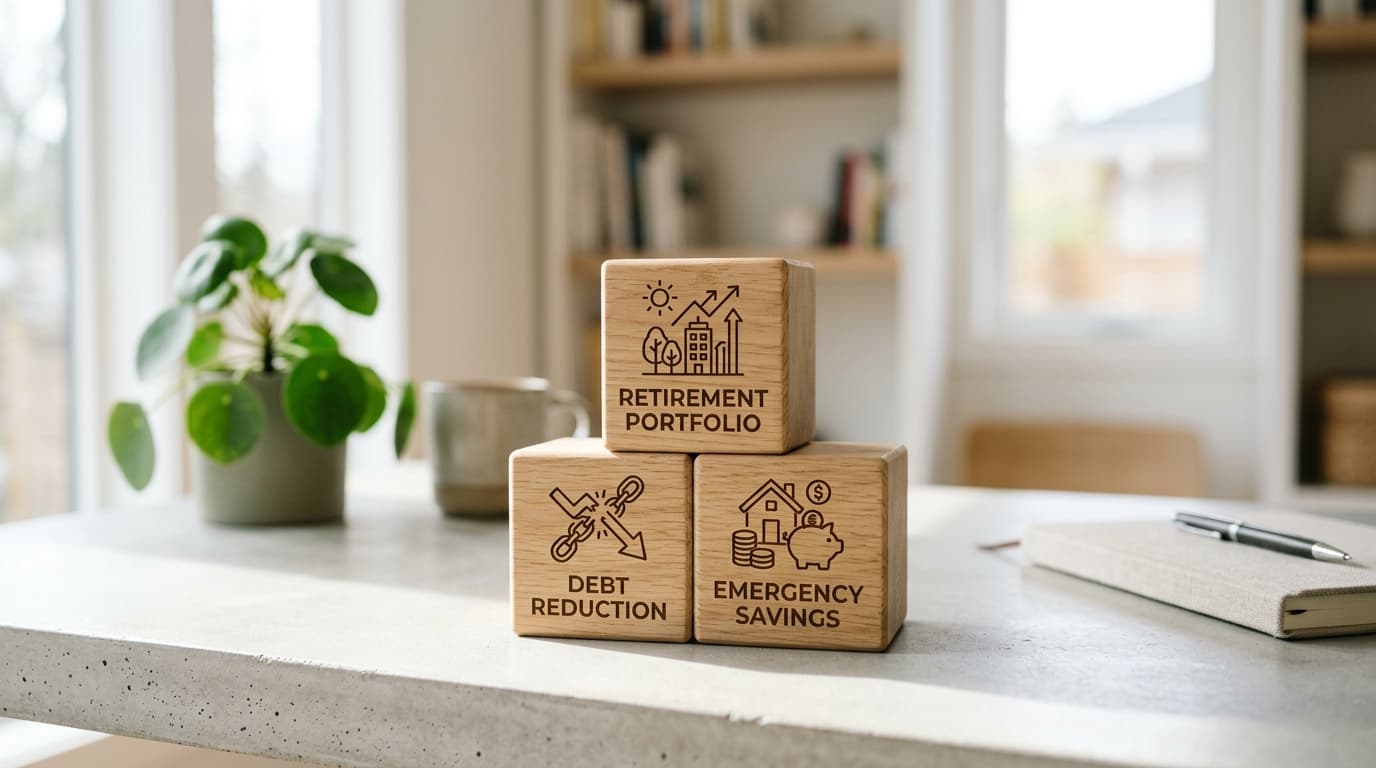
Financial priorities: why paying off debt comes before retirement saving
Before you start building wealth through an Altersvorsorgedepot, paying off expensive consumer debt and building an emergency fund come first. Because the interest burden on existing loans is in many cases well above the long-term expected return of an ETF portfolio, every repayment earns you a risk-free, tax-free return. The only debts exempt from this priority order are long-term, low-interest liabilities such as a mortgage.
- Paying off expensive consumer debt: overdrafts with average interest rates above 12 percent, or instalment loans, weigh heavily on the monthly budget and should be paid off immediately.
- Building an emergency reserve: before your first investment, an emergency fund of three to six months' expenses belongs in an easily accessible instant-access savings account, to cover unexpected costs without taking on new debt.
- Starting retirement saving: once your financial base is stable, it's worth starting the state-subsidised Altersvorsorgedepot, where career starters can benefit from allowances and the one-off career-starter bonus.
From a financial-mathematics point of view, this order is unshakeable: someone who pays off an overdraft at an interest rate of around 12 percent, for example, saves that interest cost immediately. By comparison, historical stock-market returns of around 7 to 8 percent a year are, unlike the return on repayment, not guaranteed. Once this foundation of debt-free status and an emergency reserve is in place, you can invest your savings in the new account. Use our knowledge section to find the right investment strategy for the start of your career. (Note: not investment advice within the meaning of § 1 Abs. 1a Nr. 1a KWG.)
The mathematical reality: a guaranteed interest saving beats a speculative account
As a career starter, you're facing an exciting phase: your first own salary is coming in, and you'd love to start building wealth right away. The state-subsidised Altersvorsorgedepot in particular tempts with attractive allowances. But before you invest your first euro, financial logic demands a look at your liabilities. If you're still carrying expensive consumer debt or an overdrawn current account, that will destroy your financial return faster than any equity investment can build it up.
| Financial option | Interest rate / expected return (p.a.) | Risk profile | Priority for career starters |
|---|---|---|---|
| Overdraft (current-account overdraft) | approx. 11.31 percent[7] | Risk-free saving (guaranteed) | Immediate repayment |
| Instalment loan / consumer loan | approx. 8.49 percent | Risk-free saving (guaranteed) | High priority (before starting the account) |
| Equity market (e.g. MSCI World) | approx. 7.0 to 8.0 percent | Speculative (subject to fluctuation) | After debt is repaid |
The reasoning behind this order is simple: paying off debt is mathematically equivalent to a guaranteed investment. If you clear a negative balance on your current account that costs you an average of 11.31 percent interest, you achieve a risk-free return of exactly that size. No equity investment and no Altersvorsorgedepot in the world can guarantee you a return like that. What's more, the interest you save is, unlike investment income, completely tax-free. Only once these expensive interest drains are eliminated does a long-term investment make sense. Our knowledge section helps you lay out the fundamentals for your personal financial planning in a structured way.
This iron rule, however, does not apply equally to every type of debt. You don't necessarily have to pay off cheap, long-term loans in full before starting the Altersvorsorgedepot — things like low-interest KfW student loans or a later mortgage. If the loan's interest rate is well below the account's expected return plus the state subsidy, building both in parallel makes sense. Once your foundation of paid-off consumer debt and a solid emergency fund is in place, you can use the subsidy calculator to work out how much the state allowances speed up your wealth-building.
Note: the interest rates and historical return figures shown here are for illustration only and do not constitute investment advice within the meaning of § 1 Abs. 1a Nr. 1a KWG.
Good debt versus bad debt: when loans may keep running
Not every financial obligation should block your start into retirement saving. As a career starter, you're often faced with the question of whether outstanding liabilities have to be paid off in full first. A clear distinction is essential here: expensive consumer debt and overdrafts, whose interest rate averages over 11 percent according to the Verbraucherzentrale Hamburg (Hamburg consumer advice centre)[2], eat up any investment gain. Such liabilities take absolute priority for repayment, because the interest you save represents a risk-free return that even the new Altersvorsorgedepot can barely beat reliably. Only once these burdens are cleared and a solid emergency fund is in place is the way clear.
It's a very different story with so-called good debt. An excellent example is the BAföG loan. It is interest-free by design and does not burden your budget with ongoing interest costs. Even so, you should check whether an early lump-sum repayment would earn you a significant discount. If that isn't possible or desired, the BAföG loan is no obstacle at all to starting the subsidised Altersvorsorgedepot. Much the same applies to a long-term mortgage: such property loans are usually fixed and firmly calculated, and serve long-term wealth building. Letting them run in parallel with retirement saving makes sense in financial-mathematics terms, since it lets you benefit early from compound interest and state allowances.
| Type of debt | Typical interest rate / special feature | Priority relative to the Altersvorsorgedepot |
|---|---|---|
| Overdraft & consumer debt | Very high (often over 11% p.a.) | Absolute priority (repay immediately) |
| BAföG loan | Interest-free (discount on lump-sum repayment) | Lower priority (start the account in parallel) |
| Mortgage | Medium (predictable long term) | Lower priority (use allowances in parallel) |
For a precise judgement of the interest rate above which repayment is mathematically more worthwhile than investing, it's worth taking a structured look at the subsidy rate. If the loan's interest rate is well below the expected return including state allowances, building wealth in parallel pays off. Our neutral knowledge section has deeper analyses of interest-rate differentiation. You can also use the subsidy calculator to work out directly how much the state subsidy boosts your effective return, so you can make a well-founded decision for your personal financial plan.
The emergency fund as a firewall: safety before wealth building
Especially at the start of your career, the temptation is strong to put the first money you've earned yourself straight into long-term wealth building. But before you set up savings instalments for the Altersvorsorgedepot, you should build a stable foundation. Without financial reserves, unexpected expenses risk an expensive return to your overdraft. Such consumer debt immediately eats into your financial capacity, since the debit interest usually clearly exceeds the long-term return prospects on the equity market. The emergency fund acts here as an indispensable firewall, securing your liquidity and protecting you from debt.
- Three to six months' expenses: this iron reserve is a reliable rule of thumb for career starters to bridge unforeseeable life situations financially.
- The instant-access account as a parking spot: keep this amount strictly separate from your everyday current account, to ensure immediate availability with no market risk.
- No chasing returns with your safety buffer: the emergency fund isn't there to grow your wealth, but purely to preserve capital and secure liquidity.
From the perspective of structured financial planning, a solid cash reserve also protects your long-term retirement strategy. If you have to sell units from your Altersvorsorgedepot early in an emergency, you risk significant losses depending on the market phase. A forced sale during a stock-market correction permanently interrupts the compound-interest effect and can put your state-subsidised retirement saving at risk. If you make sure in advance that you have enough liquidity, you ensure your fund holdings can keep growing untouched. Our knowledge section shows you how to adjust your savings instalments to fit your stage of life.
Once this foundation is in place, you can take the next step with peace of mind and make full use of the state subsidies on the new Altersvorsorgedepot. Only after securing everyday life does systematic wealth building pay off, because that way you stay resilient to fluctuations in the long term and can handle financial squeezes without painful compromises.
The four-step plan: the optimal financial order for career starters
For career starters, a clear principle applies to wealth building: before you tie up hard-earned capital in the new Altersvorsorgedepot, you should pay down expensive loans and build reserves. Because loan interest rates are usually above the returns you can expect on the equity market, repayment brings immediate financial benefits. Once the foundation is laid, starting into subsidised retirement models afterwards pays off all the more.
- Step 1: Pay off consumer debt - Clear overdrafts and expensive consumer debt in full.
- Step 2: Build an emergency fund - Save up an iron reserve of three to six months' expenses in a safe instant-access account.
- Step 3: Secure the AVD subsidy - Start the subsidised Altersvorsorgedepot and take the state allowances and starter bonuses with you.
- Step 4: Adjust savings instalments dynamically - Increase your contributions step by step as your salary rises.
| Type of debt | Interest level (benchmark) | Priority | Recommended action |
|---|---|---|---|
| Overdraft | Above 11 percent | Before the Altersvorsorgedepot | Repay immediately, since the interest saving exceeds the return |
| Consumer loan | 6 to 9 percent | Before the Altersvorsorgedepot | Should be paid off as fast as possible, to stop the interest burden |
| BAföG loan | Low or interest-free | After the Altersvorsorgedepot | Keep up regular instalments and save in a subsidised account in parallel |
The mathematical logic behind this priority order is beyond dispute. While a broadly diversified equity ETF has historically achieved a return of about 7.7 percent a year[4], the average interest rate for an overdraft in Germany stood at 11.22 percent in May 2025[2]. Paying off debt therefore takes priority here, since it guarantees a risk-free saving that exceeds the market return. Only once consumer debt is paid off and a sufficient emergency fund is in place is retirement saving worthwhile. Career starters also benefit from a one-off career-starter bonus of 200 euros on the Altersvorsorgedepot, which makes an early start after clearing debt hugely attractive. You can work out the potential effect of the state allowances easily with the subsidy calculator.
Through long-term investing, young savers benefit optimally from the compound-interest effect, even if they initially invest only small monthly contributions. You'll find further analysis in the knowledge section. (Note: not investment advice within the meaning of § 1 Abs. 1a Nr. 1a KWG.)
Comparison table: types of debt and the right starting point for the account
As a career starter, you're often faced with the question of how best to split your first income. The new Altersvorsorgedepot offers attractive state subsidies, but financial reality demands a clear order of priorities. A basic principle of financial planning states: the guaranteed interest saving from paying off debt is economically almost always worth more than the speculative return on an investment. Before you tie up capital long term, you should therefore secure your financial foundation and consistently pay down expensive legacy debt.
| Type of debt | Typical interest rate | Recommendation | Prioritisation |
|---|---|---|---|
| Overdraft | 11.22%[2] | Repay immediately, before starting the account | The interest saving clearly exceeds the expected equity return. |
| Consumer / instalment loan | 6% to 11% | Prioritise consistent repayment | A high interest burden reduces the monthly savings rate available for the account. |
| BAföG loan | 0% (interest-free) | Strategic partial repayment | Check early repayment for discounts of up to 21%[8]. |
| Mortgage | 3% to 4.5% | Build wealth in parallel | Long-term low interest rates allow an early start to the account thanks to compound interest. |
This breakdown shows that expensive consumer debt in particular presents a major obstacle to your long-term retirement saving. Every euro you use to pay off an expensive overdraft earns you an immediate, risk-free return equal to the debit interest saved. That doesn't apply across the board to every liability, though: you don't need to rush to repay an interest-free BAföG loan, provided you can't make use of the state discount for a lump-sum repayment. Our knowledge section offers neutral, source-based analyses to help you weigh this up.
For the optimal planning of your future savings instalments, we recommend starting once you've paid off expensive debt and built an emergency fund of three to six months' expenses. With the subsidy calculator you can work out exactly how much the state allowances affect your expected final capital. That way you make sure your retirement saving rests on a solid foundation, without unresolved liabilities quietly eating into your return in the background (not investment advice within the meaning of § 1 Abs. 1a Nr. 1a KWG).
The strategic AVD start: making the most of state support as a career starter
Once your personal financial foundation of a solid emergency fund and a paid-off overdraft is in place, the new Altersvorsorgedepot offers, from 2027, an excellent opportunity for long-term wealth building. Young career starters under 25 in particular benefit from targeted state support when they start their contract: on top of the annual basic allowance, they receive a one-off career-starter bonus of 200 euros. Together with the state basic allowance, which amounts to 50 percent on the first 360 euros and 25 percent on further contributions up to a maximum of 1,800 euros, even small personal contributions can achieve a considerable subsidy rate[5]. The statutory minimum personal contribution is only 120 euros a year, which makes it easier to get started even on a still-tight budget in your first job. This combination of a high state subsidy rate and a low entry hurdle makes the account a highly efficient tool, especially for career starters.
| Annual personal contribution | Regular basic allowance | One-off starter bonus | Subsidy rate in year 1 |
|---|---|---|---|
| 120 euros | 60 euros | 200 euros | 216 percent |
| 360 euros | 180 euros | 200 euros | 105 percent |
| 1,800 euros | 540 euros | 200 euros | 41 percent |
Because career starters often have an extremely long investment horizon of more than 40 years, the compound-interest effect has maximum impact on them. Small amounts invested early, together with the state allowances, work in the capital markets over decades and grow exponentially. If you want to calculate your personal subsidy rate and projected final capital in detail, our platform's subsidy calculator is available to you. In the knowledge section you'll also find in-depth guides on the statutory framework. To implement your plan afterwards, you can use the independent advice service or independently choose the right partner via our provider comparison. All model calculations and subsidy examples are for illustration only and do not constitute investment advice within the meaning of § 1 Abs. 1a Nr. 1a KWG.
Two paths to a decision: deciding for yourself or getting personal advice
Once you've got your finances in order (consumer debt paid off, emergency fund built), the question for you as a career starter is how exactly to approach starting the Altersvorsorgedepot. According to a study by the Deutsches Institut für Altersvorsorge (DIA, the German retirement-provision institute), the shift from theoretical knowledge to concrete action in practice often stalls on decision anxiety or the hurdle of taking the first step[6]. This is exactly where Vorsorgedepot-Lotse offers neutral guidance. You don't have to make this defining decision alone — you can choose flexibly between two equally valid paths that fit your personal way of working and living.
The digital savings path for independent decision-makers
If you like managing your finances independently and already have some experience with securities, the fully digital path is ideal for you. To prepare, the best tool is the subsidy calculator, to work out your expected state subsidy and the long-term cost impact transparently. For implementation afterwards, the provider comparison is available to you. With this neutral tool, you compare various neobrokers and account providers against clear criteria and reach account opening through direct links. The knowledge section offers additional background information with its source-backed guides.
Personal support for complex financial questions
Not every career starter wants to make far-reaching financial decisions for old age entirely alone. If you'd like individual guidance, or you're unsure whether the subsidised account fits optimally into your overall plan, the independent advice service is the right choice. Through this service, we put you in direct contact with licensed, independent financial advisers. In a free initial consultation, you get a professional assessment tailored exactly to your personal situation.
- Option A (digital path): you work out your state allowances using the subsidy calculator, then use the provider comparison to open the right account online yourself.
- Option B (advice path): you use the independent advice service for a personal, qualified consultation with an independent expert to clarify any open questions before signing a contract.
Frequently asked questions
- Why should I pay off debt before saving into the Altersvorsorgedepot?
- Paying off expensive debt gives you a safe, risk-free return equal to the interest rate you save. Since overdrafts cost an average of 11.31 percent and instalment loans around 8.49 percent in interest, that guaranteed saving exceeds the long-term expected equity return of the account.
- Which debts absolutely must be cleared before the Altersvorsorgedepot?
- All expensive consumer debt should absolutely be paid off first, such as credit card bills, overdrafts and classic instalment loans for purchases. These loans carry high interest rates that mathematically eat into your savings faster than a securities account can gain value.
- Can I still save into the Altersvorsorgedepot despite an ongoing mortgage?
- Yes, a mortgage is a low-interest, long-term property loan and doesn't count as expensive consumer debt. Here it's usually entirely sensible to save for retirement in parallel, so you can benefit early from the compound-interest effect and the state AVD subsidy.
- How large should my emergency fund be before I pay into the Altersvorsorgedepot?
- The tried-and-tested rule of thumb recommends a liquid reserve of three to six months' expenses in an instant-access account. This emergency fund makes sure that, if unexpected expenses arise, you don't have to sell out of your account at a loss or take on an expensive overdraft again.
- Do I have to pay off my BAföG debt before I can start with the AVD?
- BAföG loans are interest-free and therefore no obstacle to the Altersvorsorgedepot. However, the Bundesverwaltungsamt (Federal Office of Administration) offers substantial discounts for an early one-off repayment. If you can make use of these discounts, immediate repayment is usually more attractive than the account.
- Is there a particular reason for career starters to begin the Altersvorsorgedepot quickly?
- Yes, the Altersvorsorgedepot offers career starters an attractive starter bonus as extra state support. Once you've paid off expensive debt and built your emergency fund, you should start early to secure these subsidies and the compound-interest effect.
Sources
Is the AVD worth it for you?
We'll help you find out whether the Altersvorsorgedepot fits your situation.
Free and without obligation. Advice from an adviser in our independent network of 1,000+ vetted advisers.