Opening an AVD at a bank or online: pros and cons

Published on · Updated on · Managing Director & Partner, Alsterspree Verlag GmbH
This article was written by an author with the support of AI.
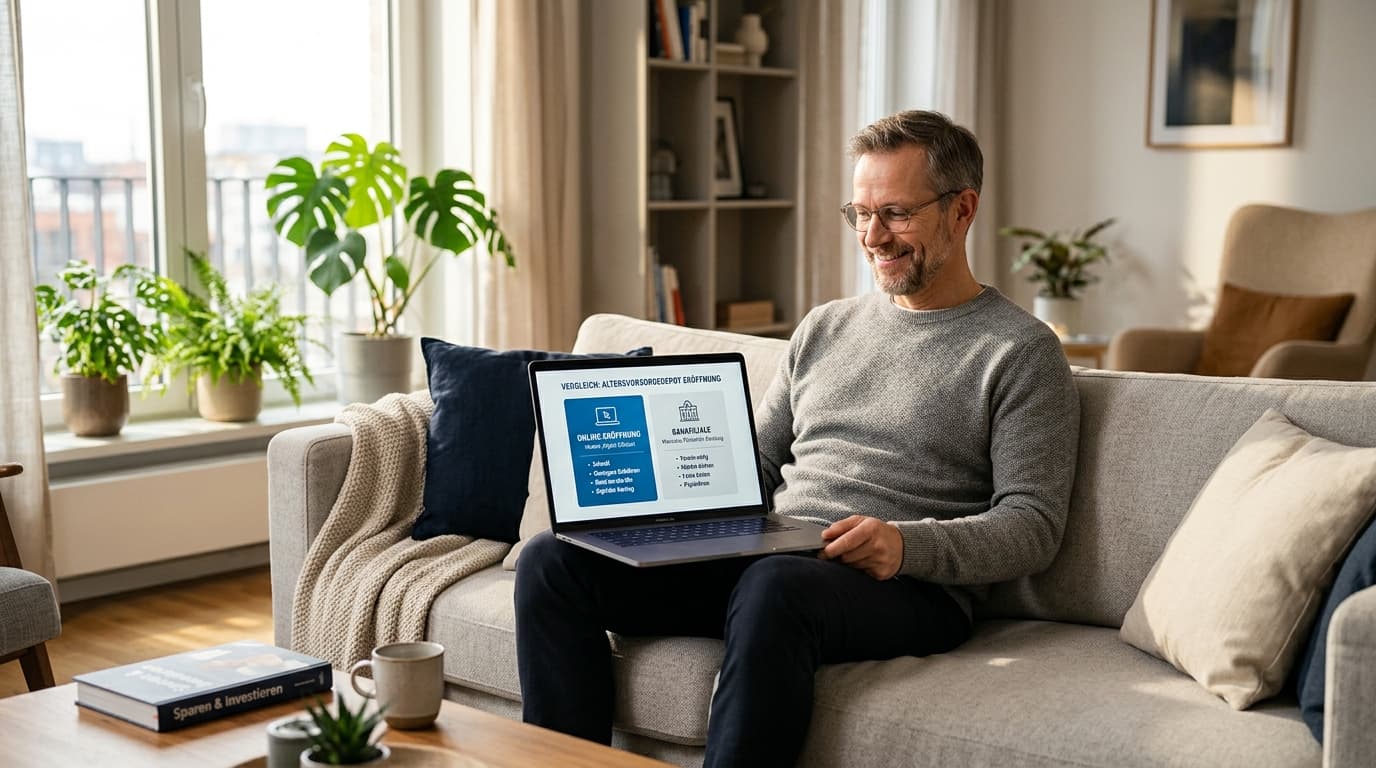
Which AVD provider fits you?
A free, no-obligation conversation with an adviser from our independent network of 1,000+ vetted advisers.
Bank or online: where does the new Altersvorsorgedepot really belong?
An Altersvorsorgedepot can be opened either flexibly online or the traditional way, at a bank branch. The digital route is usually faster and cheaper, but calls for a minimum of self-sufficiency when verifying your identity via VideoIdent or your online ID. The branch, by contrast, offers personal guidance and a familiar sense of security, but it's tied to opening hours and often comes with higher account fees. For the opening itself, the online option is usually entirely sufficient, while for deeper questions, expert advice offers the safer route in.
With the launch of the reformed Altersvorsorgedepot on 1 January 2027, a new era of state-subsidised pension provision begins for private savers in Germany, replacing the previous Riester-Rente[1]. For security-minded investors, one fundamental question comes to the fore: where should the account be held, and how should it be opened? The choice between going to your local branch bank and registering independently online with a neobroker or a direct bank is far more than a matter of taste. It marks the classic tension between personal support on the ground and tight control of the costs that shape your return over the long run. In our knowledge section, we set out the pros and cons of both routes transparently and with sources, so you can make a well-founded decision.
| Criterion | Opening online | Opening at a branch |
|---|---|---|
| Duration | A few minutes (instant identification) | Several days (appointment needed) |
| Cost | Usually free (low-cost account administration) | Opening or advisory fees more common |
| Help with questions | Digital support (FAQs and chat) | Personal advice from bank staff |
| Security & identification | VideoIdent, PostIdent or online ID | Personal ID check in person |
Especially for security-minded savers who are sceptical of purely online account opening, it's important to understand that digital processes such as VideoIdent or PostIdent offer the same statutory level of security as identity verification at a bank branch[2]. No one needs to worry about data misuse today, since these processes are regulated by strict rules. But if you value the familiar conversation and feel uncertain about choosing a product, you'll find the human support you want at a branch. That guidance has its price, though, since branch banks often charge higher fees that can eat into your long-term capital growth. Before you decide, you can use our subsidy calculator to run through different cost and savings scenarios, to analyse precisely how they affect your final capital (please note that comparisons are illustrative and do not constitute investment advice within the meaning of the KWG).
The opening process in detail: branch versus a digital click
An Altersvorsorgedepot can either be opened independently online in a few minutes, or in person with support at a bank branch. The digital route is usually faster and cheaper, but requires a certain amount of self-initiative. Opening in person does offer personal guidance and direct advice, but it's tied to opening hours and often comes with higher account fees.
| Criterion | Opening online | Opening at a branch |
|---|---|---|
| Duration | A few minutes (immediate activation) | Several days (due to appointment scheduling and postal transit) |
| Cost | Usually permanently fee-free or very cheap | Often higher account fees and set-up costs |
| Help | Digital guides or video help | Personal guidance from a bank adviser in person |
| Security | High (certified VideoIdent process) | High (personal ID check in person) |
With online opening, you carry out every step yourself, from entering your details to verifying your identity. The latter takes either five to ten minutes via the VideoIdent process on screen, or the traditional route via PostIdent at a post office branch[3]. This independence is decisive, since you take on responsibility for choosing your own provider, but in return benefit permanently from lower costs. If you're unsure about choosing a product, our knowledge section offers reliable guidance on the way to your private pension provision.
Identity verification: how safe and fast are VideoIdent, PostIdent and eID?
The statutory identity check required when opening an Altersvorsorgedepot is absolutely secure across every channel, but differs considerably in speed. The German Geldwäschegesetz (Anti-Money Laundering Act) obliges every provider to establish your identity beyond doubt before the account is activated[4]. Whether you opt for eID in a few seconds, VideoIdent in five minutes, or PostIdent in two days — the level of protection is uniformly high and strictly regulated by law.
For online opening, modern and fast processes are available to you. The VideoIdent process guides you through the app in a short call, during which you hold your ID document up to the camera[4]. Even faster is the online ID function (eID), which reads your ID card via an NFC-enabled smartphone in seconds. If you're sceptical of digital processes or value personal guidance, the PostIdent process at a post office branch provides a familiar bridge. Here, a post office employee checks your ID directly in person and sends the confirmation to the provider.
| Process | How it works | Duration | Security | Help in person |
|---|---|---|---|---|
| VideoIdent | Video chat via smartphone or PC webcam | About 5 to 10 minutes | Very high (certified) | Only via online support |
| eID (online ID) | Reading the ID card via an NFC app | A few seconds | Highest level (PIN-protected) | No support in person |
| PostIdent at a branch | Checked by a post office employee in person | 1 to 2 working days (by post) | Very high (personal check) | Personal help at the branch |
Whichever route you choose, all processes are strictly regulated by the Bundesanstalt für Finanzdienstleistungsaufsicht (Germany's Federal Financial Supervisory Authority, BaFin) and offer maximum protection for your personal data. So you don't need to worry about digital fraud, as long as you use providers' official apps. We accompany you as a neutral guide along this path. Our knowledge section offers detailed comparisons and reliable guides, so you can complete the opening of your Altersvorsorgedepot safely and with peace of mind.
The cost question: why the branch often means a return disadvantage
For security-minded savers, the traditional bank branch offers a sense of familiarity and reassurance in a face-to-face conversation. For long-term pension provision, though, it's worth taking a sober, mathematically precise look at the cost structure. While direct banks and online brokers usually charge no fees at all for running the Altersvorsorgedepot, traditional high-street banks often charge annual flat fees of ten to thirty euros, or a percentage of the total account value that's frequently around 0.2 percent a year[5]. On top of that come sometimes substantial transaction costs on every transaction: while digital online providers often execute ETF savings plans completely free of charge as part of an automated process, branch banks frequently charge noticeable percentage fees or fixed minimum fees per savings instalment, which noticeably reduces your monthly savings rate from the outset.
Ongoing fees and order costs, compared directly
| Cost item | Traditional branch bank | Online broker / neobroker |
|---|---|---|
| Account administration fee | Often 10 to 30 euros a year, or approx. 0.2 percent of the account value | Usually permanently free |
| ETF savings-plan execution | Often 1.5 percent of the instalment, or a high minimum fee | Usually free, or a very low flat fee |
| Single order (e.g. 5,000 euros) | Often around 1 percent of the purchase price (approx. 50 euros) | Usually just a fraction of that (approx. 1 to 10 euros) |
The effect of these seemingly small cost differences on your eventual pension is massive over the long run. Through the compound-interest effect, annual account costs and purchase fees add up over a typical accumulation phase of thirty or forty years to five-figure sums, which are deducted directly from the final capital available to you in retirement and partly eat into the state subsidy. Every euro you save on account or order fees stays in your Altersvorsorgedepot and instead works directly on the global capital markets for your financial security. Whether you run the account yourself or want professional advice on choosing the optimal product: you can analyse the exact effects of costs and allowances precisely and neutrally with our subsidy calculator. All the model calculations given here are for illustration and do not constitute a financial recommendation. Not investment advice within the meaning of § 1 Abs. 1a Nr. 1a KWG.
Personal support and advice: the branch's unbeatable advantage?
For many security-minded savers, the decision to take out private pension provision is a long-term commitment. When opening an Altersvorsorgedepot at a traditional bank branch, the wish for personal guidance is therefore often front of mind. The reform of private pension provision brings not just new products, but also fundamentally changes the entire state subsidy logic. In this dynamic environment, considerable demand for information and advice arises, since many savers feel uncertain[6]. A personal conversation at the branch offers the chance to clarify any open tax or regulatory questions in a direct exchange, and to build trust.
Avoiding mistakes and legal certainty through investment advice
The greatest practical benefit of opening at a branch lies in direct support with anything unclear, and protection from costly mistakes when filling in the forms. Unlike opening independently online, an adviser guides you step by step through the paperwork. The conversation at the bank is also subject to the strict requirements for investment advice under the Kreditwesengesetz (Banking Act, KWG). That means your financial situation and risk tolerance have to be analysed in detail before any concrete product recommendation is made. For savers who prefer this human element and legally protected guidance, the branch route is a proven path, which we describe on our knowledge section as an equally valid alternative to deciding for yourself online.
- Direct error prevention: support filling in the documents prevents delays in setting up the account.
- Statutory advisory protection: the documentation requirement under the KWG protects you from unsuitable investment decisions.
- A personal contact: for later questions about the state subsidy, you have a fixed point of contact in person.
- A sense of security: physical contact with an adviser eases scepticism toward purely digital processes.
For the final decision between the branch and the online route, savers should weigh up their own digital affinity against their personal need for reassurance. Anyone who wants to compare the cost structure and simulate the state subsidy themselves can use tools such as the subsidy calculator, to build a well-founded data basis before any advisory conversation. That way, the advantages of both worlds can be combined optimally.
Speed and flexibility: how quickly is the Altersvorsorgedepot ready to use?
For security-minded savers, organisational reliability plays a decisive role alongside cost. When opening an Altersvorsorgedepot, two worlds face off: the instant digital route and the classic branch route. While you're usually able to act right away with an online provider, opening via a bank branch requires noticeably more patience because of postal transit times and appointment scheduling. These delays can push back the start of your subsidised private pension provision by several days or even weeks.
| Process step | Opening online | Opening at a branch |
|---|---|---|
| Identification | VideoIdent (approx. 5-10 minutes) | PostIdent or directly in person |
| Activation | Usually within 24 hours | Several working days, due to postal transit |
| Changing your savings plan | Real time, via the online portal | Often in writing or by appointment |
Digital account opening stands out for its speed. Modern identification processes such as VideoIdent let you verify your identity online via video chat, usually within five to ten minutes, without having to leave the house, while the classic PostIdent process takes one to two working days[3]. Once legitimation is complete, many online providers activate the account within 24 hours, so you can set up your first ETF savings plans right away. This fast, digital process is a central part of modern pension-provision concepts, which we compare neutrally in the knowledge section.
Opening at a traditional bank branch offers a high level of trust through personal contact with an adviser, but requires a prior appointment and is tied to fixed opening hours. Paperwork is often processed manually, and contracts have to be sent by post, which stretches the opening process to one to two weeks. Later adjustments too, such as raising or pausing an ETF savings plan at short notice, sometimes require written forms or renewed consultations at traditional banks, whereas online accounts offer maximum flexibility here, in real time, with a click.
Security and trust: is your money just as well protected online?
Many security-minded savers hesitate to open an Altersvorsorgedepot over the internet, fearing the loss of their hard-earned savings through cyber risks or a sudden insolvency of the provider. That concern is unfounded, though, since in Germany the same strict statutory security standards of the Bundesanstalt für Finanzdienstleistungsaufsicht (BaFin) apply to modern online brokers and established branch banks alike. Your balance in the linked settlement account is protected by Germany's statutory deposit protection scheme, which, in a worst case, fully covers deposits of up to 100,000 euros per customer. So there's no financial difference between opening digitally and going to a branch in person when it comes to statutory depositor protection.
| Security criterion | Online provider (neobroker) | Branch bank in person |
|---|---|---|
| Statutory deposit protection | Up to 100,000 euros protected by law | Up to 100,000 euros protected by law |
| Status of the securities | Sondervermögen — ring-fenced assets (fully protected from insolvency) | Sondervermögen — ring-fenced assets (fully protected from insolvency) |
| Protection from unauthorised access | Two-factor authentication (app/SMS) | Two-factor authentication, PIN/TAN |
| State regulation | Supervised by BaFin and the Bundesbank | Supervised by BaFin and the Bundesbank |
Your invested ETFs and investment funds are legally classified as state-protected Sondervermögen. In the unlikely event of your account provider becoming insolvent, these securities never form part of the insolvency estate; instead, they always remain your direct property and can be transferred to another institution without complication. Protection from unauthorised digital access is provided by default through the statutorily required two-factor authentication on every transaction and every login. Through our knowledge section, we offer you deeper, source-backed analysis of this legal framework. If you'd prefer personal guidance despite the high online security standards, our independent advice service can help you find the right human point of contact for your pension provision.
The decision-making aid: which opening route suits your profile?
Choosing the right opening route for the new Altersvorsorgedepot depends strongly on your personal preferences. Security-minded savers often waver between the familiar branch bank and opening digitally. While the online route is usually cheaper and faster, many people value personal guidance in person. Our knowledge section offers you source-based, neutral guidance on this, so you can make the right decision for you.
| Criterion | Opening online | Opening at a branch |
|---|---|---|
| Duration & legitimation | 5 to 10 minutes via VideoIdent | Several days, via PostIdent or an appointment |
| Cost structure | Often very low-cost | Sometimes higher fees for service and the branch network |
| Help with questions | Independent, with digital help | Personal advice in person |
| Security standard | High, thanks to state-regulated processes | Very high, thanks to manual verification in person |
The right route for self-directed savers and those seeking advice
If you want to save on costs and feel confident online, opening online is ideal. A digital VideoIdent process verifies you in a few minutes, so the account is ready to use right away[7]. Our provider comparison is well suited to this independent route, helping you compare online providers' terms transparently. If, on the other hand, you have detailed questions or want the reassurance of personal guidance for your pension plan, the advised route is worthwhile. Through our independent advice service, you get access to licensed, independent experts who support you in making your decision.
Checklist for your decision
- Online route: you want to minimise account fees and you're a confident user of online banking.
- Online route: you prefer a fast process via VideoIdent on your smartphone or PC.
- Branch route: you place great value on a direct, person-to-person conversation in person.
- Branch route: you want to hand over all the paperwork completely to an adviser.
Note: this overview serves as neutral guidance and does not constitute investment advice within the meaning of § 1 Abs. 1a Nr. 1a KWG.
Frequently asked questions
- How does identity verification work when opening an account online?
- When opening an account online, you verify your identity digitally. The VideoIdent process is used most often, where an employee of the bank or the post office checks your ID details via your smartphone camera. This process usually takes only 10 minutes. Alternatively, with many providers you can also use your ID card's online ID function (eID) to legitimate yourself digitally in seconds, or choose the classic PostIdent process at a Deutsche Post branch.
- Can I also open an Altersvorsorgedepot entirely at a bank branch?
- Yes, traditional branch banks offer the option of opening the Altersvorsorgedepot at a personal appointment in person. An adviser goes through the contract with you, handles the data entry, and checks your ID card directly at the counter. Bear in mind, though, that branch banks often charge significantly higher fees for this service, and for running the account afterwards, than pure online providers or neobrokers.
- Which identification process is best for security-minded savers?
- Security-minded savers who are sceptical of video-identification apps can use the PostIdent process. You print out a coupon and have your identity confirmed by an employee in person at a post office branch. Anyone looking for maximum data security and speed uses the eID (online ID function), since the data is read encrypted directly from the chip in the ID card, with no video chat with third parties needed.
- Are my savings in the Altersvorsorgedepot just as safe online as at a branch bank?
- Yes, the statutory security of securities is identical at online brokers and branch banks. All funds and ETFs held in an Altersvorsorgedepot are legally classified as Sondervermögen. That means: in the unlikely event of the provider becoming insolvent, your capital is fully protected and doesn't form part of the insolvency estate. German online brokers are also subject to strict supervision by the Bundesanstalt für Finanzdienstleistungsaufsicht (BaFin).
- What documents do I need to open the Altersvorsorgedepot?
- For both opening routes, you need a valid ID document, such as your ID card or passport. With a passport, a current certificate of registration (Meldebescheinigung) is often additionally required. For opening digitally, you also need a smartphone with a camera for the VideoIdent process, or an NFC-enabled device for the eID function. If opening at a branch, you need to bring the documents with you physically to your advisory appointment.
- How long does it take until the Altersvorsorgedepot is ready to use?
- With online opening and successful digital legitimation via VideoIdent or eID, the account is often activated within a few hours, or after 1 to 2 working days at the latest. If you choose the PostIdent process at a post office branch, it usually takes 2 to 3 working days longer because of postal transit. Opening at a bank branch depends on the availability of advisory appointments and can therefore take several days.
Sources
Which AVD provider fits you?
We'll help you find the right broker for your Altersvorsorgedepot.
Free and without obligation. Advice from an adviser in our independent network of 1,000+ vetted advisers.