Altersvorsorgedepot waiting list: is signing up worth it?

Published on · Managing Director, Aeiforia GmbH and Aeiforia Operations GmbH
This article was written by an author with the support of AI.
Ready to open your AVD?
A free, no-obligation conversation with an adviser from our independent network of 1,000+ vetted advisers.
When can you take out an Altersvorsorgedepot?
The short answer: providers can offer certified Altersvorsorgedepots from 1 January 2027, according to the Federal Ministry of Finance (BMF) in its FAQ on the reform[1]. Until then, a contract that is safe for subsidies is not possible: under § 14 Abs. 7 AltZertG, certification for contracts under the new law can be granted no earlier than 1 January 2027[5]. A waiting list or pre-registration with a broker does not replace such a contract and does not yet create any entitlement to state subsidies or to particular terms.
The legal basis is the Altersvorsorgereformgesetz (pension reform act), signed on 26 May 2026 and promulgated in the Federal Law Gazette on 29 May 2026 (BGBl. 2026 I Nr. 156)[5]. Among other things, it amends the Income Tax Act and the Altersvorsorgeverträge-Zertifizierungsgesetz (AltZertG); the rules for the new product landscape take effect on 1 January 2027. Under these rules, subsidies apply to personal contributions paid into a certified retirement savings contract; certification is granted by the certification body at the Federal Central Tax Office (BZSt)[1][6]. The allowances are paid by the Central Allowance Office for Retirement Assets (ZfA) at Deutsche Rentenversicherung Bund[7]. The law provides for two product categories[1]:
- Altersvorsorgedepots including the Standarddepot: no guarantee and focused on growth, invested according to a statutory positive list of permitted assets, such as ETFs and funds.
- Guarantee products: a separate second category with a contribution guarantee or a lower guarantee level, under which at least 100 or 80 percent of the amounts paid in are available at the start of the payout phase.
Certification is the precondition for personal contributions to be subsidised. From 2027, it is granted without a full prior review and subject to revocation. Under § 5 Abs. 1 AltZertG, this reservation lapses two years after the end of the calendar year in which the certification body sent the certification number; for all applications received by 31 December 2028, a transitional period of four years applies (§ 14 Abs. 7 AltZertG)[5]. If a certification is revoked, you can transfer your capital to another retirement savings contract within six months without losing subsidies. Important for your assessment: certification only confirms that the contract complies with the AltZertG; it checks neither the economic viability nor whether the provider can keep its promises[1][6]. We summarise what the Altersvorsorgedepot is at its core in our guide.
What does a waiting list or pre-registration promise legally?
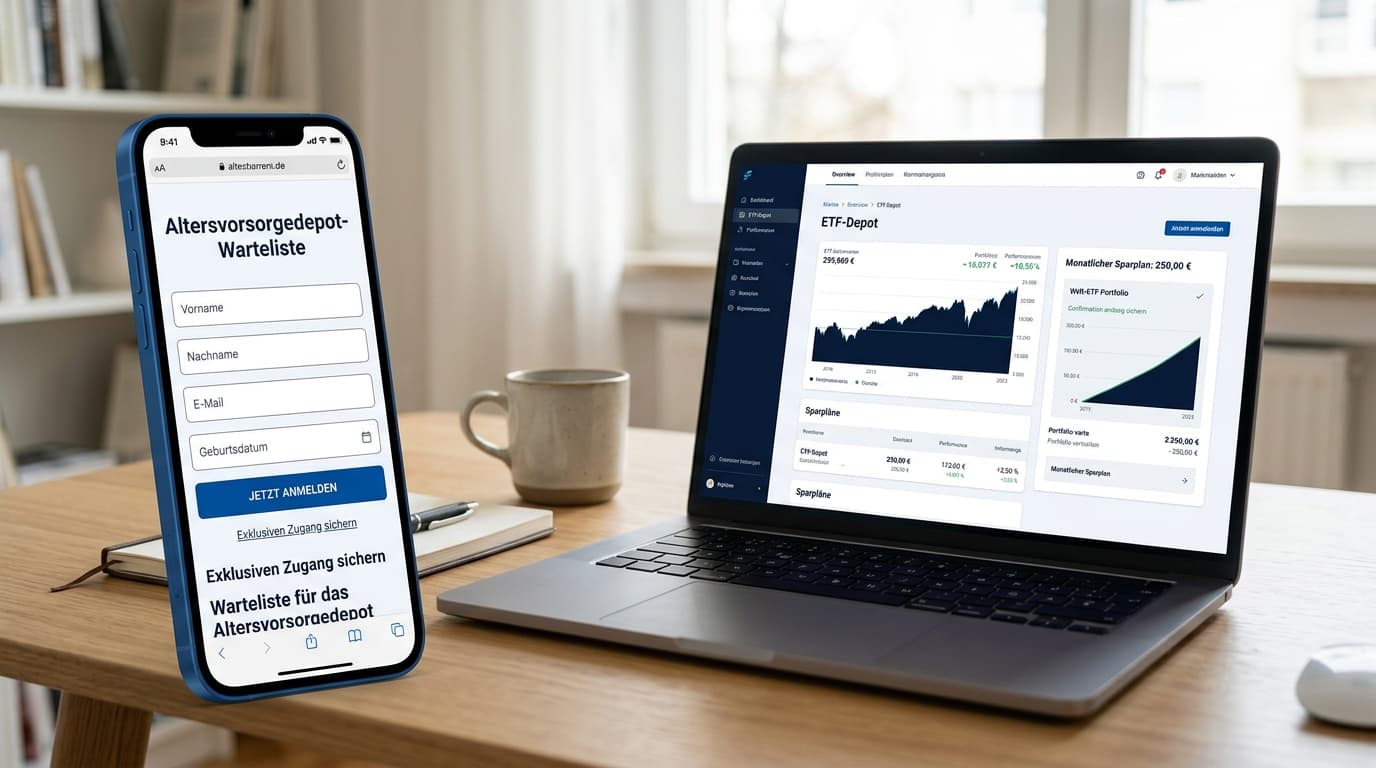
Legally, a waiting list or pre-registration is purely an expression of interest, technically often no more than a newsletter sign-up. It is not a retirement savings contract within the meaning of the AltZertG. Three things follow from this: no entitlement to subsidies arises, no contract arises, and neither you nor the provider is bound to later terms.
How differently providers are handling the run-up is shown by the state of play at the end of August 2026 (Stiftung Warentest, 27.08.2026)[2]:
- Scalable Capital was the first provider to publish concrete terms and lets interested customers add the Altersvorsorgedepot to their account already.
- Trade Republic and Smartbroker+ are advertising their offers from January 2027.
- ING has set up a waiting list.
The picture has moved on since then: after Scalable Capital, Quirion, Smartbroker and Deka have also named terms, according to the VersicherungsJournal media review (8 and 9 September 2026)[11]. Insurers such as Allianz Leben, Alte Leipziger and the W&W Group have announced offers for early 2027 (AssCompact, 11.05.2026)[10].
These announcements show that the market is preparing for 2027. But they say nothing about how the contracts will eventually be designed, and we do not rate them here on their pros and cons. What counts is only the certified contract text, which will be available from 2027 at the earliest. Whether pre-registration gives you a practical advantage, such as faster account opening, is up to the individual provider; it does not create any subsidy advantage.
Will an ETF savings plan you hold today be subsidised later?
No, there is no automatic conversion. According to the BMF FAQ, subsidies apply to personal contributions paid into a certified Altersvorsorgedepot, up to a maximum subsidised amount of 1,800 euros per year (plus the allowances)[1]. The basic allowance is 50 cents per euro on the first 360 euros of personal contributions and 25 cents per euro on up to 1,440 euros more, at most 540 euros a year in total; the precondition is a minimum personal contribution of 120 euros per year (§§ 84, 86 EStG)[5]. Your current ETF savings plan, by contrast, runs through an ordinary securities account that is not certified; the reform does not change how it is taxed.
An ordinary securities account also cannot be converted into a subsidised Altersvorsorgedepot from 2027. The certified contract has to be newly taken out with a provider of your choice[3]. For savers who make their own decisions, this sets out a clear starting point:
- Split the savings rate: part goes into the subsidised Altersvorsorgedepot, the rest stays in the unrestricted savings plan.
- Open a second account: the existing savings plan stays untouched, and the subsidised account is added alongside it.
- The savings plan you have today remains an unsubsidised portfolio: income is subject to the flat-rate withholding tax (with partial exemption for equity funds), and there are no state allowances. In the Altersvorsorgedepot, by contrast, income stays tax-free during the saving phase and is only taxed later, in the payout phase[1].
We compare in detail how subsidies, tax treatment and flexibility differ between the two routes in our guide Altersvorsorgedepot or ETF savings plan.
What does pre-registration mean for Riester savers?
For Riester savers, pre-registration changes nothing about grandfathering: the Altersvorsorgedepot sits alongside the Riester pension and replaces nothing. Contracts concluded before 1 January 2027 are grandfathered; you can continue your existing Riester contract as usual and with the previous tax subsidy[1][7]. The German Insurance Association (GDV) likewise sees "no acute need for action" for Riester savers[8].
- Continue: existing Riester contract with the previous subsidy, no action needed.
- Switch the subsidy only: move to the new subsidy system by declaration to the provider, with all other terms unchanged. This declaration is irrevocable; switching back to the old subsidy is not possible.
- New contract: switch to a new retirement savings contract on the new terms without repaying the previous subsidy; this may, however, incur switching, acquisition and sales costs.
Pre-registration triggers none of these steps and does not replace running the numbers on your existing Riester contract. The consumer advice centres recommend doing the maths before switching or signing a new contract and not giving up old Riester contracts hastily; in their example, effective costs of just 1.0 percent a year eat up around a third of capital market returns over 40 years[4]. Whether staying or switching suits your situation better depends on age, remaining term, contract costs and risk appetite; we lay out the decision systematically in our guide Keep or switch Riester.
Is there a disadvantage if you only compare in 2027?
No, there is no disadvantage for the 2027 subsidy. The state subsidy for the whole of 2027 is still available retroactively if you sign in December 2027, as Stiftung Warentest notes[2]. This is in line with the law: the basic allowance is based on the retirement contributions paid "in the contribution year", not on the date the contract was signed (§ 84 EStG)[5]. Signing in January 2027 is therefore not necessary to receive the full annual subsidy. What matters is that the personal contributions have actually been paid in by 31 December 2027 and reach the minimum personal contribution of 120 euros.
The consumer advice centres expressly advise not to let yourself be pressured, and expect the sales wave for new contracts to pick up towards the end of the year[4].
On the merits, there is a good case for choosing the timing of your comparison freely: only once contracts are certified are the actual contract terms available, and the more providers publish their terms, the more reliable the comparison becomes. According to a survey by Strategy&, PwC Germany and Assekurata Solutions of 25 providers, two thirds plan to launch new products, and 94 percent of them want to start in the first half of 2027; at the time of the survey (April to June 2026), 59 percent had not yet set effective costs for their portfolio products (Pfefferminzia, 04.09.2026)[9]. There is no legal obligation to sign at a particular time, nor any obligation to make a so-called informed decision by a fixed date; the subsidy depends solely on the personal contributions in the certified contract[1].
What information should be available before you sign?
Before you sign a retirement savings contract, the following information should be available and documented. The checkpoints are based on the BMF FAQ and the rules of the AltZertG[1][5]:
- Certification number: the contract has been certified by the certification body at the BZSt; the number is the basis for the subsidy.
- Effective costs: disclosed and traceable. The cap of at most 1.0 percent a year applies only to the Standarddepot contract; there is no cost cap for other contracts, and the consumer advice centre cites 1.5 to 2.5 percent a year or more for expected premium models[4].
- Switching rules: in the first five years after signing, the transferring provider may charge at most 150 euros for a switch; after that, it must allow it free of charge. The receiving provider may charge a one-off administration fee of at most 150 euros[1][5].
- Standarddepot structure: can be taken out without individual investment decisions, with two funds set by the provider before the contract is concluded and a gradual shift into the lower-risk fund before the payout phase begins, unless you want a different split[1]. Advice remains an option, not a condition.
Our guide Choosing a provider for the Altersvorsorgedepot brings together what to look for in detail. All figures mentioned are statutory parameters and provider information, not a return forecast; our comparisons and sample calculations do not constitute investment advice within the meaning of § 1 Abs. 1a Satz 2 Nr. 1a KWG.
Once certified terms are available, a systematic comparison is worthwhile: the criteria-based provider comparison on vorsorgedepot-lotse.de sets neobrokers and Altersvorsorgedepot providers side by side on costs, ETF selection and flexibility, including direct links to open an account as soon as providers actually offer their contracts.
Frequently asked questions
- Is a waiting list or pre-registration for the Altersvorsorgedepot binding?
- No. Pre-registration is purely an expression of interest, usually an email notification for the launch. It is not a contract, creates no entitlement to state subsidies and does not bind the provider to later terms. Subsidies only apply to personal contributions paid into a certified contract, which providers can offer from 1 January 2027.
- Do I lose subsidies if I only take out the Altersvorsorgedepot later in 2027?
- No. According to Stiftung Warentest, the state subsidy for the whole of 2027 is still available retroactively in December 2027. What counts are the personal contributions paid in the 2027 contribution year; they must be paid in by 31 December 2027 and amount to at least 120 euros. Signing on 1 January 2027 is not necessary to get the full subsidy.
- Can I convert my existing ETF savings plan into an Altersvorsorgedepot?
- No, there is no automatic conversion. An ordinary securities account cannot be converted into a subsidised Altersvorsorgedepot from 2027, because the subsidy requires a certified contract. You can split your savings rate or open an Altersvorsorgedepot in addition; the savings plan you have today remains unsubsidised.
- As a Riester saver, do I have to switch my contract in 2027?
- No. Riester contracts concluded before 1 January 2027 are grandfathered: you can continue the contract with the previous subsidy. Switching to a new contract is possible without repaying the previous subsidy, but may incur switching, acquisition and sales costs and should be calculated case by case.
- What does switching to an Altersvorsorgedepot under the new law cost?
- According to the BMF, acquisition costs will in future have to be spread over the entire saving phase. In the first five years after signing, the transferring provider may charge at most 150 euros; after that, it must allow the switch free of charge; the receiving provider may charge an administration fee of at most 150 euros. When switching from a Riester contract, switching, acquisition and sales costs may also apply.
- What information should a provider disclose before you sign?
- What matters is certification of the contract by the certification body at the Federal Central Tax Office, the disclosed effective costs (a cap of 1.0 percent a year applies only to the Standarddepot) and the switching conditions. The cost cap does not apply to other contracts outside the Standarddepot; according to the consumer advice centre, effective cost ratios of 1.5 to 2.5 percent are conceivable there.
- When can I take out an Altersvorsorgedepot at all?
- Providers can offer certified Altersvorsorgedepots from 1 January 2027. The precondition for subsidies is a contract certified by the certification body at the Federal Central Tax Office under the Altersvorsorgeverträge-Zertifizierungsgesetz. The legal basis is the Altersvorsorgereformgesetz of 26 May 2026 (BGBl. 2026 I Nr. 156); certification under the new law can be granted no earlier than 1 January 2027.
Sources
- [1]Bundesministerium der Finanzen (BMF): Fragen und Antworten zur Reform der geförderten privaten Altersvorsorge, Stand 05.05.2026
- [2]Stiftung Warentest: Scalable nennt Konditionen fürs Altersvorsorgedepot, 27.08.2026
- [3]t-online: Altersvorsorgedepot – kann man einen bestehenden ETF-Sparplan fördern lassen?, aktualisiert 04.05.2026
- [4]Verbraucherzentrale: Neues Altersvorsorgedepot – Rentenchance oder teure Verkaufsfalle?, Stand 20.07.2026
- [5]Altersvorsorgereformgesetz vom 26.05.2026, BGBl. 2026 I Nr. 156 (recht.bund.de)
- [6]Bundeszentralamt für Steuern (BZSt): Zertifizierung von Altersvorsorge- und Basisrentenverträgen
- [7]Deutsche Rentenversicherung / ZfA: Altersvorsorge-Reformgesetz
- [8]GDV e. V.: Riester-Nachfolge – mehr Wahlfreiheit, aber kein Pflichtwechsel, 22.06.2026
- [9]Pfefferminzia: Altersvorsorgedepot – Anbieter wollen loslegen, wissen aber noch nicht recht wie, 04.09.2026
- [10]AssCompact: Altersvorsorgedepot beschlossen – wo stehen die Produktgeber?, 11.05.2026
- [11]VersicherungsJournal.de (Medienspiegel): Die Preisschlacht um das Altersvorsorgedepot hat begonnen, 08.09.2026
- []What is the Altersvorsorgedepot? Definition and 2027 launch
- []Altersvorsorgedepot or ETF savings plan: which pays off more?
- []Keep or switch Riester: what works for whom?
- []Which provider for the Altersvorsorgedepot? The selection guide
- []Kriteriengestützte Anbietervergleich
Ready to open your AVD?
Opening an account is easier than you think. We'll guide you through the process.
Free and without obligation. Advice from an adviser in our independent network of 1,000+ vetted advisers.